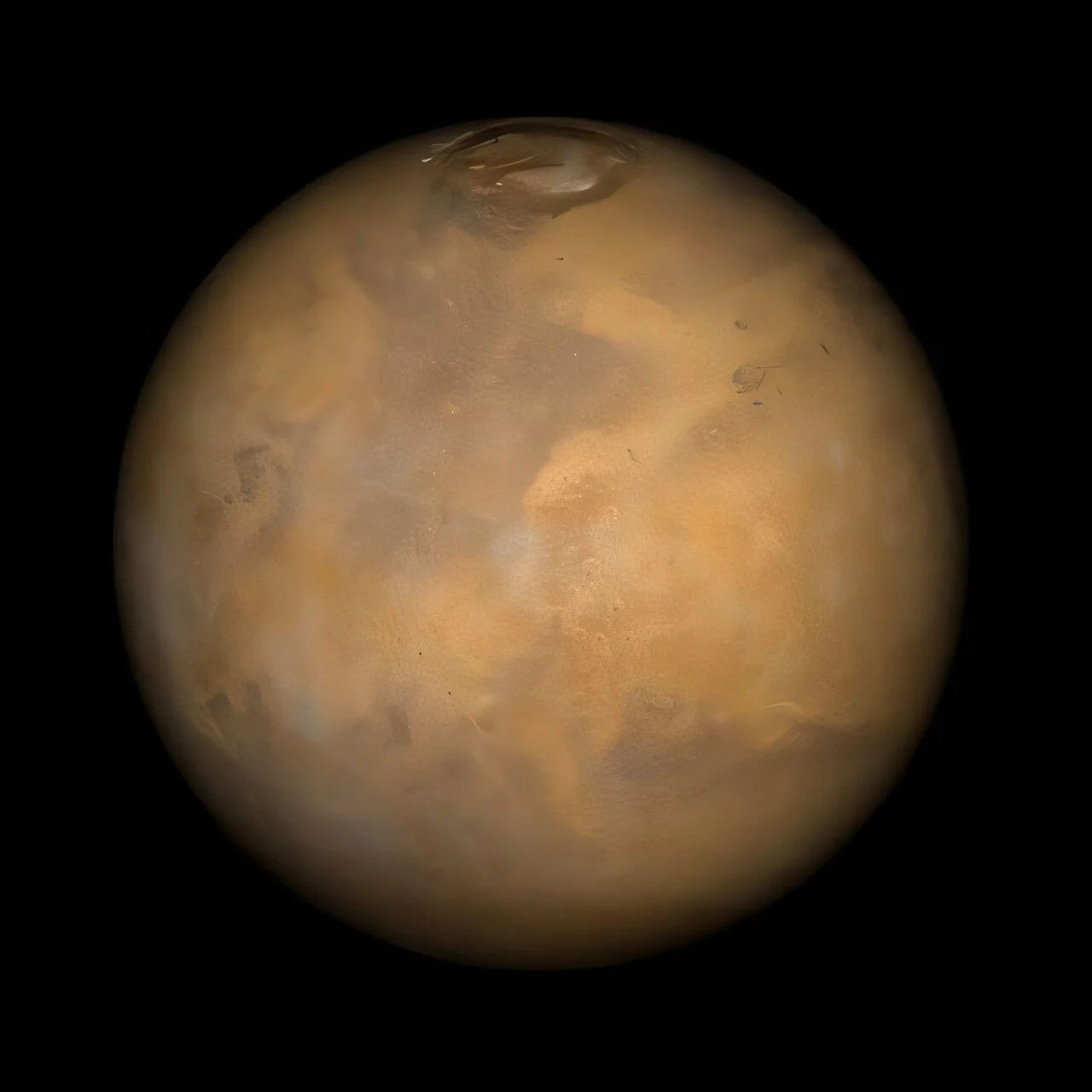
Imagine standing on the surface of Mars, staring at the red landscape, and trying to check the time. A familiar atomic clock, ticking away on your wrist, tells you the time on Earth—but how does it compare to Mars’ time? Can we even synchronize clocks across planets?
The question of time on Mars may seem trivial at first, but it’s a crucial one for the future of space exploration. For NASA and other space agencies planning long-term missions to the red planet, precise timekeeping will be essential for everything from navigation to communication. And, as it turns out, understanding the way time passes on Mars is a complex puzzle that requires more than just a simple comparison of clocks.
Physicists at the National Institute of Standards and Technology (NIST) have tackled this challenge, providing the first-ever calculation of how time behaves on Mars. Their findings reveal that clocks on Mars tick slightly faster than those on Earth, but the difference isn’t constant. In fact, it fluctuates due to the planet’s unique orbit and gravitational forces.
A New Answer to an Ancient Question
The theory that clocks run at different rates depending on gravity is not new. It stems from Albert Einstein’s groundbreaking work on relativity, which showed that gravity warps time itself. Clocks closer to a massive object, like Earth, tick slower compared to clocks that are farther away. In the case of Mars, gravity is weaker than on Earth—only about one-fifth as strong—which means time moves a little faster on Mars.
However, it’s not just Mars’ gravity that influences the ticking of a clock. The planet’s orbit plays a big role, too. Mars has a more elliptical, or oval-shaped, orbit compared to Earth. This means that the distance between Mars and the Sun changes constantly, which causes subtle fluctuations in time, speeding it up or slowing it down depending on where Mars is in its orbit.
To understand just how significant these effects are, NIST physicists set out to calculate Mars’ timekeeping in precise detail. They found that, on average, clocks on Mars will tick 477 microseconds faster than those on Earth every day. For perspective, that’s about one-thousandth of the time it takes for a human to blink. But that small difference can add up over time, especially when you’re dealing with the complexity of interplanetary navigation and communication.
The Challenge of Martian Time
When NIST physicists Bijunath Patla and Neil Ashby first set out to calculate the time differences between Earth and Mars, they faced a far bigger challenge than they had anticipated. The calculations were not as straightforward as they might have seemed.
Gravity, of course, affects how time moves. The weaker gravitational pull on Mars means time runs a little faster compared to Earth. But as Patla explains, there’s more to the story than just gravity. Mars’ orbit is not like Earth’s—its path around the Sun is much more elongated. This gives rise to variations in the passage of time, as the planet moves closer to or farther from the Sun. These variations make timekeeping on Mars more complicated than on Earth, where the planet’s orbit is more stable.
Patla and Ashby’s calculations needed to account for the influence of not just Mars’ gravity and orbit, but also the gravitational effects of other planets and the Sun. “A three-body problem is extremely complicated,” Patla says, referring to the interactions between Mars, Earth, and the Sun. “Now we’re dealing with four: the Sun, Earth, the Moon, and Mars.”
After considering all these factors, the physicists were able to determine that Mars’ clocks will tick faster by an average of 477 microseconds each day. But there’s more to it—this number fluctuates as Mars moves along its orbit, sometimes speeding up by as much as 226 microseconds a day, depending on the position of the other planets in the solar system.
A Stepping Stone to Solar System Communication
While 477 microseconds might sound like a negligible difference, the impact of this time discrepancy becomes significant when it comes to space missions. Today, communication between Earth and Mars is far from instantaneous. Depending on where the two planets are in their respective orbits, signals can take anywhere from four to 24 minutes to travel between them. In a world accustomed to instant communication, this delay is a huge challenge for real-time interaction, whether it’s sending commands to a rover or coordinating with astronauts on a long-term mission.
In a way, current communication with Mars is like sending handwritten letters across the ocean—waiting days, weeks, or even months for a response. This time lag makes it impossible to have a conversation in real-time, let alone synchronize networks of equipment across such vast distances.
But with the new understanding of time on Mars, things could change. Precise timekeeping could help synchronize communication between Earth, Mars, and even other celestial bodies like the Moon. If scientists can overcome the time differences, it could pave the way for real-time communication, allowing humans to interact more efficiently with robotic missions or even future Mars colonies.
Patla envisions a future where accurate time synchronization would make interplanetary communication feel almost instantaneous. “If you get synchronization, it will be almost like real-time communication without any loss of information,” he says. “You don’t have to wait to see what happens.”
The Importance of this Research
So why does understanding time on Mars matter? The implications stretch far beyond just knowing how fast or slow clocks tick on another planet. This research is a crucial step in preparing for future missions to Mars and beyond. As NASA and other space agencies develop plans for human and robotic exploration of Mars, reliable, synchronized timekeeping will be essential for coordinating everything from navigation systems to communication networks.
“This is the closest we have been to realizing the science fiction vision of expanding across the solar system,” Patla says. By establishing an accurate model for time on Mars, scientists are one step closer to making long-term space missions a reality. And, as Ashby points out, these advancements won’t be limited to Mars. They will help guide future exploration on other planets and moons, laying the groundwork for the kind of universal navigation systems we see in science fiction.
Moreover, this research enhances our understanding of Einstein’s theory of relativity. By applying his ideas to the time differences between Earth and Mars, scientists are able to test and refine the theory in new ways. “It improves our knowledge of the theory itself, the theory of how clocks tick and relativity,” says Patla. In a sense, this is as much a step forward for physics as it is for space exploration.
The passage of time is one of the most fundamental concepts in science, and understanding how it works on Mars is a crucial piece of the puzzle in our quest to explore the stars. As scientists continue to unlock the mysteries of space and time, the next frontier is beginning to take shape, one microsecond at a time.
More information: Neil Ashby et al, A Comparative Study of Time on Mars with Lunar and Terrestrial Clocks, The Astronomical Journal (2025). DOI: 10.3847/1538-3881/ae0c16