Imagine a planet so vast that it dwarfs Jupiter, the mighty king of our solar system. Yet, this super-Jupiter, a brown dwarf known as VHS 1256B, behaves in ways no one expected. While scientists have long assumed that these distant worlds would share similarities with Jupiter—like swirling bands of clouds and massive storms—the latest discovery upends that notion entirely. Instead of mimicking the Great Red Spot, VHS 1256B reveals an entirely new way that giant dust storms form, offering a rare glimpse into the complex atmospheres of celestial giants.
This breakthrough, published in Science Advances, comes courtesy of an international team of researchers, including Stanimir Metchev, a physics and astronomy professor at Western University, and his collaborator Xianyu Tan from Shanghai Jiao Tong University. Their findings are based on images from the James Webb Space Telescope (Webb), a marvel of modern science that has opened up previously unimaginable views of distant worlds.
Unveiling a Dusty World
VHS 1256B is not just any planet. It’s a brown dwarf—an object that is more massive than a giant planet but not quite a star. These enigmatic bodies never reach the temperatures necessary to sustain hydrogen fusion, which means they cool over time, becoming similar in appearance to giant planets like Jupiter. Some brown dwarfs, like VHS 1256B, are up to 10 times the mass of Jupiter, earning them the nickname “super-Jupiters.” Their atmospheres, like Jupiter’s, are a stormy mystery, making them an excellent stand-in for studying exoplanets—the planets that orbit stars far beyond our sun.
In the past, scientists believed that brown dwarfs behaved much like Jupiter, with large east-west bands and relatively stable atmospheric features. But Metchev and his team have shown that the reality is far more complicated than that. “Astronomers have generally assumed that brown dwarfs behave like Jupiter, with strong east-west bands and stable storms shaping their skies,” Metchev explains. “Our research challenges that idea, suggesting that some of these worlds don’t follow Jupiter’s pattern after all.”
Through their groundbreaking research, the team found that the way dust storms form on brown dwarfs is dramatically different. Instead of the calm, orderly storm systems found on Jupiter, these super-Jupiters like VHS 1256B exhibit a chaotic and dynamic atmosphere driven by different forces.
A New Way to See Dust Storms
The story begins with the brightness of VHS 1256B. As the brown dwarf orbits its star, its light changes in a peculiar way—rising and falling dramatically over time. This pattern, known as “large-amplitude variability,” is a telltale sign that something unusual is happening in the atmosphere. For years, researchers wondered what could cause such erratic changes. The answer, it turns out, is giant dust storms.
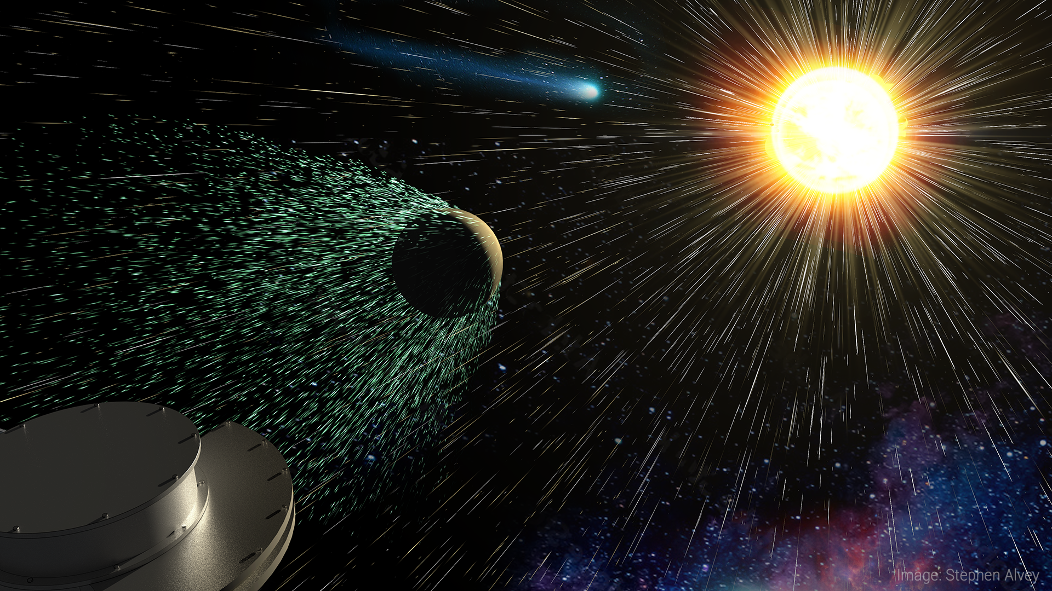
Metchev’s team, alongside Tan, used Webb’s sharp observations to simulate the brown dwarf’s atmosphere, recreating its fluctuating brightness. Their model, which mimicked the large-amplitude variability, showed that VHS 1256B’s storms were quite different from anything observed on Jupiter. Instead of stable, long-lasting cyclonic storms, the dust storms on VHS 1256B were driven by massive equatorial waves—enormous temperature imbalances that occur when the clouds near the equator heat up more than those at higher latitudes.
These waves move east to west, sweeping across the surface of the brown dwarf and stirring up massive dust storms in their wake. This phenomenon, which scientists call “cloud-radiative feedback,” explains the dramatic shifts in brightness. The dust storms on VHS 1256B are not stationary—they evolve and shift with time, creating a constantly changing light curve that scientists can now observe and measure.
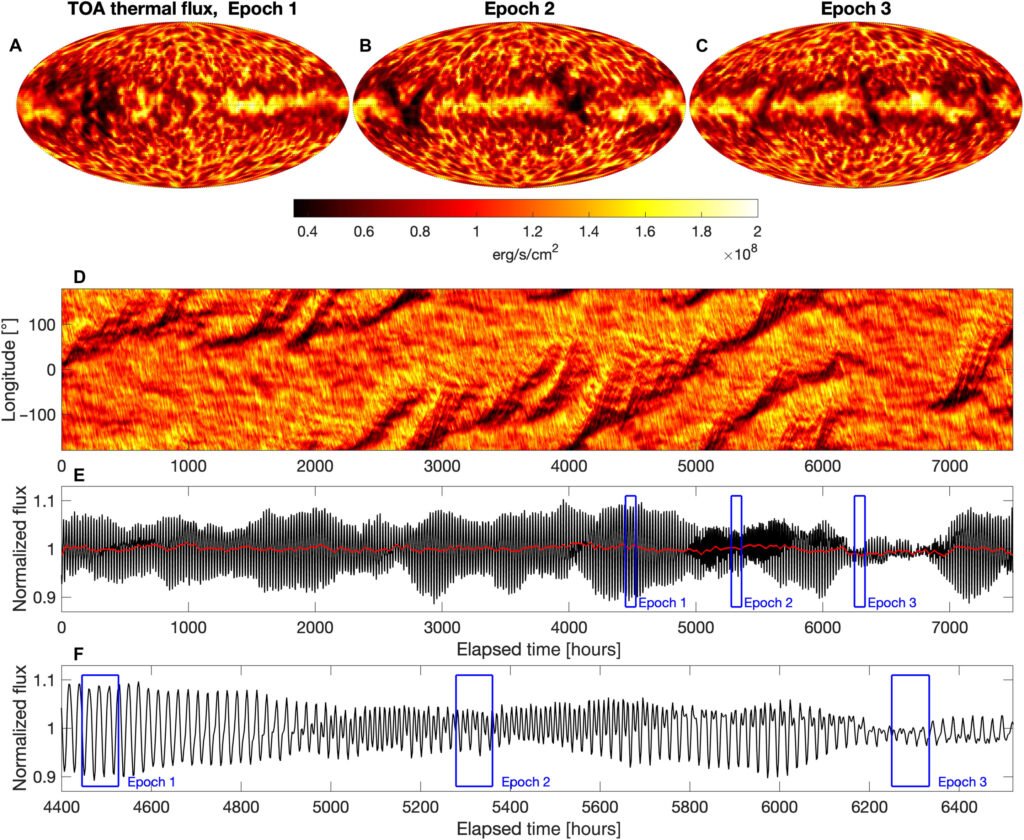
As Tan explains, “The cloud-radiative feedback circulation mechanism has been proposed, but for a model to be truly validated, it must withstand the test of observations, which is perhaps even more challenging than proposing the theory itself.” Fortunately, the Webb observations confirmed their model, validating the new understanding of these strange, dynamic atmospheres.
Super-Jupiters Are Not Like Jupiter
What makes VHS 1256B and other super-Jupiters so different from Jupiter is their temperature. These brown dwarfs are significantly hotter than the gas giants of our solar system, and this increased heat changes everything about how their atmospheres behave. The heat causes their atmospheres to react more quickly to incoming radiation, resulting in the large-scale waves that drive the dust storms. On Jupiter, by contrast, the atmosphere is cooler, allowing for a slower, more stable formation of zonal bands—the iconic east-west cloud bands that give Jupiter its distinctive look.
As Xi Zhang, a professor at UC Santa Cruz and a collaborator on the study, puts it: “The mechanism of giant planets’ atmospheric circulation has long been an important and unresolved question in planetary science. These novel wave dynamical processes on super-Jupiters provide us with a unique perspective to examine our fundamental understanding of this problem.”
The discovery of these novel wave dynamics marks a turning point in our understanding of planetary atmospheres. It suggests that the behavior of super-Jupiters is much more complicated than previously thought. While Jupiter’s atmosphere builds its bands through slower turbulent processes, super-Jupiters like VHS 1256B show how a hot, fast-moving atmosphere can create massive, shifting storms in ways that were once unimaginable.
Why This Research Matters
The implications of this discovery reach far beyond our solar system. By studying brown dwarfs like VHS 1256B, astronomers can gain valuable insights into the atmospheres of distant exoplanets—planets that orbit stars other than our Sun. These exoplanets, some of which are similar in size and composition to super-Jupiters, are common throughout the Milky Way. Understanding their atmospheres is crucial for understanding the potential habitability of distant worlds and how they might behave in the harsh environments of their own solar systems.
Moreover, this research highlights the importance of the James Webb Space Telescope, a tool that is revolutionizing our understanding of the universe. With its powerful infrared capabilities, Webb has enabled scientists to observe celestial objects like never before, unveiling the mysteries of brown dwarfs and exoplanets with unprecedented detail. The findings from this study showcase the immense potential of Webb to answer some of the most pressing questions in planetary science.
In the grand scheme of things, this research is a reminder that the universe is full of surprises—hidden worlds and strange phenomena that challenge our assumptions and push the boundaries of what we know. As we continue to explore the cosmos, discoveries like this one remind us that our understanding of the universe is still just beginning.
More information: Xianyu Tan et al, Large-amplitude variability driven by giant dust storms on a planetary-mass companion, Science Advances (2025). DOI: 10.1126/sciadv.adv3324