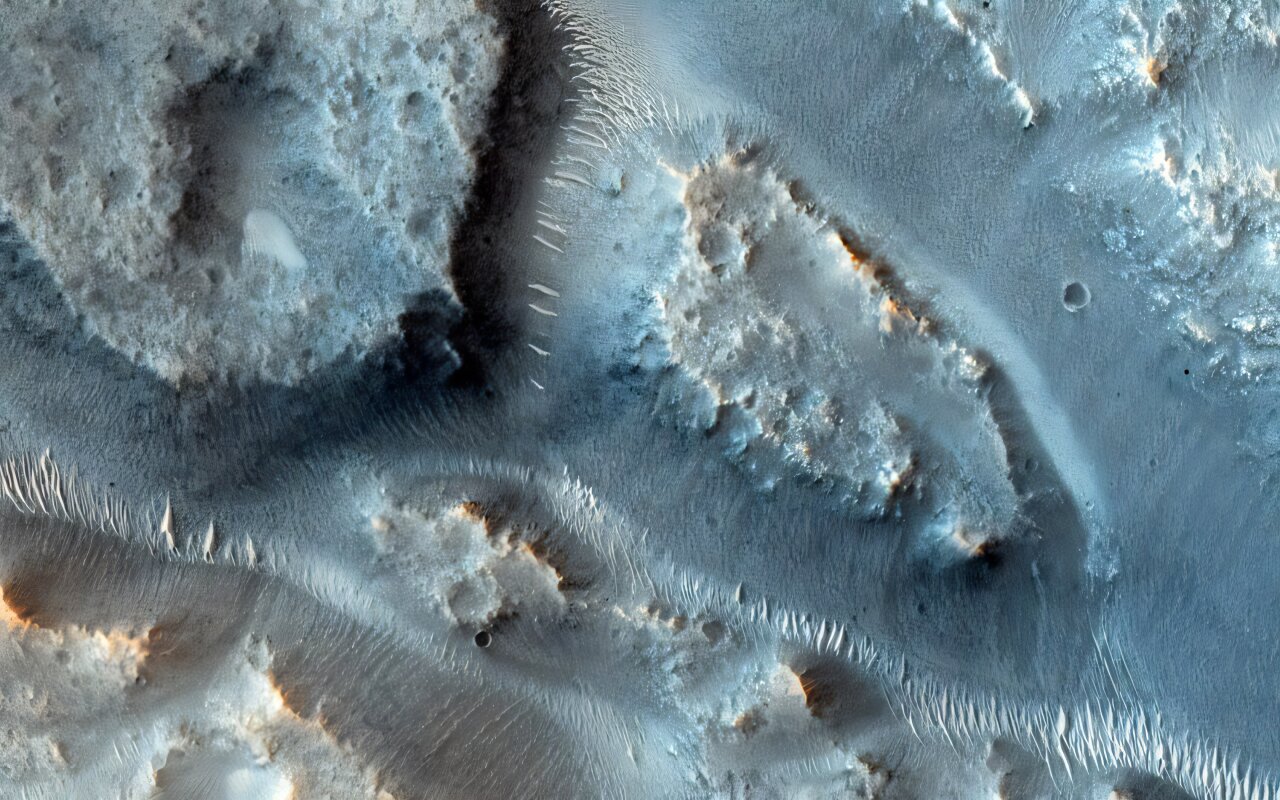
Billions of years ago, the surface of Mars looked dramatically different. Instead of a cold, dry desert, the planet was alive with flowing rivers, winding valleys, and massive lakes. Water collected in vast river basins, spilling over the rims of craters and carving out canyons—possibly even feeding a large Martian ocean. It was a landscape where, like Earth’s own river systems, life might have flourished in the rich waters that once cradled it.
Now, thanks to groundbreaking research, we are a step closer to understanding where exactly this potential cradle of life might have been. A new study, published in the Proceedings of the National Academy of Sciences, takes a bold step forward by defining large river drainage systems across Mars—a first in planetary science.
Uncovering the Martian River Basins
For years, scientists knew that rivers once flowed across Mars, but the extent of these river systems and their potential to support life remained a mystery. Thanks to the work of researchers from The University of Texas at Austin, we now know that Mars was home to 16 large-scale river basins. These basins, each spanning over 100,000 square kilometers, could have been prime spots for the development of life—similar to how Earth’s largest rivers support thriving ecosystems.
“We’ve known for a long time that there were rivers on Mars,” said Timothy A. Goudge, co-author of the study and an assistant professor in the Department of Earth and Planetary Sciences at the UT Jackson School of Geosciences. “But we really didn’t know the extent to which the rivers were organized in large drainage systems at the global scale.”
For this study, Goudge and his colleague Abdallah S. Zaki collected data from various Martian valley networks, lakes, and rivers. They then pieced together this data to map out 19 clusters of valley networks, streams, lakes, canyons, and sediment deposits. Of these, 16 clusters connected together into massive drainage basins, each one larger than 100,000 square kilometers—the threshold used to define a large river basin on Earth.
“It’s a simple thing we did,” Zaki explained. “We just mapped them and pieced them together.” But the results were revolutionary.
Comparing Mars to Earth
On Earth, river systems of this scale are common. In fact, there are 91 large river basins, each larger than 100,000 square kilometers. The Amazon River basin, the largest on Earth, spans a staggering 6.2 million square kilometers, feeding one of the most biodiverse ecosystems on the planet. Where there is water, life thrives—this is a principle that holds true across planets. The vast river basins on Earth support ecosystems rich in life, with species that rely on the constant movement of water to distribute nutrients across large areas.
Mars, however, lacks the tectonic activity that drives the formation of large mountain ranges, valleys, and other varied topography. As a result, the Red Planet has fewer massive drainage systems than Earth. Nonetheless, the systems identified by Goudge and Zaki represent some of the most significant regions to explore when it comes to the search for Martian life.
Why These River Basins Matter
While the vast majority of Mars’ surface is covered by smaller drainage systems, these 16 large river basins stand out as key locations for future exploration. They make up a small fraction—only 5%—of the planet’s ancient terrain. Yet, they represent nearly half (42%) of all the material that Mars’ rivers once eroded, making them invaluable to understanding the planet’s history.
Sediment, which is carried by rivers, contains essential nutrients. These nutrients, over time, may have interacted with water and rocks to create chemical reactions that could have supported microbial life. According to Zaki, “The longer the distance, the more you have water interacting with rocks, so there’s a higher chance of chemical reactions that could be translated into signs of life.”
These large river basins offer the best chances for finding evidence of past Martian life. The more sediment that was carried through these channels, the greater the potential for detecting chemical signatures of life—if, in fact, life ever existed on Mars.
Searching for Life on Mars
The search for signs of life on Mars has been a central focus of planetary exploration for decades. While smaller river systems may have supported isolated pockets of life, the large drainage basins identified in this study present the most promising locations for future missions. As Goudge puts it, “It’s a really important thing to think about for future missions and where you might go to look for life.”
When we think of Earth’s largest river systems, we think of biodiversity—of the rich ecosystems supported by large bodies of water. On Mars, these ancient river basins could have been the cradles of life, the places where the conditions were right for life to emerge and potentially thrive.
These findings are vital not just for understanding the history of Mars but for planning future space exploration. Where will we send our rovers to search for signs of ancient life? Where should we look to unlock the secrets of the planet’s past? The answer might just lie in these large river basins.
Why This Research Matters
This new research is not just an academic exercise—it’s a vital step in our quest to understand whether Mars could have supported life. It offers a clear map of where scientists should focus their efforts, guiding future missions as we continue to explore the Red Planet.
“Tim Goudge and his team continue to be leaders in the field, making groundbreaking contributions to the understanding of Mars’ planetary surface and hydrologic processes,” said Department Chair Danny Stockli. And indeed, this study adds another important layer to our understanding of Mars. It suggests that some of the most promising areas for life, past or present, may be within these ancient river basins.
With each new discovery, the possibility that Mars once harbored life becomes more tangible. As scientists continue to explore these vast, ancient river systems, the mystery of whether life ever existed on Mars inches closer to being solved. And perhaps, one day, we’ll look back at these findings and realize that these ancient Martian rivers were the true birthplace of life on the Red Planet.
More information: Abdallah S. Zaki et al, Large drainage systems produced half of Mars’ ancient river sediment, Proceedings of the National Academy of Sciences (2025). DOI: 10.1073/pnas.2514527122