Nearly a millennium ago, in the year 1054, observers on Earth looked up to find a stranger in the sky. A pinpoint of light had blossomed into a brilliance so intense it rivaled the sun, remaining visible even during the bright hours of the day for several weeks. This celestial guest was the death rattle of a massive star, a supernova that occurred 6,500 light-years away in the constellation Taurus. While the ancient astronomers eventually watched the light fade, the story of that explosion was far from over. It was merely shifting into a new, ghostly chapter that we are still reading today.
A Ghostly Renaissance in the Deep Night
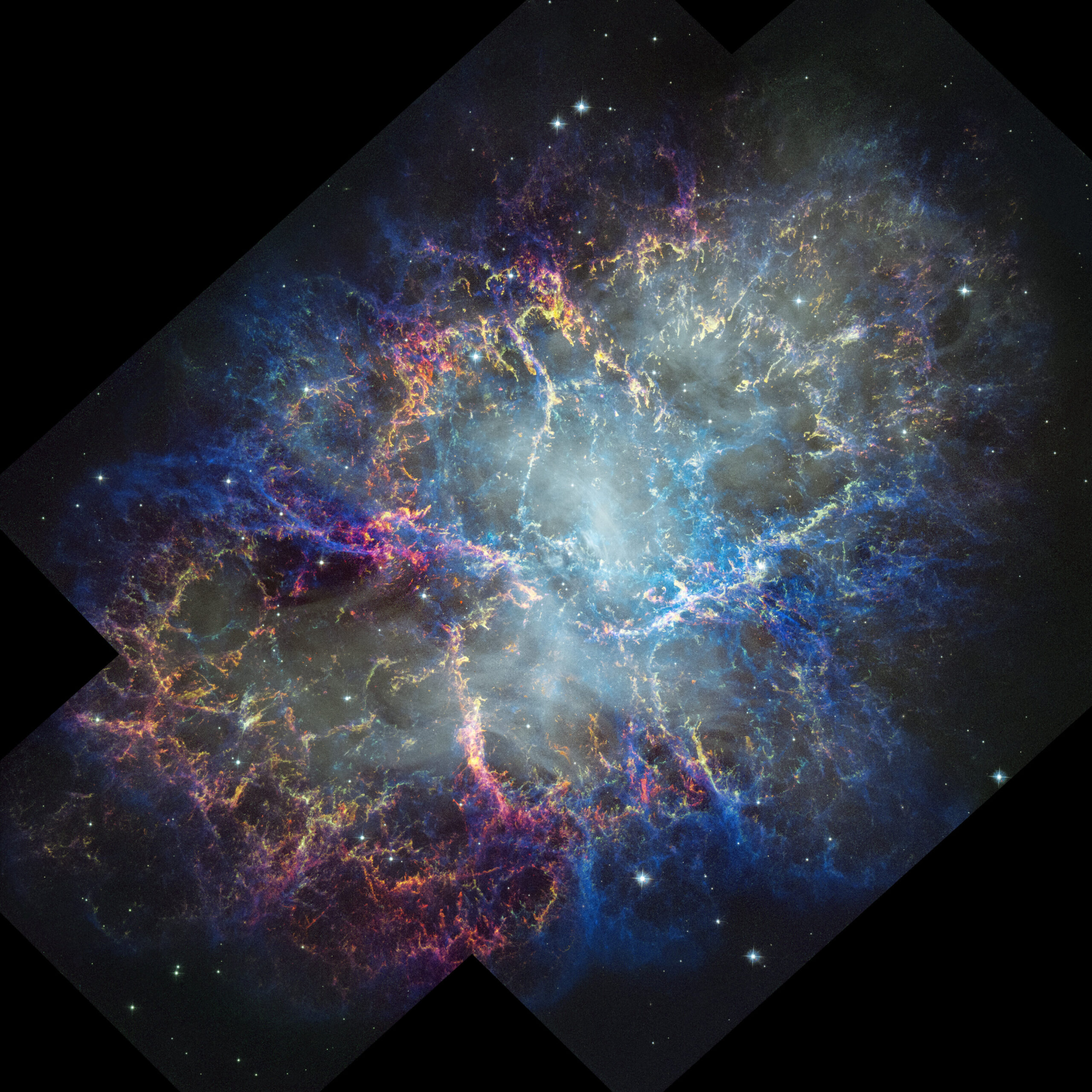
For centuries, the wreckage of this explosion—now known as the Crab Nebula—remained a smudge of light in the darkness, a mystery waiting for the right tools to unlock its history. It wasn’t until the mid-18th century that the remnant was officially “discovered” by modern telescopes, but its true origin remained a subject of debate. The breakthrough came in the 1950s, when the legendary astronomer Edwin Hubble and his colleagues noticed a striking coincidence. The position of this sprawling nebula matched perfectly with the ancient Chinese records of that “guest star” from nearly a thousand years prior.
As our technology advanced, we realized the nebula wasn’t just a cloud of gas; it was a high-energy engine. At its heart sits a pulsar, a rapidly rotating neutron star that survived the initial blast. This tiny, dense core acts like a cosmic lighthouse, spinning with incredible speed and powering the expansion of the entire nebula. It was the discovery of this pulsar that finally allowed modern science to shake hands with ancient history, confirming that the Crab Nebula is the direct aftermath of the SN 1054 supernova.
The Patient Watch of a Legend
While many telescopes have glanced at the Crab, the Hubble Space Telescope has spent decades staring at it with unrivaled persistence. Now, a quarter-century after its first comprehensive look at the full nebula, Hubble has revisited this ancient wreckage to see how much has changed in a mere twenty-five years. Because of its incredible resolution and its long life in orbit, Hubble is the only instrument capable of detecting the subtle, creeping evolution of a supernova remnant in real-time.
To understand the transformation, scientists took Hubble’s original 1999 data and reprocessed it, placing it side-by-side with the fresh observations. The result is a cinematic view of a disaster in slow motion. The nebula is not a static painting; it is a living, breathing storm. The vibrant variation of colors in these images isn’t just for show. They represent a complex map of the local temperature, the density of the gas, and the shifting chemical composition of the star’s guts as they spill into the vacuum of space.
Chasing the Speed of Light and Shadow
The most startling revelation from this twenty-five-year check-up is the sheer speed of the debris. The nebula’s filamentary structure—the web-like veins of gas that give the Crab its name—is screaming outward at a pace of 5.5 million kilometers per hour. However, this expansion isn’t happening uniformly. Hubble’s sharp eyes noticed that the filaments on the outer edges of the nebula are moving significantly faster than the material near the center.
Unlike other famous supernova remnants where the expansion is driven by a violent shockwave plowing through shells of old gas, the Crab is a different beast entirely. It is a pulsar wind nebula. The expansion is fueled by synchrotron radiation, a process where the pulsar’s intense magnetic field interacts with the nebula’s material, pushing it outward from the inside. Interestingly, these filaments don’t seem to be stretching like rubber bands; they appear to be moving as solid units, maintaining their shape even as they race into the void.
These new high-resolution views have also allowed astronomers to think in three dimensions. By looking at how the shadows of certain filaments fall across the hazy glow of the interior’s synchrotron radiation, researchers can map the nebula’s depth. In a strange twist, some of the brightest filaments in the new images cast no shadows at all. This “counterintuitive” finding is a vital clue: it tells scientists that those specific structures must be located on the far side of the nebula, hidden behind the central glow from our perspective on Earth.
Building a Masterpiece of Universal History
The true power of this research lies in how it bridges the gap between different ways of seeing. While Hubble provides an exquisite view in visible light, the mission to understand the Crab Nebula is now a collaborative effort. In 2024, the James Webb Space Telescope contributed its own perspective, capturing the nebula in infrared light.
By layering the Hubble data with the infrared views from Webb and observations from other telescopes across various wavelengths, scientists are constructing the most complete picture of a supernova aftermath ever attempted. We are moving beyond simple snapshots and toward a total understanding of how a star’s death continues to shape the universe. This research matters because it allows us to witness the physics of the extreme—how matter, magnetism, and light interact under conditions that could never be recreated on Earth. It turns a thousand-year-old mystery into a laboratory for the future, proving that even in the cold remains of a dead star, there is a vibrant, moving story that is still being written.
Study Details
William P. Blair et al, The Crab Nebula Revisited Using HST/WFC3, The Astrophysical Journal (2026). DOI: 10.3847/1538-4357/ae2adc