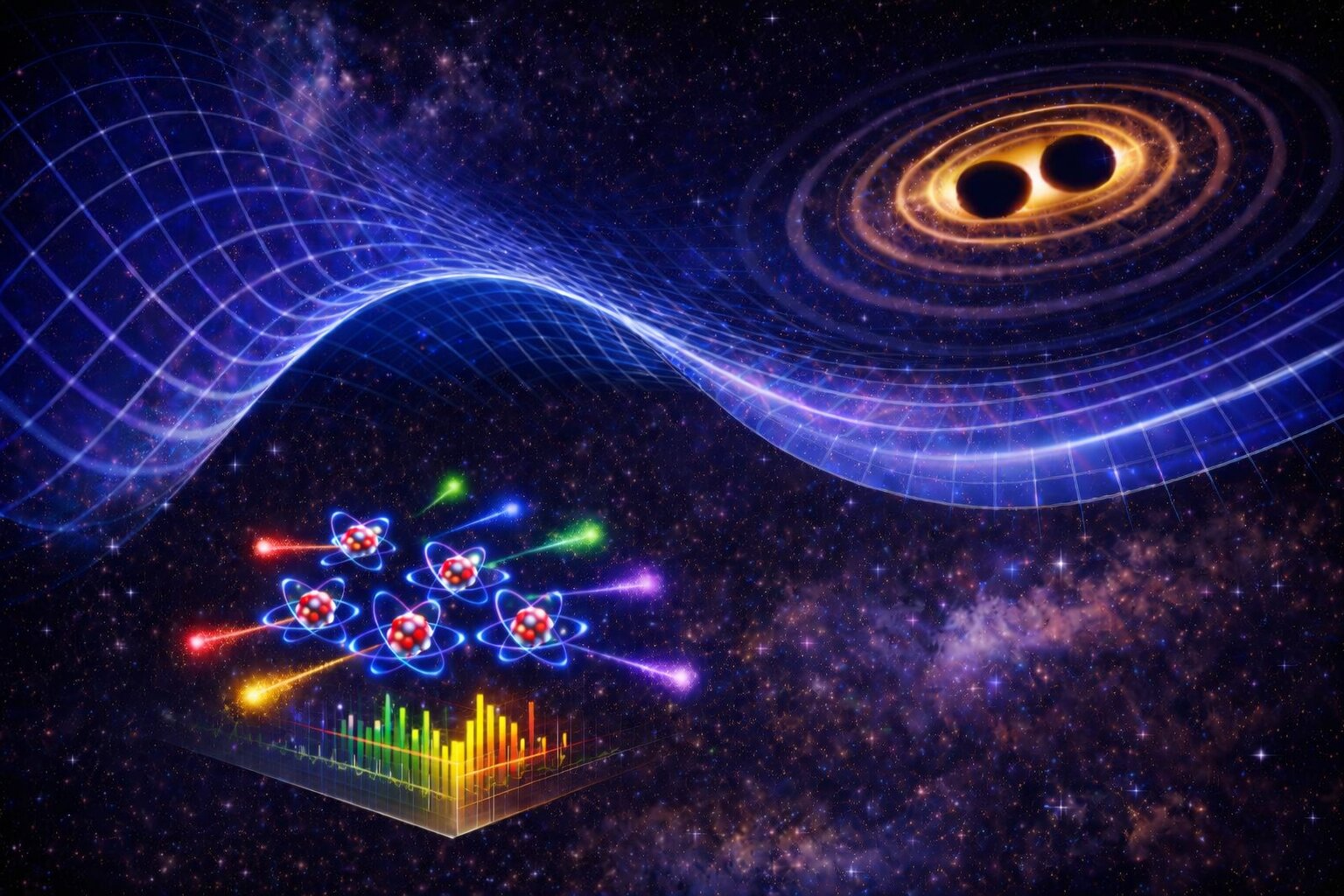
Imagine the universe as a vast, silent ocean. For centuries, we could only see the ripples on the surface—the light from distant stars and galaxies. But in recent years, humanity has learned to hear the deep, underwater groans of the cosmos: gravitational waves. These ripples in spacetime are born from the most violent events imaginable, like the collision of gargantuan black holes. Until now, catching these waves has required gargantuan machines, miles-long tunnels of light and mirrors that wait for a tremor smaller than the width of an atom. Yet, a team of researchers from Stockholm University, Nordita, and the University of Tübingen has proposed a radical new way to listen. Instead of building bigger tunnels, they suggest we look at the smallest building blocks of reality. They want to see how the fabric of the universe itself warps the light shining from a single atom.
The Secret Language of Shifting Light
To understand this new vision, one must first look at how an atom behaves in the quiet of space. When an atom becomes excited, it eventually wants to return to its calmest state. To do this, it releases energy by spitting out a particle of light, a photon. This process, known as spontaneous emission, is one of the foundational dances of quantum mechanics. Usually, this light is emitted at a very specific, predictable characteristic frequency. It is the heartbeat of the microscopic world, steady and unwavering. However, the research team realized that this heartbeat is not happening in a vacuum; it is happening within the quantum electromagnetic field, which is draped over the geometry of the universe like a cloth.
When a gravitational wave rolls through a patch of space, it doesn’t just move objects; it stretches and squeezes the very “cloth” of the field. As Jerzy Paczos, a Ph.D. student involved in the study, explains, these cosmic ripples actually modulate the quantum field. This modulation acts like a subtle hand tweaking the strings of an instrument. As the atom prepares to release its light, the warped field changes the “pitch” of the photons. This means the light leaving the atom carries a tiny, encoded message about the gravitational wave that just passed through it.
A Hidden Song Played in Every Direction
For a long time, scientists may have missed this phenomenon because of a clever cosmic disguise. When the researchers calculated the overall rate at which atoms emit light, they found that the total number of photons stays the same, even when a gravitational wave is present. Because the total energy output didn’t change, the effect remained hidden in plain sight. But the team discovered that if you stop looking at the “how much” and start looking at the “where,” a beautiful pattern emerges.
The gravitational wave makes the atom’s light direction-dependent. Imagine a music player sitting in the center of a room, playing a perfectly steady middle C. If a gravitational wave passes through, someone standing north of the player might hear the note go slightly sharp, while someone to the east hears it go slightly flat. The “volume” or the emission rate is constant, but the photon frequencies vary depending on which way the light is traveling. This directional spectral pattern acts like a fingerprint. By looking at how the frequency shifts in different directions, scientists could potentially figure out exactly where the wave came from and its polarization, allowing them to separate the cosmic signal from the messy background noise of the universe.
Shrinking the Giants of Science
The current gold standard for finding these ripples involves kilometer-scale instruments, but the researchers believe the future could be much, much smaller. They are looking toward cold-atom systems and atomic-clock platforms. These systems use narrow optical transitions, which essentially mean the atoms stay in an “excited” state for a relatively long time. This provides a longer interaction time for the gravitational wave to work its magic on the light.
Navdeep Arya, a postdoctoral researcher on the project, suggests that this could lead to compact gravitational-wave sensing. While current detectors are massive landmarks, the relevant group of atoms needed for this new method—the atomic ensemble—could be as small as a millimeter-scale device. While a full experimental demonstration is still a goal for the future and a thorough noise analysis is required to see if it can work in the real world, the first estimates suggest that these tiny atomic listeners are remarkably promising.
Why the Pulse of the Atom Matters
This research represents a shift in how we think about the largest and smallest things in existence. For decades, gravity was the domain of the massive—planets, stars, and galaxies—while light and atoms belonged to the quantum world. This study bridges that gap, showing that a ripple caused by a collision of giants can be felt by the humblest particle.
If this theoretical path leads to a working detector, it could revolutionize our ability to spot low-frequency gravitational waves, which are currently a major goal for space-based observatories. By turning atoms into microscopic antennas, we may soon be able to map the history of the universe’s most violent moments using devices that fit in the palm of a hand. It suggests that the secrets of the shifting cosmos aren’t just hidden in the vastness of the stars, but are being whispered by the light of every atom.
Study Details
Gravitational wave imprints on spontaneous emission, Physical Review Letters (2026). DOI: 10.1103/1gtr-5c2f