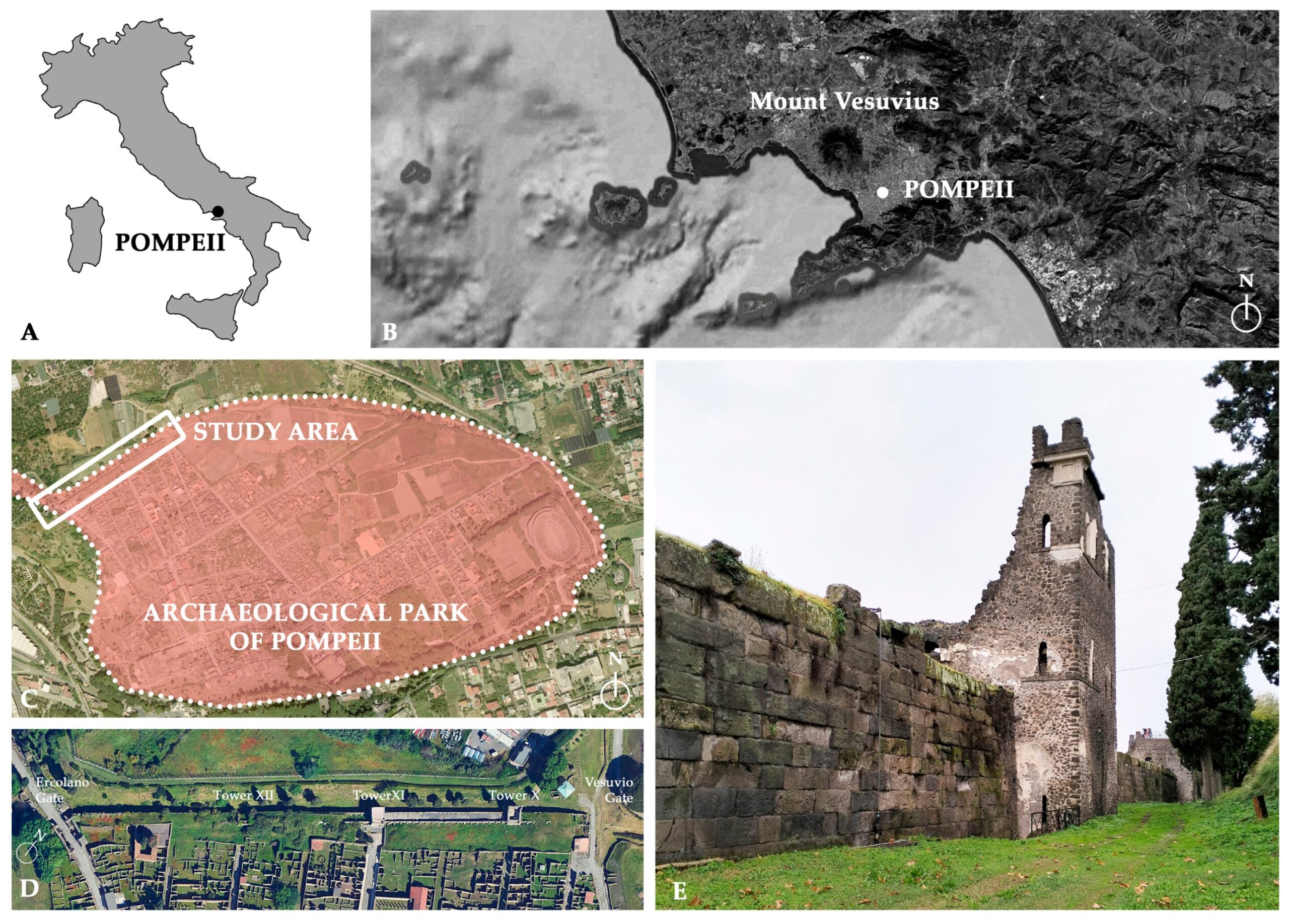
For centuries, the silent stones of Pompeii have been celebrated as a tragic time capsule, frozen in the violent instant when Mount Vesuvius buried the city in AD 79. Yet, beneath the layers of volcanic ash and the well-known stories of Roman life, the city’s northern walls hold a darker, older secret. Long before the fire of the volcano, Pompeii faced the fire of man. If you look closely at the ancient fortifications, you will find more than just the wear and tear of time; you will find the ballistic scars of a terrifying, high-tech assault that predates the eruption by nearly a century. This is the story of the Siege of Sulla, where archaeology has recently uncovered evidence of what some are calling an ancient version of a machine gun.
The Ghostly Scars of a Forgotten War
The narrative of Pompeii is often dominated by its final hours, but researchers from Italy have been looking further back into the city’s history, specifically to the first century BC. During this era, the Roman general Lucius Cornelius Sulla laid siege to the city, and the evidence of his wrath is still etched into the limestone. For years, historians focused on the massive, circular craters pockmarking the walls—the clear calling cards of heavy stone balls launched from standard Roman catapults. These were the heavy hitters of ancient warfare, designed to crumble stone and spirit alike.
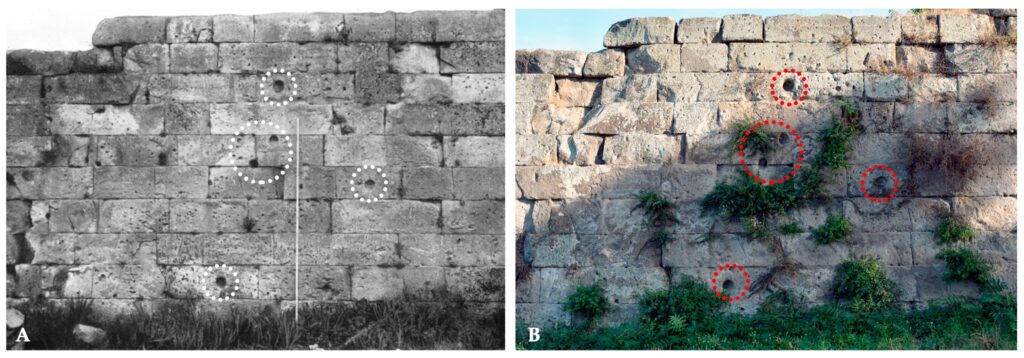
However, scattered between these giant impact zones, the team noticed something odd. There were smaller, four-sided holes arranged in a peculiar, fan-like shape. Traditionally, these marks were dismissed as general battle damage or the simple erosion of the centuries. But the research team, publishing their findings in the journal Heritage, suspected that these were not random accidents of time. Instead, they proposed that these clusters represented a deliberate, rapid-fire bombardment from a weapon far more sophisticated than a simple bow or a slow-moving catapult.
Reconstructing the Geometry of Violence
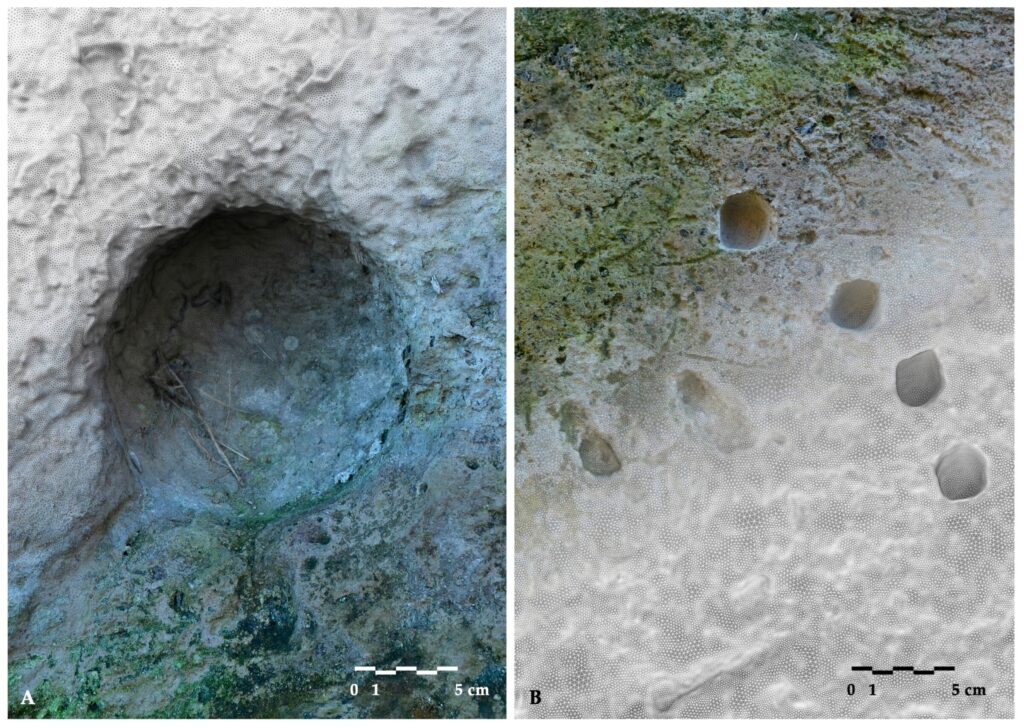
To prove their theory, the scientists turned to modern technology to peer into the ancient past. They utilized laser scanning and photogrammetry to create high-resolution 3D models of the impacts. This wasn’t just about taking pictures; it was about measuring the physics of a strike that happened over two thousand years ago. By meticulously analyzing the exact depth, width, and shape of the four-sided holes, the team could calculate the force required to make such a mark.
The data told a compelling story. The velocity needed to create these specific “ballistic scars” was far too high for a handheld weapon like a traditional bow. The sheer consistency and power pointed toward a heavy, high-velocity machine. The researchers began to look for a culprit in the annals of ancient engineering, specifically the polybolus, a legendary repeating catapult. This was a weapon capable of firing multiple projectiles in rapid succession, a feat of mechanical ingenuity that seems almost out of place in the ancient world.
Blueprints from the Ancient Underground
The digital evidence was only the first piece of the puzzle. To bridge the gap between 3D models and historical reality, the team compared their findings to third-century BC Greek engineering blueprints. These ancient manuals described the inner workings of a repeating catapult, detailing the mechanics of how such a machine could cycle through ammunition. The “smoking gun” appeared when the researchers matched the fan-shaped pattern of the holes on the wall to the mechanical sweep described in the engineering manuals.
It appeared the weapon didn’t just fire straight; it moved with a calculated, side-to-side motion, spraying the battlements with a lethal rain of iron. This was further confirmed by physical evidence found in museum collections. The team examined surviving projectiles from other Roman military sites, specifically iron-tipped bolts associated with the Scorpion catapult. When they compared these physical bolts to the dimensions of the 3D models created from the wall damage, the fit was nearly perfect. The holes in the wall were the exact “fingerprints” of these heavy, metal-tipped bolts.
A Rain of Iron on the Ramparts
The tactical picture painted by this research is one of brutal efficiency. The researchers hypothesized that this automatic scorpion was used with a very specific, lethal intent. In their paper, they described the radial configuration of the impacts as evidence of a weapon designed to suppress the defenders of Pompeii. As archers emerged from the lateral posterns of the towers, or as defenders briefly exposed themselves between the merlons (the upright sections of the wall), the “machine gun” would open fire.
Once the provisional wooden parapets—the temporary shields used by soldiers—had been compromised by heavier artillery, the defenders were left vulnerable. The polybolus would then sweep the top of the wall, ensuring that any soldier who tried to return fire was met with a high-velocity bolt. It was a weapon of psychological and physical dominance, designed to keep the enemy’s head down while the Roman legions moved in. The reason these impacts survived so clearly for us to study today is the very thing that eventually destroyed the city. Because Vesuvius buried the city in ash less than a century after the siege, the walls were protected from the elements, preserving the scars of Sulla’s machines in pristine condition.
Why This Ancient Tech Still Matters
This discovery is more than just a footnote in military history; it fundamentally changes our understanding of the technological capabilities of the ancient world. It proves that the Romans—and the Greeks before them—were capable of creating complex, automatic weaponry that we often assume belonged to much later eras of human history. By combining archaeology with digital ballistics and ancient engineering, researchers have shown that the “modern” concept of rapid-fire suppression has roots that go back millennia.
Furthermore, this research demonstrates the incredible power of 3D modeling in historical preservation. It allows us to “read” the walls of ancient cities like a crime scene, extracting data from the smallest dents and cracks to reconstruct events that occurred over two thousand years ago. The walls of Pompeii are no longer just ruins; they are a recorded history of innovation, strategy, and the relentless evolution of human conflict. Through these “ballistic scars,” we gain a clearer, more vivid window into the terrifying reality of Roman warfare and the sophisticated machines that built an empire.
Study Details
Adriana Rossi et al, From Pompeii to Rhodes, from Survey to Sources: The Use of Polybolos, Heritage (2026). DOI: 10.3390/heritage9030096