High above the Sea of Galilee, on the windswept plateau of Antiochia Hippos, the silence of the archaeological dig was broken by the steady, rhythmic chirp of a metal detector. It was 2025, and Dr. Michael Eisenberg’s team was scouring the earth near the Sussita Stream, a rugged riverbed that snakes beneath the city’s ancient eastern gate. For a besieging army, this ravine was a strategic nightmare; for the defenders on the walls above, it was a shooting gallery.
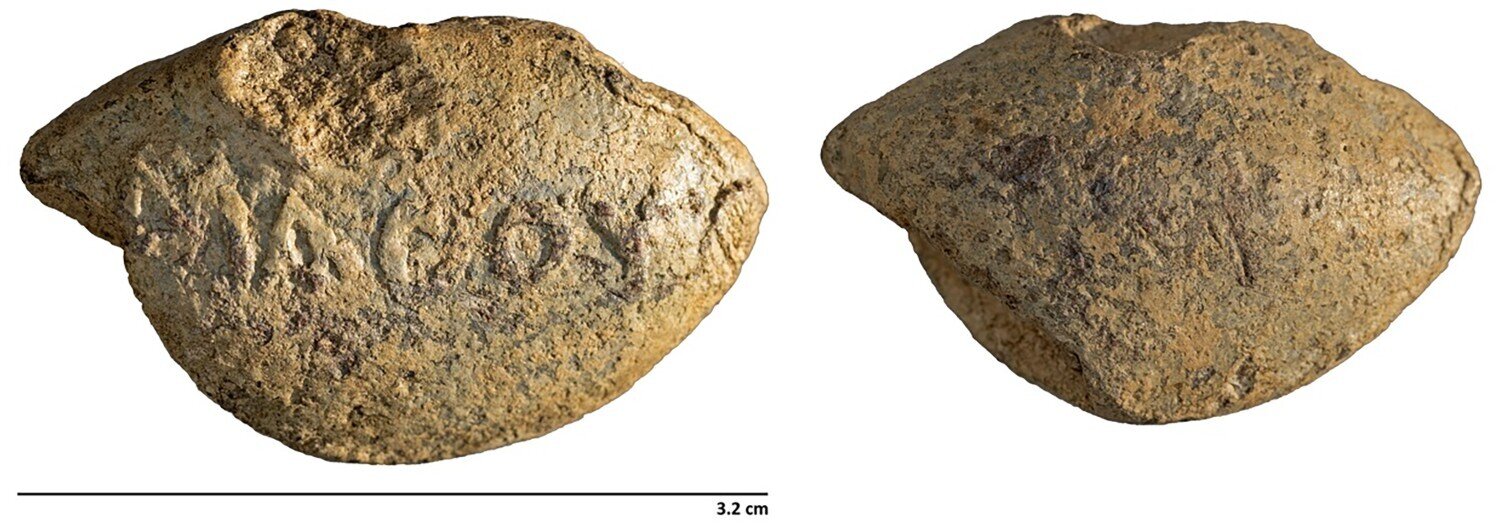
As the sensor hummed over the soil, it struck a dense pocket of history. From the dirt emerged a small, almond-shaped object, heavy for its size and coated in the dull grey patina of age. It was a lead sling bullet, a weapon of war that had waited over two millennia to deliver its final, silent message.
The Weight of Ancient Artillery
To the casual observer, the find might have looked like a simple river stone, but to the researchers at Hippos, it was a piece of high-tech military hardware from the Hellenistic period. While prehistoric warriors relied on stones or molded clay, the soldiers of the Classical era turned to lead. It was the perfect material: cheap, easy to melt, and incredibly dense.
These projectiles were typically cast in stone molds that could produce eight bullets at a time, each measuring roughly 3×2 centimeters. With a mass ranging from 20 to 55 grams, these were not mere toys. When tucked into a leather pouch and whirled at the end of a long rope sling, the centrifugal force transformed the lead into a lethal bolt. At distances of up to 100 meters, a skilled slinger could pick off an individual target with terrifying precision. At longer ranges, a rain of these “bullets” could devastate a cluster of advancing enemies.
At Hippos, the team had already recovered more than 70 lead bullets, many of them bearing the symbols of war—scorpions to signify a stinging strike or thunderbolts representing the wrath of the gods. But as the researchers cleaned the oxidation from this new find, identified as B19655, they realized they were looking at something never before seen in the history of the site.
A Voice from the Ramparts
Etched into the soft metal was a single Greek word: ΜΑΘΟΥ.
Inscribed sling bullets are not unheard of in the ancient world. They often acted as a form of “signed” ammunition, carrying the names of deities, military units, or victorious commanders. Some were even used to identify the city of origin. However, this bullet was different. It carried no name and no official seal. Instead, it carried an attitude.
The word translates to “Learn your lesson!” and it represents a rare, visceral glimpse into the psychological warfare of the 2nd century BCE. Unlike bullets inscribed on both sides—which usually denoted a personal name—this one bore its message on a single face, intended as a taunt for the poor soul on the receiving end.
Dr. Eisenberg and his colleagues, in their study published in Palestine Exploration Quarterly, noted that the inscription was written in the Greek middle-voice. This grammatical nuance adds a layer of biting sarcasm. It’s as if the bullet itself is being commanded to “learn” how to hit the enemy well, or, more likely, it is a mocking directive to the target to “educate” themselves on the lethality of the Hippos defenses. It belongs to a tradition of ancient “hate mail” found on other battlefields, where bullets were inscribed with phrases like “take a taste,” “receive this,” or “take it.”
The Scar of the Strike
The bullet tells a story not just through its letters, but through its physical state. Lead is a soft metal, yet it is remarkably resistant to time. It does not erode; it simply develops a protective layer of patina. However, because it is soft, it often retains the physical history of its final moments.
On the surface of the ΜΑΘΟΥ bullet, researchers found a distinct scar. This indentation is a “testimony to its use”—a permanent mark left when the lead slammed into a hard surface at high velocity. It is a frozen echo of a scream, a shield splintering, or a stone wall being struck during a desperate defense.
While the exact conflict that saw this bullet fly remains a mystery, the history of Antiochia Hippos offers several candidates. The city, a member of the Roman Decapolis, was a frequent prize of war. It may have been cast during the Battle of Paneion around 199 BCE, or perhaps during the attempted conquest by Alexander Janneus in 101 BCE. It could even date to the city’s final fall in 83 BCE. Regardless of the specific year, the bullet was almost certainly hurled by a defender standing atop the high city walls, looking down at the attackers struggling through the Sussita Stream.
Why the Lesson Still Matters
This tiny piece of lead is more than just a relic of ancient ballistics; it is a bridge to the human experience of the past. It reminds us that war, even two thousand years ago, was not just about strategy and steel—it was about emotion, ego, and dark humor.
The discovery of the “Learn your lesson!” bullet provides archaeologists with a specific linguistic footprint of the Hellenistic influence in Greater Syria. It shows that the soldiers guarding the gates of Hippos were literate, witty, and perhaps a bit arrogant in their prowess. By deciphering these “taunts in flight,” researchers gain a clearer picture of the cultural atmosphere of the Decapolis cities, where Greek language and Roman military reality collided.
Ultimately, the find proves that while technology changes—moving from stone to lead to the digital sensors used to find them—human nature remains constant. The impulse to shout a defiant boast at an enemy, even one etched into a thumb-sized piece of metal, is a thread that connects the modern world to the ancient defenders of the heights. The lesson, it seems, has finally been learned.
Study Details
Michael Eisenberg et al, Learn! – A New Type of Inscription on a Sling Bullet from Hippos of the Decapolis, Palestine Exploration Quarterly (2026). DOI: 10.1080/00310328.2026.2641294