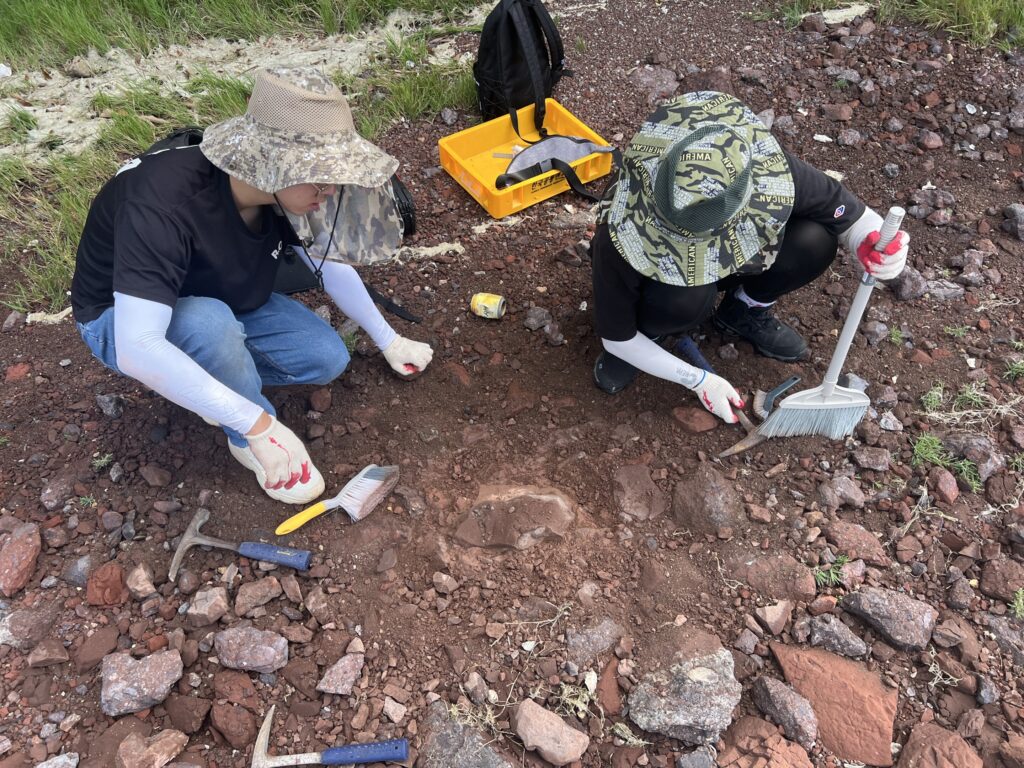
On the rugged, wind-swept shores of Aphae Island, South Korea, the ground holds secrets millions of years old. For decades, this region has been world-renowned for its “trace” fossils—the footprints, nests, and eggs left behind by ancient giants—but the physical bones of the creatures themselves remained frustratingly elusive. That changed in 2023 when researcher Hyemin Jo spotted something unusual embedded in the hard, unforgiving rock. What began as a glimpse of a few skeletal fragments has since transformed into a story that bridges the gap between prehistoric reality and modern cultural imagination.
A Legend Trapped in Stone
For the people of South Korea, the name Dooly carries a specific kind of magic. A mischievous, green baby dinosaur with two distinct sprigs of hair, Dooly is a beloved cartoon icon that has captured the hearts of every generation. When a team of researchers from The University of Texas at Austin and the Korean Dinosaur Research Center realized they had discovered a new species of juvenile dinosaur, the choice for a name was clear. They christened the creature Doolysaurus huhmini.
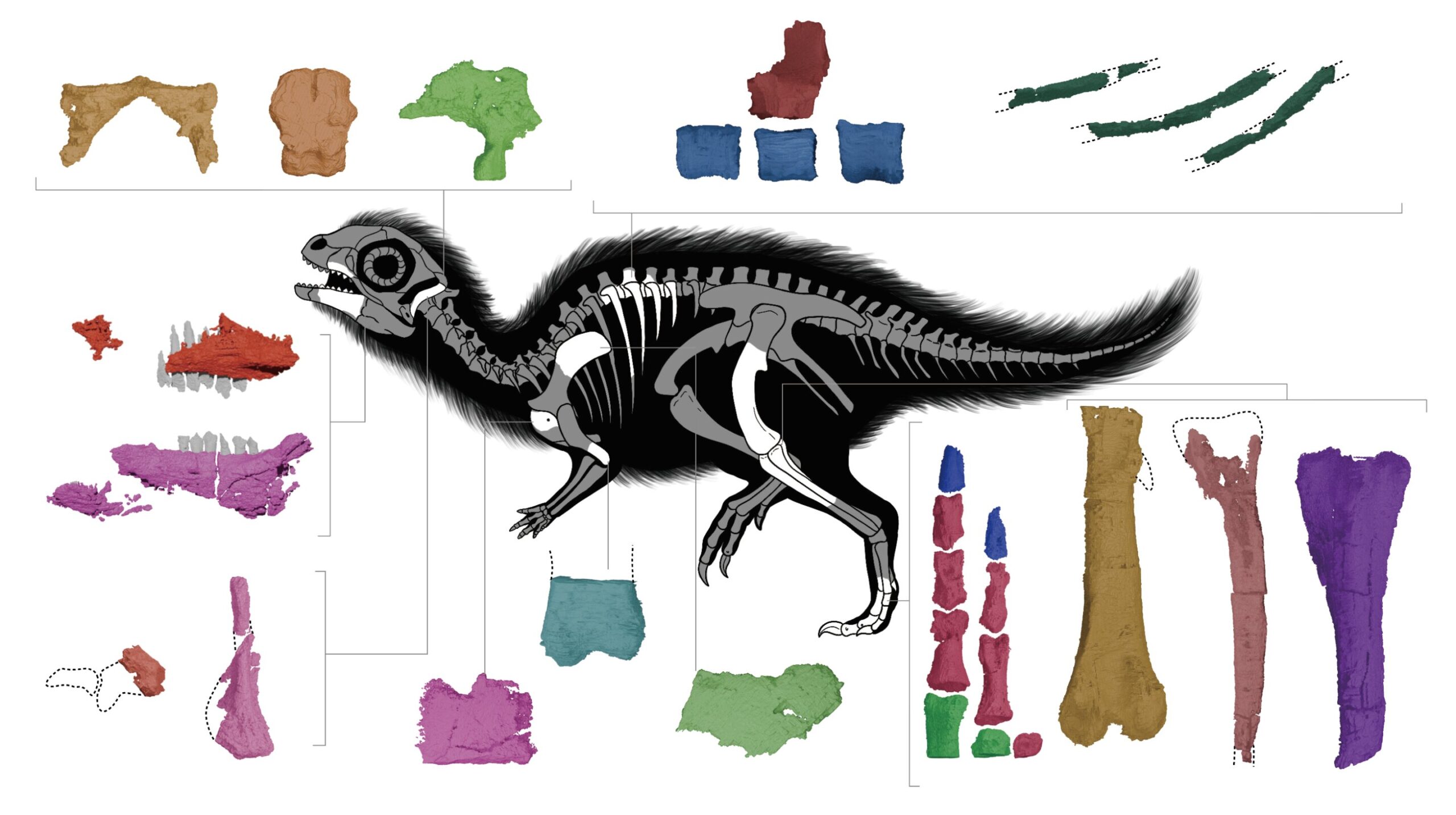
The second part of its name, huhmini, serves as a professional tribute to Min Huh, a pioneering paleontologist who spent thirty years founding research centers and working with UNESCO to preserve Korea’s fossil heritage. While the name honors a titan of the field, the fossil itself belonged to a much humbler creature. This was a “baby” dinosaur, a tiny wanderer from the mid-Cretaceous period, specifically living between 113 and 94 million years ago. It is the first new dinosaur species found in Korea in fifteen years, but its significance goes far deeper than a mere tally on a list. It represents a rare “holy grail” for the region: the first Korean dinosaur fossil ever found with parts of its skull intact.
Peering Through the Unyielding Earth
When the specimen was first pulled from the field, it didn’t look like much more than a dense block of stone with a few leg bones and vertebrae peeking out from the surface. In the past, extracting such a delicate treasure from such hard rock would have been a grueling, decade-long test of patience. A trained preparator would have had to chip away at the matrix by hand, millimeter by millimeter, risking damage to the fragile bones hidden within.
However, the team opted for a more futuristic approach. They transported the block to the University of Texas High-Resolution X-ray Computed Tomography (UTCT) facility. Here, a micro-CT scan acted as a set of digital eyes, slicing through the solid rock without ever touching the bone. The results were immediate and electrifying. Instead of just a few limb fragments, the scans revealed an entire hidden world inside the stone. There were more bones than anyone had dared hope for, including the elusive segments of the skull.
This technology has become a lifeline for paleontologists studying small non-avian dinosaurs and ancient birds, whose bones are often as thin and delicate as eggshells. What would have taken ten years to see with the naked eye was revealed in just a few months, allowing researchers Jongyun Jung and Julia Clarke to spend the following year meticulously mapping the creature’s anatomy.
The Little Lamb of the Cretaceous
Based on the data gathered from the scans, a picture of Doolysaurus began to emerge. It was a thescelosaurid, a member of a group of small, bipedal dinosaurs known to inhabit both East Asia and North America. By examining a thin slice of its femur, or thigh bone, researchers identified specific growth markers—much like the rings of a tree—that told a somber story. This particular individual was only about 2 years old and still growing when it died.
In life, this baby was roughly the size of a turkey, though if it had reached adulthood, it might have grown to twice that size. Scientists believe it wouldn’t have looked like the scaly monsters of cinema. Instead, it likely sported a coat of fuzzy filaments, giving it a soft, downy appearance. Co-author Julia Clarke noted that with its small stature and fuzzy exterior, the creature probably looked quite a bit like a “little lamb.”
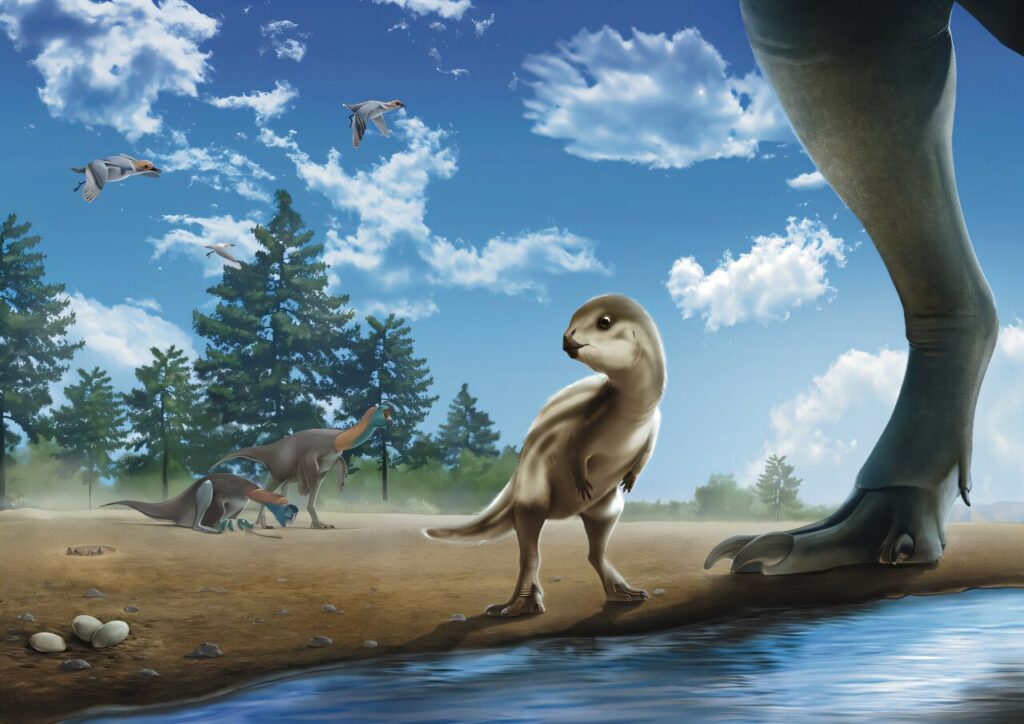
But this “lamb” had a curious diet. Inside its abdominal cavity, the CT scans picked up dozens of gastroliths—small pebbles that the dinosaur had swallowed. These stones acted as a biological gristmill, tumbling around in the stomach to grind up tough food. The presence of these stones, combined with the shape of its body, suggests that Doolysaurus was an omnivore, likely foraging for a mix of plants, crunchy insects, and perhaps the occasional small animal.
The Clues Left Behind in the Belly
The discovery of the gastroliths was actually the “smoking gun” that led to the discovery of the skull. Because these stomach stones are small and lightweight, they are usually the first things to be washed away or scattered by scavengers after an animal dies. When the team saw a cluster of these stones nestled perfectly between two leg bones, they realized the carcass hadn’t been pulled apart before it was buried.
This physical integrity suggested that if the stomach was there, the rest of the body—including the head—might still be locked inside the rock. It was this observation that prompted the team to fly the specimen to Texas for scanning. The gamble paid off, proving that even the smallest pebbles can point the way to the greatest discoveries.
Why This Little Dinosaur Changes Everything
The story of Doolysaurus is more than just a heartwarming tale of a baby dinosaur named after a cartoon. It represents a massive shift in how we understand the ancient history of the Korean Peninsula. For years, the abundance of footprints and eggs suggested that Korea was a bustling prehistoric nursery, yet the “missing” skeletons led some to wonder if the bones simply hadn’t survived the passage of time.
The success of the micro-CT analysis on this find suggests that the bones aren’t missing—they are just hiding. Jongyun Jung and his colleagues, Minguk Kim and Hyemin Jo, are now taking the advanced imaging skills they honed in Texas back to Korea to hunt for more “hidden” residents of Aphae Island.
This research matters because it provides a template for the future of paleontology in the region. By proving that small, delicate skeletons can be recovered from the hardest rocks, Doolysaurus has opened the door to finding more species that have remained invisible for millions of years. It turns a landscape of footprints into a landscape of living history, ensuring that the real-life “Doolys” of the ancient world are finally getting their chance to be seen.
Study Details
Jongyun Jung et al, A new dinosaur species from Korea and its implications for early-diverging neornithischian diversity, Fossil Record (2026). DOI: 10.3897/fr.29.178152 , fr.pensoft.net/article/178152/