Deep within the sun-scorched stretches of South Africa’s Karoo Basin, a discovery has emerged that rewrites the history of Earth’s first true masters of the land. Long before the first dinosaur ever left a footprint in the mud, a group of terrifying, sabre-toothed creatures known as gorgonopsians reigned supreme. For decades, the scientific narrative suggested these predators started small and only grew into giants over many millions of years. However, a newly identified species, Jirahgorgon ceto, has shattered that linear timeline, proving that nature’s appetite for apex predators was far more ambitious—and much earlier—than we ever imagined.
The Ghostly Hunters of a Lost Continent
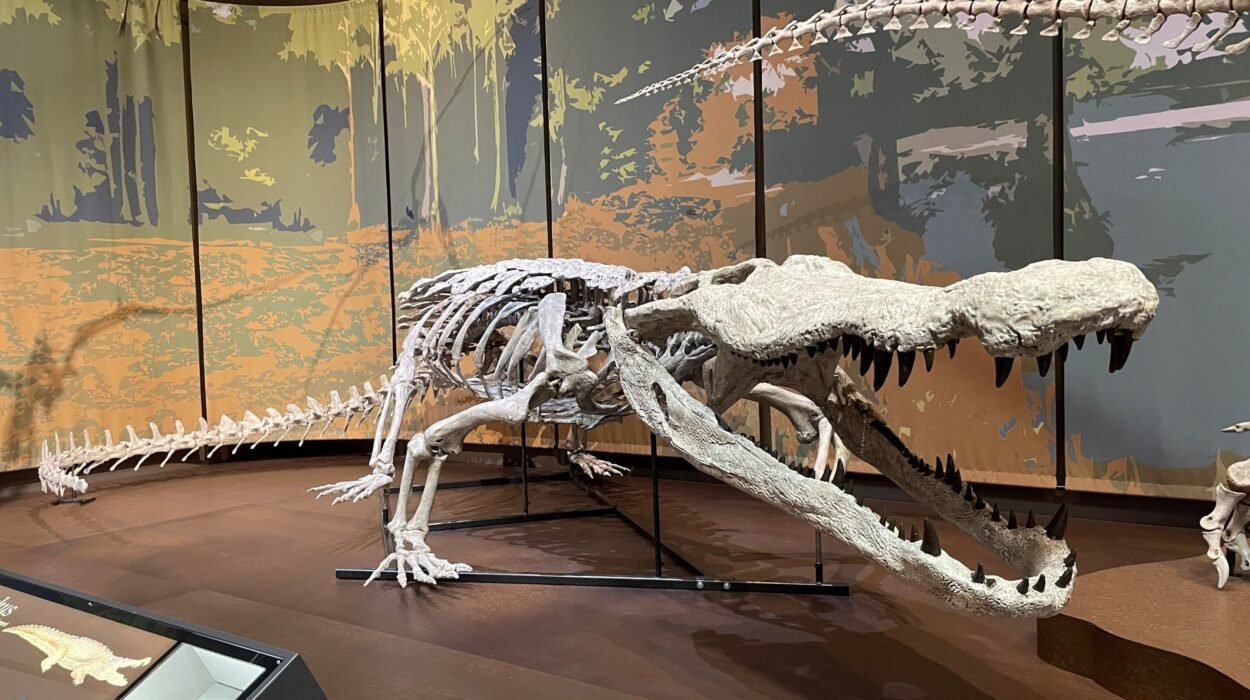
Imagine a world 260 million years ago, a time during the middle Permian. This was not the Earth we recognize today. All the continents were fused into a singular, colossal landmass called Pangea. It was a hot, mostly dry realm of open plains and winding river systems, populated by strange, early plants and experimental lineages of animals. Among these inhabitants were the gorgonopsians, ancient carnivorous animals that represent some of the earliest relatives of mammals.
These were the first top hunters on land to brandish sharp teeth designed for the kill. Until recently, the fossil record from Russia and South Africa suggested a slow, predictable rise to power. Most early specimens found were small to medium-sized, leading researchers to believe that body-size diversification—the evolution of massive, bone-crushing giants—didn’t happen until the late Permian. The prevailing theory was a “slow and steady” climb to the top of the food chain. But the rocks of the Abrahamskraal Formation held a different story, waiting for the right moment to surface.
A Chance Encounter in the Dust
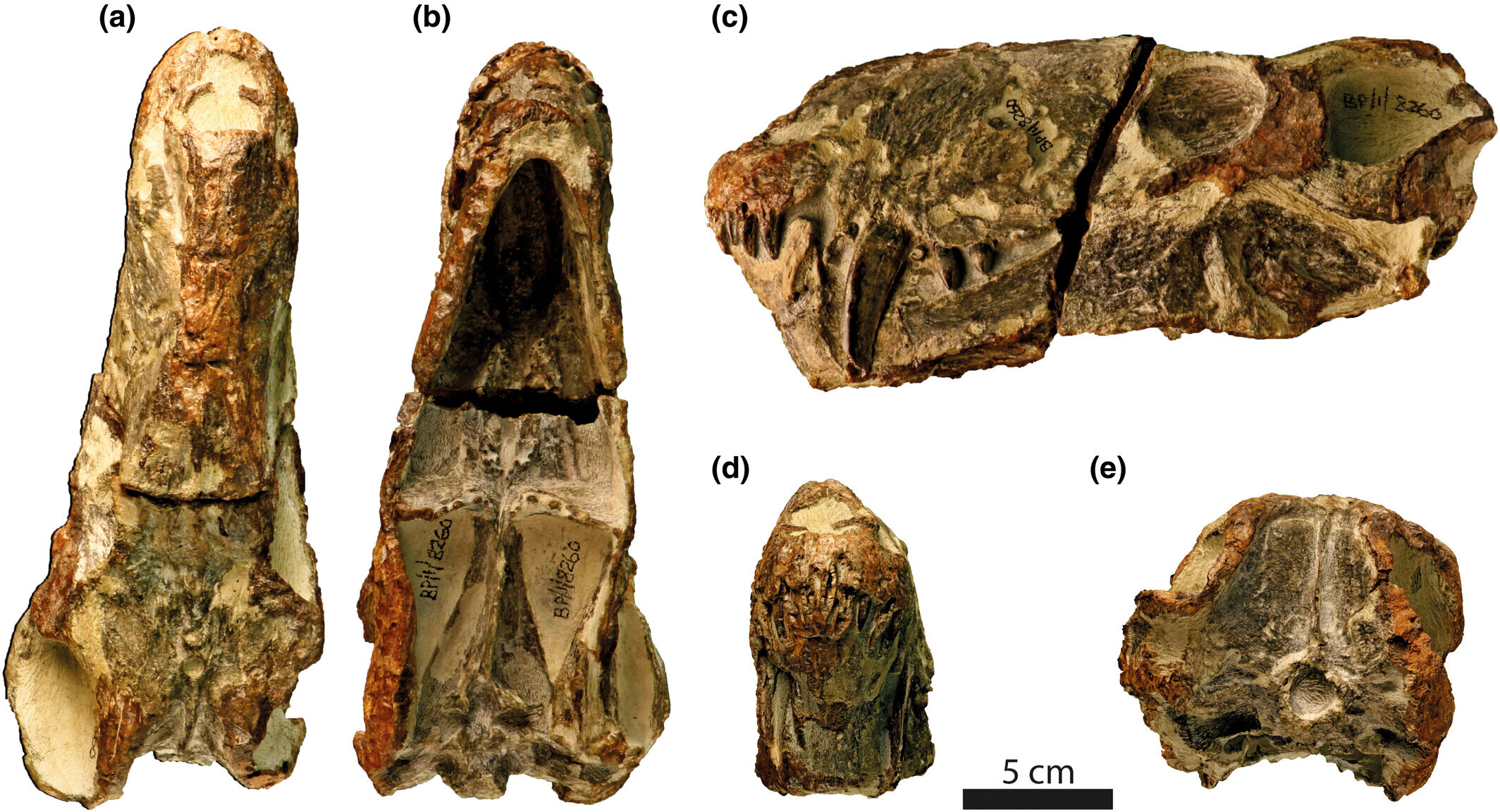
The breakthrough occurred in March 2019, on the Wilgerbos farm in the Lainsburg District of the Western Cape. Dr. Julien Benoit and Dr. Michael Day were scouring the rugged landscape when they stumbled upon a fossil that looked out of place. It was a skull and jaw, but its proportions didn’t match the small-bodied hunters usually found in such ancient layers.
Radiometric dating of the surrounding rock confirmed the site was formed at the boundary between the Wordian and Capitanian periods. This made the find one of the oldest windows into the dawn of the gorgonopsian lineage. Dr. Zanildo Macungo, the lead author of the study, noted that the specimen’s presence in a region previously known only for very small creatures was an immediate red flag that they had found something revolutionary. The fossil was named Jirahgorgon ceto, a name that honors Dr. Sifelani Jirah for his work with the Karoo collections, while “ceto” nods to Greek mythology—the mother of the gorgons and wife of Phorcys.
Peering Through Stone with Light
To understand what made Jirahgorgon so special without damaging the precious bone, the researchers sent the fossil to Grenoble, France. There, it underwent synchrotron X-ray micro-computed tomography. This high-tech scanning allowed scientists to peer through the rock and bone, creating a highly detailed 3D reconstruction of the skull’s internal microstructure.
The results were startling. The skull featured a vertical occiput and proportions strikingly similar to the rubidgeines. Rubidgeines were a group of famously large gorgonopsians characterized by thick, heavy skulls, but they weren’t supposed to appear for another several million years. Finding these rubidgeine-like cranial proportions in the Wordian period completely overturned the idea that large-bodied carnivores were a late-stage evolutionary development. Jirahgorgon was already a giant while its cousins were still small, proving that large body sizes evolved much earlier than the Wuchiapingian stage of the late Permian.
The Mechanics of a Monster
The anatomical analysis revealed that Jirahgorgon wasn’t just bigger; it was built differently. By examining the arrangement of the pterygoid bones in the roof of the mouth, researchers realized this predator was already evolving a more powerful, clamping bite. This wasn’t a generalist hunter; it was an ecological specialist designed to tackle larger prey.
This discovery suggests that the evolution of size in these ancient “mammal-like” reptiles wasn’t a single, upward trajectory. Instead, increases in gorgonopsian body size seem to have arisen independently and somewhat randomly multiple times across different branches of the family tree. While shared ancestry played a role in their development, the pressure to become a giant was an experiment nature ran more than once. Because of these unique traits, Jirahgorgon ceto and its relative, Phorcys dubei, have now been placed into a brand-new family: the Phorcyidae.
Why This Ancient Predator Matters Today
The discovery of Jirahgorgon ceto is more than just the addition of a new name to a dusty catalog; it changes our fundamental understanding of how apex predators occupy an ecosystem. It proves that the “big predator” niche was filled much sooner than previously thought, showing that ecosystems in the middle Permian were far more complex and diverse than the fossil record once suggested.
By identifying the Phorcyidae family, scientists have uncovered a “hidden” radiation of large carnivores that existed millions of years before the famous giants of the late Permian. This research underscores the importance of the Karoo Basin as a world-class laboratory for understanding deep time. Every new fossil, like this powerful-jawed hunter, helps us piece together the volatile history of life on Earth and the resilient ancestors that paved the way for the age of mammals. As fieldwork continues on the Wilgerbos farm, the hope is to find more specimens that will further illuminate this era of prehistoric giants.
Study Details
Zanildo Macungo et al, Evolutionary radiation of large‐bodied gorgonopsians from the lower Abrahamskraal formation of South Africa, The Anatomical Record (2026). DOI: 10.1002/ar.70181