The universe has a peculiar way of hiding its most profound secrets in the smallest of places. For over a century, the textbooks of quantum mechanics have teased us with a reality that feels more like a fever dream than a physical law: the idea that a single particle can exist in two places at once. While we have grown comfortable with this strangeness in the world of light, seeing it happen with tangible, heavy matter has remained one of science’s most elusive challenges. Recently, a team of dedicated researchers at the Australian National University (ANU) managed to pull back the curtain on this mystery, witnessing helium atoms performing a dance of entanglement that defies our everyday intuition.
The Ghostly Dance of the Double
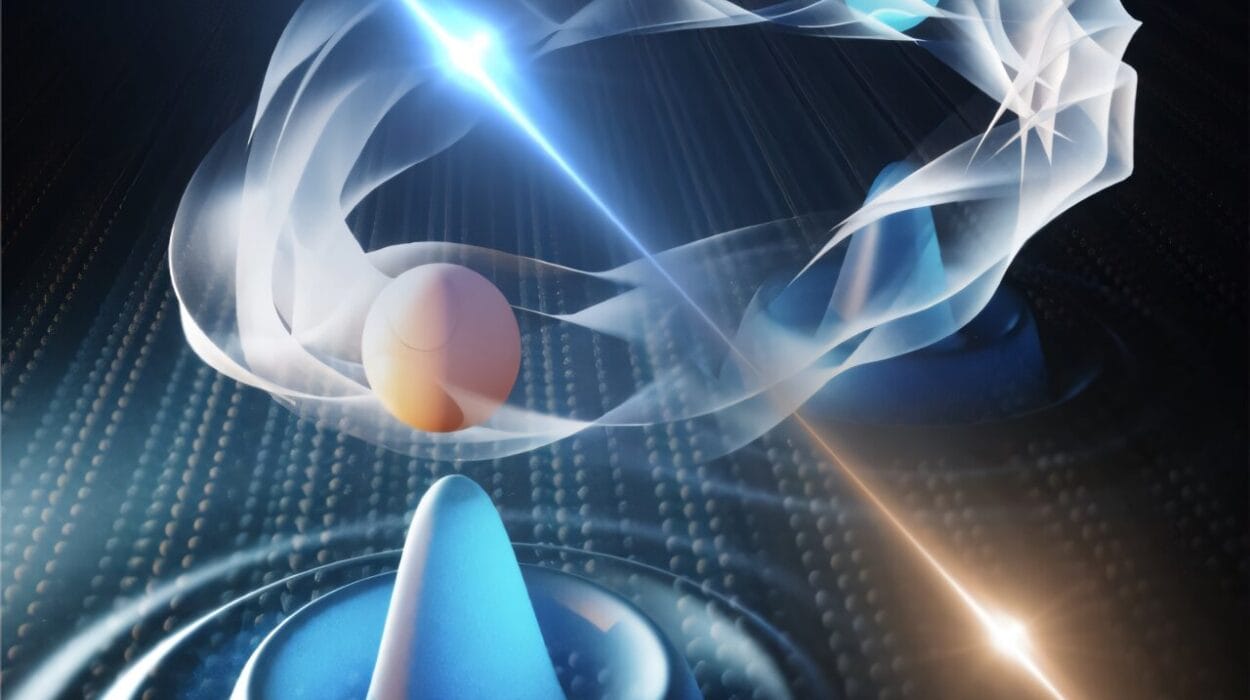
To understand the magnitude of this feat, one must first grapple with how truly “weird” the quantum world is. As Dr. Sean Hodgman from the ANU Research School of Physics points out, it is one thing to read about these concepts in a cold, academic text, but it is another entirely to realize that this is the fundamental architecture of our universe. The concept of superposition suggests that a particle isn’t just “here” or “there” but can effectively be in both locations simultaneously. When these particles become entangled, their fates are linked; what happens to one immediately influences the other, regardless of the distance between them. For years, physicists have successfully demonstrated these effects using photons, which are weightless particles of light. However, light is ethereal. To truly test the limits of reality, scientists needed to see if the same rules applied to atoms—the massive, physical building blocks of the world we can touch and feel.
Cooling the Chaos to Find the Truth
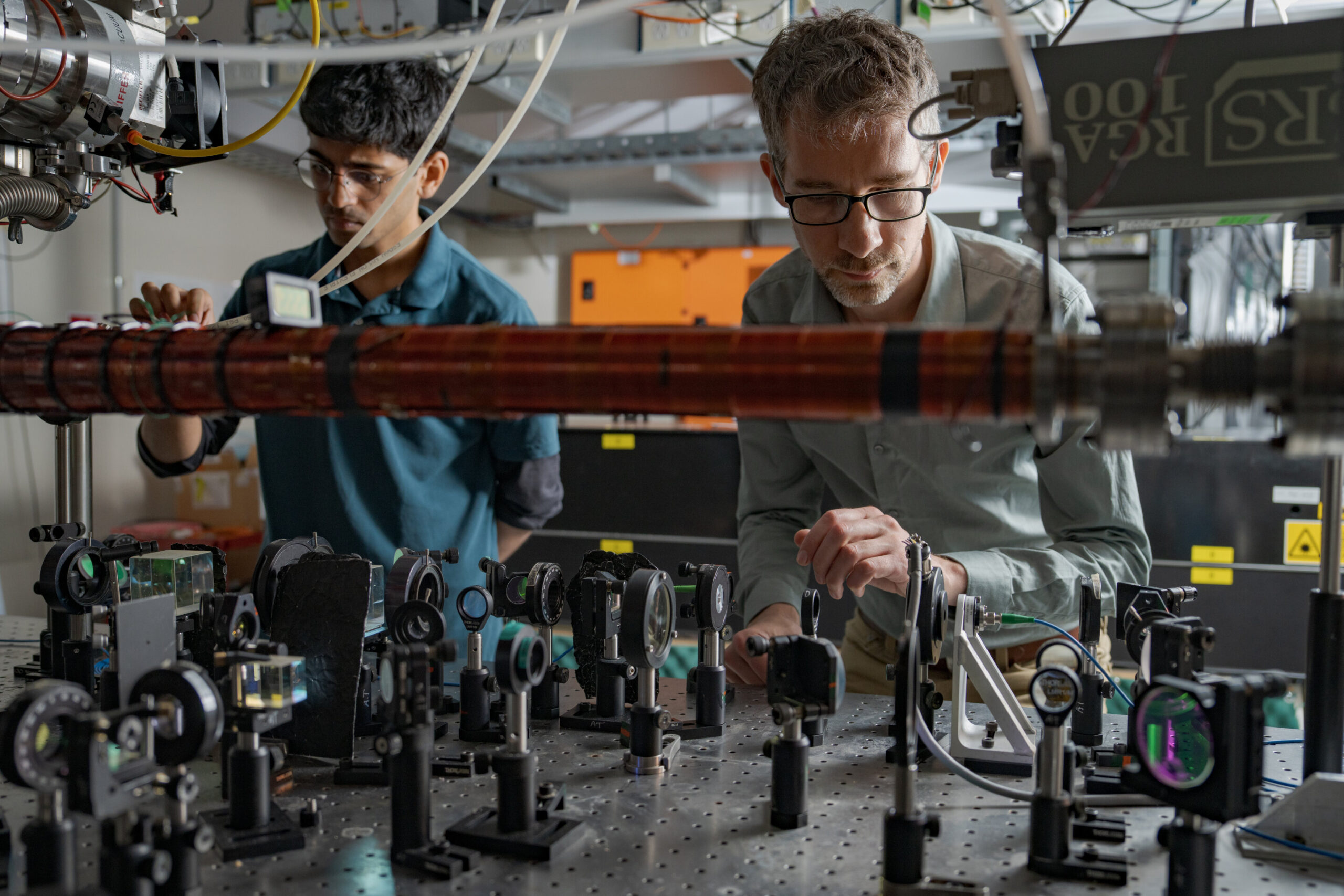
The journey to this discovery was fraught with technical hurdles that have tripped up researchers for decades. Lead author and Ph.D. researcher Yogesh Sridhar Arthreya notes that while many have attempted to demonstrate these effects in massive particles, most have come up short. The difficulty lies in the sheer sensitivity of atoms. Unlike photons, helium atoms have mass. They are influenced by gravitational fields, making them much harder to keep in a stable quantum state. To succeed where others failed, the ANU team had to find a way to hold, cool, and manipulate these atoms with extreme precision. By stripping away the heat and chaos of the macroscopic world, they created a controlled environment where the delicate quantum signatures of the atoms could finally be observed. They weren’t just looking for a signal; they were looking for atoms entangled in motion, a state where the very movement of the particles was inextricably linked in a way that classical physics simply cannot explain.
When Matter Mirrors Itself
The result of this meticulous experimentation was a stunning confirmation of a century-old prediction. The researchers observed that matter can indeed exist in two locations at once and, perhaps even more remarkably, it can interfere with itself across those locations. This phenomenon, known as quantum interference, is the ultimate proof of the wave-like nature of matter. It suggests that even though we perceive an atom as a solid “thing,” at its most fundamental level, it behaves like a ripple in a pond that can overlap with itself. By proving that these massive particles follow the same hauntingly beautiful rules as light, the team has bridged a gap between the abstract math of the early 1900s and the physical reality of the 21st century. It is a validation of the pioneers of physics who dared to suggest that the world was far more complex than it appeared to the naked eye.
Bridging the Gap Between the Small and the Vast
Why does it matter that a few helium atoms were caught in a state of entanglement? The answer lies in the greatest rift in modern science. Currently, our understanding of the universe is split into two incompatible halves. On one side, we have quantum mechanics, which perfectly describes the tiny world of atoms. On the other, we have general relativity, which explains the vast world of stars, galaxies, and gravity. The two do not play well together. Because helium atoms have mass and respond to gravity—unlike the weightless photons used in previous studies—they serve as a perfect “middle ground” for testing how these two realms interact. This research, published in Nature Communications, provides a new toolkit for scientists to investigate how the small-scale physics of the quantum world meshes with the universal scale of relativity.
The Search for a Unified Reality
Ultimately, this breakthrough is about more than just atoms; it is about our quest for a theory of everything. For generations, physicists have dreamt of a single framework that could explain every force in nature, from the spinning of an electron to the warping of spacetime around a black hole. By successfully observing quantum entanglement in massive matter, we are moving past the theoretical and into the experimental. We are finally beginning to poke and prod the boundaries where gravity meets the quantum void. While we are still in the early stages of this exploration, each successful observation of an atom in two places at once brings us one step closer to understanding the true fabric of the cosmos. It suggests that the “theory of everything” might not be just an academic dream, but a tangible truth waiting to be uncovered.
Study Details
Y. S. Athreya et al, Bell correlations between momentum-entangled pairs of 4He* atoms, Nature Communications (2026). DOI: 10.1038/s41467-026-69070-3