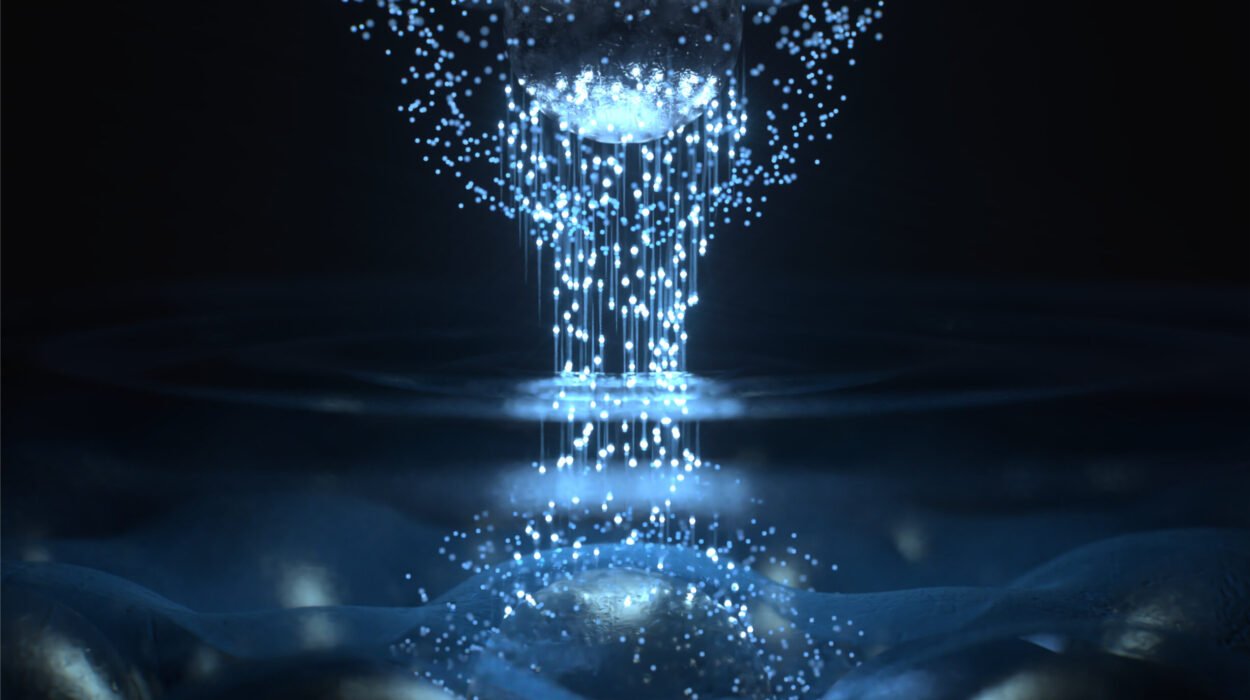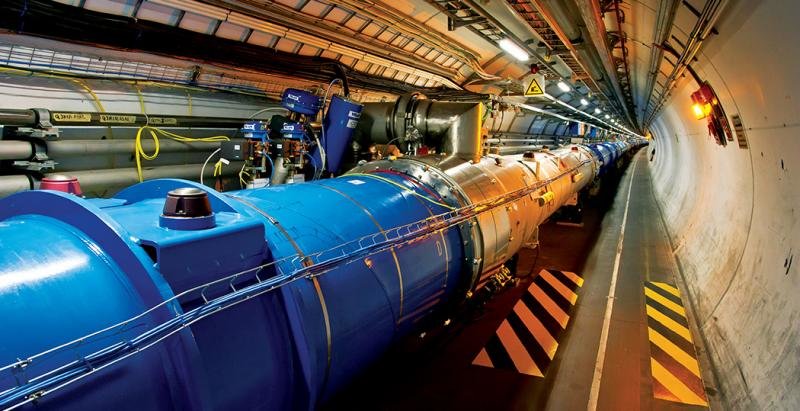
Deep within the high-tech tunnels of the Large Hadron Collider near Geneva, a long-standing mystery of the subatomic world has finally been solved. For decades, physicists have hunted for a specific arrangement of matter—a heavy, exotic cousin of the humble proton. Now, thanks to an international collaboration led by the University of Manchester, that search has ended with the discovery of the Ξcc⁺ (pronounced Xi-cc-plus). This is not just another entry in a physics catalog; it is a breakthrough that validates years of theoretical predictions and marks the first major success of the newly upgraded LHCb detector.
A Heavier Shadow of the Proton
To understand the significance of this new arrival, one must look back to the very foundation of nuclear physics. In the early 20th century, Ernest Rutherford and his colleagues in Manchester fundamentally changed our view of the universe by discovering the proton. That familiar particle, which sits at the heart of every atom, is composed of three even smaller building blocks known as quarks—specifically, two up quarks and one down quark. For over a century, the proton has been the gold standard for understanding how matter holds together.
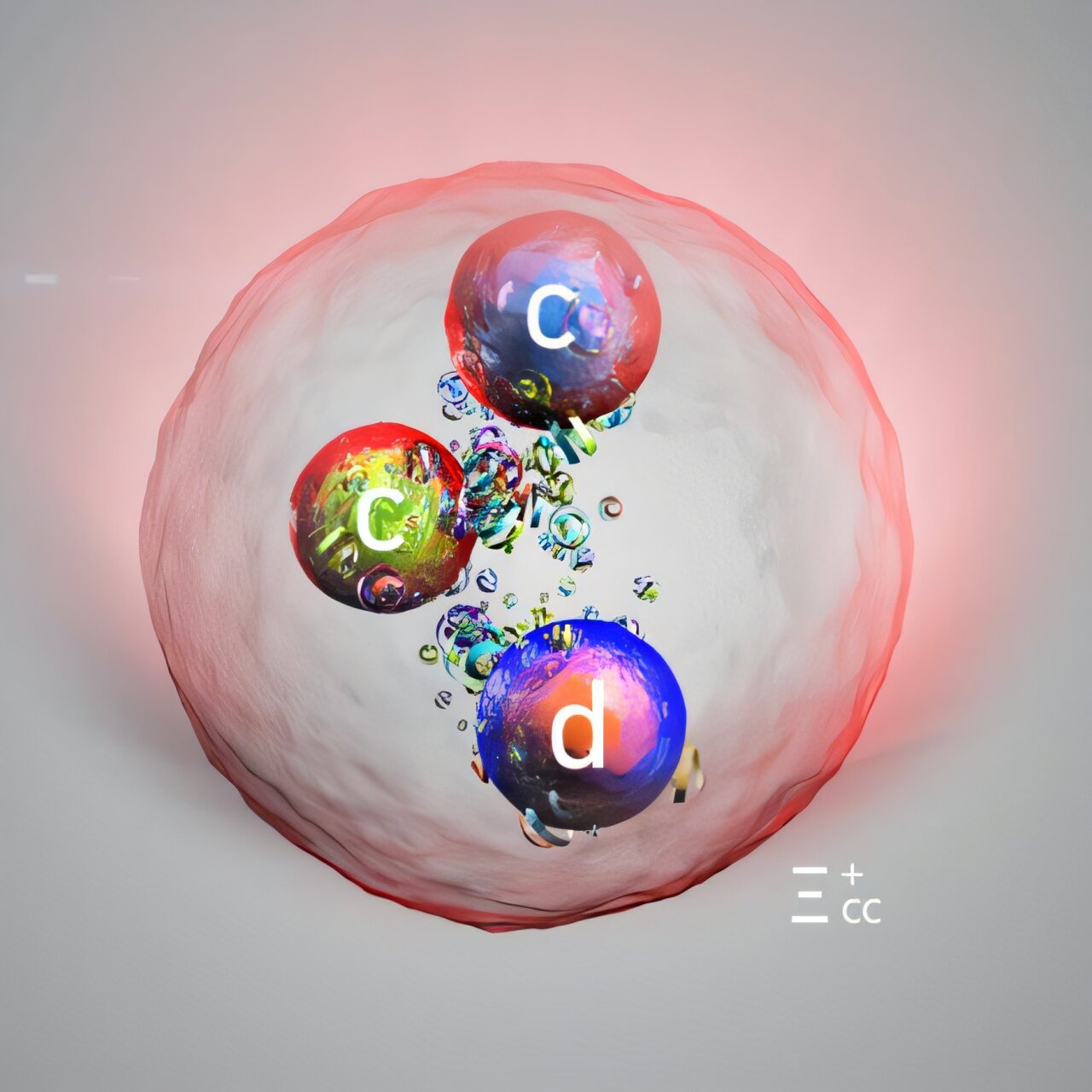
However, nature has a way of repeating its patterns using heavier materials. Quarks come in different “flavors,” and the charm quark is a much heavier relative of the up quark. Physicists have long wondered what would happen if you swapped the light components of a proton for these heavyweights. The Ξcc⁺ is the answer to that curiosity. It is a proton-like particle, but instead of two up quarks, it contains two charm quarks alongside a single down quark. This swap makes the particle significantly more massive than the protons that make up our bodies, offering a rare glimpse into how the “glue” of the universe functions when the stakes are heavier.
The Camera that Sees Forty Million Moments
Detecting such a rare and fleeting inhabitant of the subatomic realm required a monumental feat of engineering. The discovery was made using the LHCb detector, a massive instrument supported by over 1,000 scientists across 20 countries. The United Kingdom provided the largest national contribution to this upgrade, with Manchester physicists at the helm. Inside the Schuster Building at the University of Manchester, teams designed and built the heart of the machine: the silicon pixel detector modules.
These modules act as a specialized “camera” designed to image the chaotic aftermath of proton-proton collisions. Because these particles exist for only a fraction of a second before decaying into something else, the camera must be unimaginably fast. It captures images 40 million times per second. This technology is so precise that a variant of the silicon chip used in the detector is also being adapted for use in medical imaging. It was this high-speed tracking system that allowed scientists to reconstruct the path of the Ξcc⁺ as it broke apart, leaving behind a trail of three lighter particles: the Λc⁺, the K⁻, and the π⁺.
Resolving a Two Decade Old Mystery
The journey to this moment was fraught with uncertainty. For more than twenty years, the physics community lived with an unconfirmed claim that this particle had been seen before. However, the data was never definitive, leaving a hole in our understanding of the Xi particle family—a lineage of matter that Manchester physicists first began identifying back in the 1950s. The new results from the 2024 run of the LHCb Upgrade have finally cleared the air.
As the Large Hadron Collider smashed protons together, the detectors recorded a clear “peak” in the data, representing approximately 915 events. These events pointed toward a particle with a mass of 3,619.97 MeV/c². This specific mass is crucial because it is incompatible with the unconfirmed claims from two decades ago, but it perfectly matches the theoretical expectations based on a previously discovered partner particle, the Ξcc⁺⁺. By finding the Ξcc⁺ at this exact weight, the team has turned a twenty-year-old question into a confirmed fact of nature.
Why This Pursuit of the Small Matters
This discovery is a testament to the power of curiosity-driven research. Just as Rutherford’s basement experiments with gold foil transformed our grasp of the atom, this new milestone at CERN pushes the boundaries of how we define matter. By observing the Ξcc⁺, scientists can test the complex theories that describe the strong force—the fundamental interaction that binds quarks together.
Furthermore, the success of the LHCb Upgrade sets the stage for the future of physics. The University of Manchester is already moving toward LHCb Upgrade 2, which will utilize the High-Luminosity LHC accelerator to peer even deeper into the fabric of reality. Each new particle discovered is a piece of a cosmic puzzle; by understanding these heavy relatives of the proton, we gain a clearer picture of the rules that govern everything from the smallest atom to the largest star. This research proves that when international expertise and cutting-edge technology converge, we can finally see the invisible building blocks of our universe.