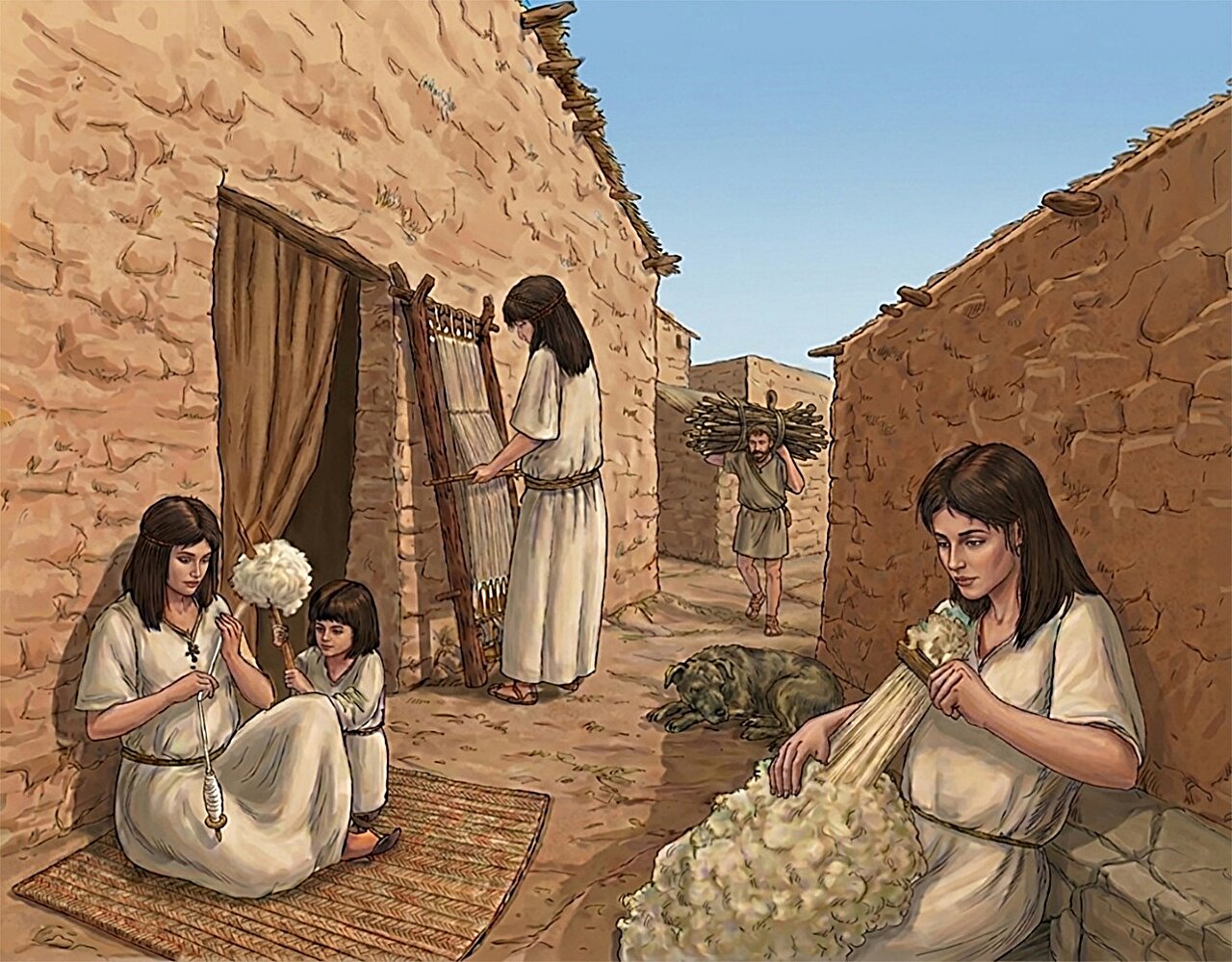
Imagine walking through the dusty, sun-drenched hills of southern Spain nearly 3,500 years ago. In the settlement of Cabezo Redondo, the air would have been filled with the rhythmic sounds of daily life, but tucked inside one of the dwellings, a sophisticated piece of machinery was at work. This wasn’t a machine of gears and metal, but one of Aleppo pine wood, plant fiber ropes, and carefully molded clay. It was a warp-weighted loom, a vital tool of the Bronze Age that allowed ancient weavers to turn raw fibers into the fabric of their lives. For millennia, these wooden skeletons have vanished, surrendered to the natural decay of organic materials, leaving archaeologists to guess their true shape from the scattered stones and clay weights left behind.
A Ghost in the Ashes
The story of this discovery begins not with a gleaming artifact, but with the charred, blackened remains of a tragedy. Thousands of years ago, a fire swept through a structure at Cabezo Redondo, consuming the home but inadvertently preserving a moment in time. Because the wooden beams were charred, they didn’t rot away; instead, they turned into carbon ghosts of their former selves. When researchers, led by Dr. Ricardo E. Basso Rial from the University of Granada, began their excavation, they found something extraordinary: timbers and ropes resting exactly where they had fallen, still in close association with clay loom weights.
In the world of archaeology, finding the “hardware” of a loom is like finding a needle in a haystack. While we have plenty of spindle whorls used for spinning thread and thousands of loom weights, the actual wooden frames are almost never seen. This specific find is now considered one of the best-preserved examples of a warp-weighted loom in the western Mediterranean. It provides a “frozen” snapshot of a craft that was once the backbone of ancient society, allowing scientists to move beyond mere theory and into the realm of physical reconstruction.
Gravity as a Weaver’s Tool
To understand why this discovery is so significant, one has to understand how a warp-weighted loom actually functions. Unlike a modern horizontal loom, this device stood upright, leaning slightly against a wall. The vertical threads, known as the warp, hung down from a top beam. To keep these threads under the high tension required for weaving, ancient craftspeople tied heavy objects to the bottom of the strands. At Cabezo Redondo, these weights were made of clay, pulling the threads taut so the weaver could pass horizontal threads, or the weft, back and forth through them.
The analysis of the Aleppo pine timbers and the plant fiber ropes found at the site has allowed researchers to visualize the loom morphology—the physical structure and shape of the machine. By looking at the spatial organization of where the weights fell, they can see exactly how the loom was set up. It wasn’t just a pile of debris; it was a sophisticated arrangement of organic and inorganic parts working in harmony. This discovery bridges a massive gap in our knowledge, moving us away from relying solely on the loom weights and allowing us to see the entire engineering feat as it existed in the second millennium BC.
The Secrets Hidden in Clay
While the wood tells us about the structure, the clay loom weights found at the site tell us about the fashion and the technology of the era. Interestingly, the weights at Cabezo Redondo were found to be much lighter than other examples typically found across Mediterranean Iberia. This might seem like a small detail, but in the world of textile physics, weight is everything. Lighter weights suggest the production of much finer or more varied fabrics.
According to the research published in the journal Antiquity, these specific characteristics suggest the loom was capable of more than just the standard tabby weaves. While tabby fabrics—simple over-under patterns often made from flax—were the norm from the Neolithic through the Bronze Age, the team believes this loom could produce denser and more technically complex textiles. This likely included early versions of twill weaves, a more intricate pattern that creates a diagonal ribbing in the fabric. This finding marks a major leap in our understanding of how advanced Iberian textile technology really was during this period.
At the Edge of a Revolution
The presence of potential twill weaves at Cabezo Redondo points toward something even larger: a “textile revolution.” Historically, twill is closely associated with the use of wool rather than plant fibers. The shift from using flax to using wool was a transformative moment in human history, leading to warmer, more durable, and more decorative clothing. Because twill didn’t become widespread until the beginning of the 1st millennium BC, finding evidence for it here, in the second millennium BC, suggests that this site was at the forefront of a technological shift.
This transition wasn’t just about fashion; it was about the technical diversification of an entire industry. The weavers at Cabezo Redondo were experimenting with new materials and new ways of interlacing threads, pushing the boundaries of what a warp-weighted loom could achieve. They were the engineers of their time, refining the tension of their clay weights and the strength of their Aleppo pine frames to create fabrics that were thinner, stronger, and more complex than those of their ancestors.
Why This Ancient Craft Matters Today
This research is vital because it transforms our understanding of the Bronze Age economy and daily life. For a long time, our view of ancient history was dominated by metal tools and stone monuments, but the “soft” history of textiles is just as important. Textiles were a primary commodity, a source of wealth, and a reflection of cultural identity. By reconstructing the warp-weighted loom of Cabezo Redondo, we are finally able to see the full scope of the textile technology that supported one of the most important periods in Western history.
Furthermore, this discovery reminds us that innovation isn’t a modern invention. The “textile revolution” occurring in southern Spain 3,500 years ago was a moment of profound change, where human ingenuity met the natural properties of wool and wood to create something entirely new. Understanding how these ancient people organized their workspace and mastered their tools allows us to appreciate the complexity of their society. It proves that even the simplest-looking objects, like a clay weight or a charred timber, can hold the keys to understanding a massive leap in human capability.
Study Details
Ricardo E. Basso Rial et al, Evidence of a warp-weighted loom in the Bronze Age settlement of Cabezo Redondo (south-east Spain), Antiquity (2026). doi.org/10.15184/aqy.2026.10312