The story of how humanity conquered the vast, blue wilderness of the Pacific Ocean has long been told as a swift, linear march. For decades, the prevailing narrative suggested that ancient explorers, carrying a purely East Asian genetic signature, set sail from places like Taiwan or the Philippines around 3,500 years ago. These travelers, part of the legendary Austronesian expansion, were thought to have bypassed local populations, only mingling with the Papuan groups of New Guinea much later in their history. But deep within the limestone caves and ancient burial grounds of Palau, a small nation of roughly 340 islands, a different story has been waiting for thousands of years to be told.
The Whispers of the Ancestors
To uncover this hidden history, an international research team led by scientists from Harvard University turned to the most intimate record of the past: DNA. They focused their efforts on the skeletal remains of 21 individuals unearthed from four distinct sites across the Palauan archipelago. These ancestors lived and died between 3,200 and 1,100 years ago, spanning a massive stretch of human history. By extracting ancient genetic material from these bones, the researchers were able to peer back through the centuries, comparing the code of these islanders with thousands of other ancient and modern people from across the globe.
The process of decoding this heritage is a delicate dance of biology and mathematics. When two distinct groups of people meet and have children, their genomes blend together. In the first generation, the segments of DNA from each parent are long and continuous. However, as the generations pass, these blended pieces naturally break into smaller and smaller bits through a process of genetic shuffling. By meticulously measuring the lengths of these DNA segments, the scientists could work backward, calculating exactly how many generations had passed since the original groups first met. It is a biological clock that counts the heartbeats of an entire population.
Correcting the Clock of the Sea
Before the team could trust their genetic clock, they had to ensure their timeline was grounded in physical reality. They employed radiocarbon dating on the bones to establish a chronological framework, but they encountered a classic archaeological hurdle: the marine reservoir effect. Because the ancient inhabitants of Palau relied heavily on the ocean for sustenance, their bones absorbed carbon from seafood. This can make skeletal remains appear hundreds of years older than they truly are.
To solve this, the researchers performed isotopic analysis, a chemical study that revealed the specific details of the ancient islanders’ diets. By understanding exactly how much of their protein came from the sea versus the land, the team could adjust their dates, ensuring the history they were writing was accurate to the century. With the timeline secured, the genetic results began to paint a picture that directly challenged the traditional maps of human migration.
A Pre-Blended Heritage
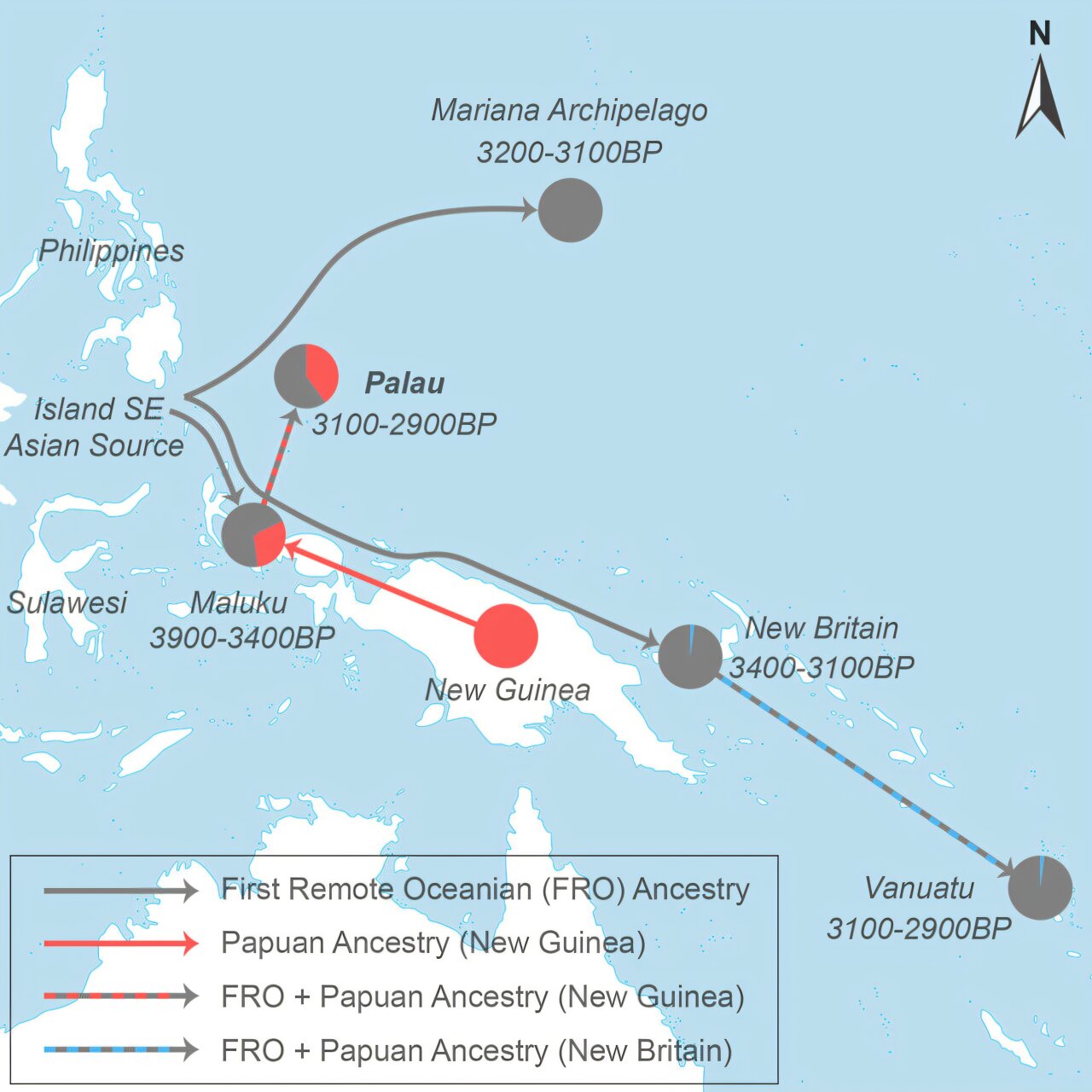
The results were startling. The first settlers of Palau were not the “pure” East Asian explorers that history books had imagined. Instead, the study revealed that the very first people to step onto Palauan shores were already a mixed population. Their genetic makeup was a roughly 60/40 split, with the majority coming from East Asian ancestry and approximately 40% originating from Papuan ancestry.
Most significantly, this mixing didn’t happen on the islands of Palau. The genetic clock indicated that this blending occurred around 4,000 years ago—long before these sailors ever reached the remote western Pacific. This means that by the time these explorers launched their canoes toward Palau, they were already the descendants of a long-standing cultural and biological exchange. They weren’t just passing through the region of New Guinea and Indonesia; they were a product of it.
The Great Stability of the West
As the researchers looked further down the timeline, they discovered something even more unusual. Typically, island populations are subject to waves of new migrations, leading to constant shifts in their genetic makeup as new groups arrive and intermarry. However, in Palau, the specific genetic blend identified in the earliest settlers persisted for nearly 3,000 years.
This represents the longest recorded period of a population remaining genetically unchanged in all of remote Oceania. For three millennia, the people of Palau maintained a stable ancestral signature, suggesting a highly successful and self-sustaining society that remained remarkably consistent despite the vast distances of the Pacific. This discovery refutes the idea of a simple, direct migration from Taiwan through the Philippines. Instead, it points to a “complex pattern” of movement, likely winding through eastern Indonesia and involving deep, long-term interactions between ancient Papuan and East Asian groups.
Why These Ancient Voyagers Matter
This research is more than just a correction of a historical map; it is a fundamental shift in how we understand human connection and resilience. By proving that the first inhabitants of remote Oceania were a blended people, the study highlights that the “expansion” into the Pacific was not a solitary journey of one group, but a collaborative legacy born of diverse cultures meeting and merging.
It reminds us that the boundaries we draw on maps today—between East Asia, Indonesia, and Melanesia—were fluid and porous to our ancestors. The stability of the Palauan genome over 3,000 years also demonstrates the incredible success of these early societies in establishing a lasting way of life in one of the world’s most challenging environments. Ultimately, this work honors the complexity of the human spirit, showing that our greatest leaps into the unknown have often been taken together, as a tapestry of different origins woven into a single, enduring story.
Study Details
Yue-Chen Liu et al, Papuan admixture predated the settlement of Palau, Cell (2026). DOI: 10.1016/j.cell.2026.02.011