The universe we see is only a tiny fraction of the reality we inhabit. When we look at the night sky, every shimmering star, every swirling nebula, and every distant galaxy represents a mere sliver of the cosmos—specifically, only about 4% of everything that exists. The rest is a silent, invisible vastness composed of dark energy and dark matter. While we know dark matter makes up roughly 23% of the universe and acts as the invisible glue forming the largest structures in existence, the identity of its particles remains one of the greatest mysteries in physics. Now, a new study led by Professor Joachim Kopp from Johannes Gutenberg University Mainz and Dr. Azadeh Maleknejad from Swansea University suggests that the answer to where this invisible world came from might lie in the ancient, rhythmic ripples of spacetime itself.
The Secret Echoes of a Young Universe
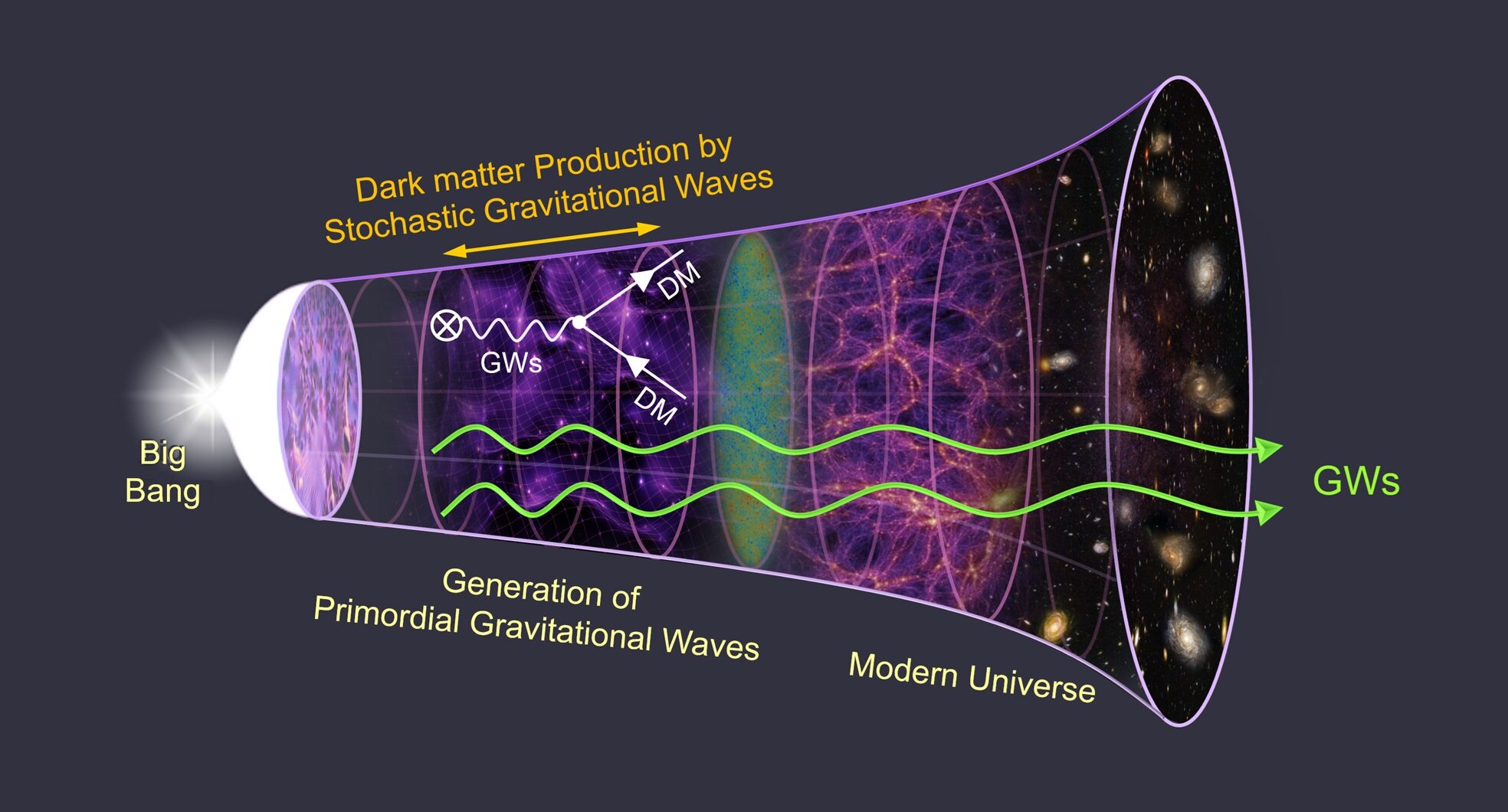
In the immediate aftermath of the Big Bang, the universe was a chaotic, high-energy soup. Today, we often think of gravitational waves as the dramatic echoes of massive collisions, such as when two black holes or neutron stars merge in a violent dance. However, there is another, more subtle kind of ripple known as stochastic gravitational waves. These are not the result of singular, massive objects crashing together; instead, they are a form of background noise—a cosmic hum that has permeated the universe since its earliest moments.
These waves are incredibly old, originating from phenomena that occurred as the universe began to cool. During this cooling process, the cosmos underwent phase transitions of matter, similar to how steam condenses into water. Other sources for this background noise include primordial magnetic fields that flickered into existence at the dawn of time. According to the research published in Physical Review Letters, these ubiquitous waves may have played a much more active role in building the universe than simply being passive echoes of the past.
From Ripples to Reality
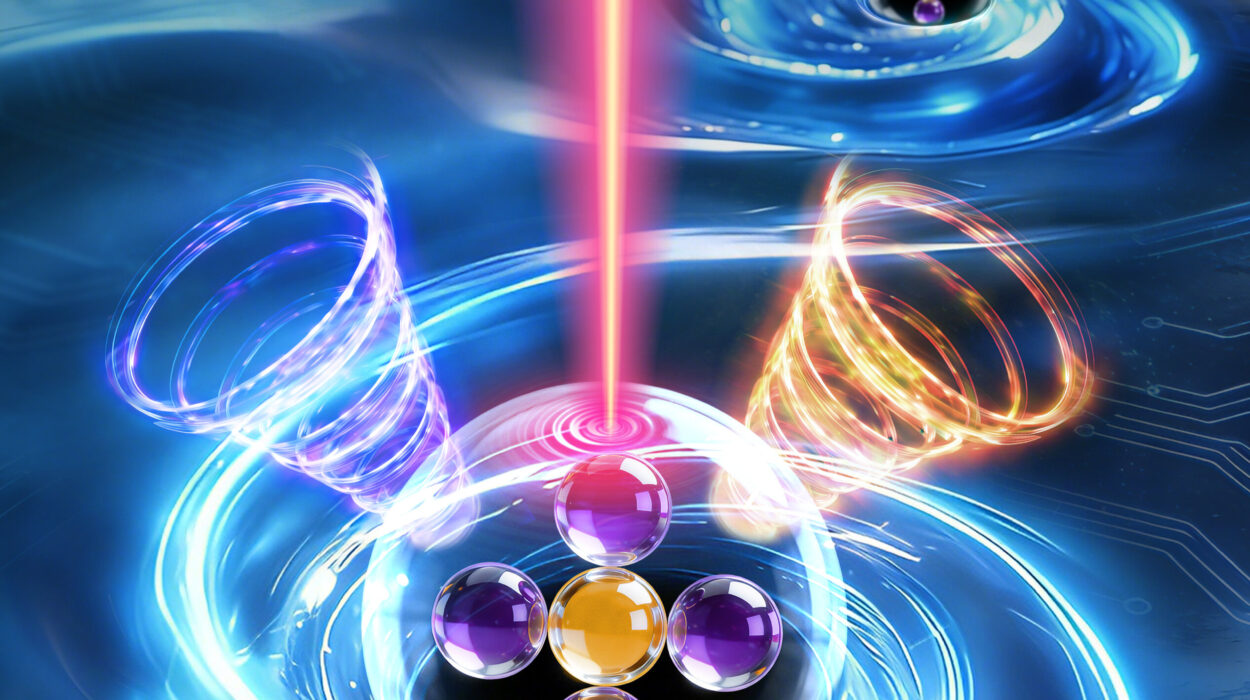
The core of the discovery lies in a previously unresearched mechanism of particle production. Professor Kopp and his team investigated the possibility that these early gravitational waves were partially converted into physical particles. Their calculations show that the energy carried by these spacetime ripples could have triggered the formation of fermions. This family of particles is familiar to us—it includes the electrons, protons, and neutrons that make up our bodies—but the fermions produced by these ancient waves were different.
Initially, these particles were mass-free or nearly mass-free. They existed as ghostly precursors in the high-energy environment of the early universe. As the cosmos evolved and conditions shifted, these weightless fermions began to acquire mass. This transformation effectively turned a ripple in the fabric of space into the solid, enduring dark matter particles that still exist today. It is a process that suggests matter didn’t just appear; it was forged from the very vibrations of the young universe.
Mapping the Invisible Architecture
If this theory holds, it changes how we view the “invisible” side of our world. We have long known through astrophysical observations that dark matter is everywhere, forming the scaffolding upon which galaxies are built. Without it, the stars would fly apart, and the complex structures of the cosmos would never have stabilized. Yet, despite its importance, dark matter has remained a phantom, refusing to interact with light or ordinary matter in ways we can easily detect.
By identifying stochastic gravitational waves as a potential source, researchers are providing a new map to locate these missing particles. The study suggests that dark matter is not an alien substance that exists apart from the laws of physics we understand, but rather a direct descendant of the same fundamental forces that shaped spacetime. The transition from a weightless fermion to a massive dark matter particle represents a bridge between the era of pure energy and the era of structured matter.
The Unbalanced Scales of Existence
The implications of this research extend beyond the origin of dark matter. Professor Kopp suggests that the influence of gravitational waves in the early universe might solve other profound headaches in particle physics. One such mystery is the matter-antimatter asymmetry—the fact that the universe contains significantly more matter than antimatter. Usually, when energy turns into matter, it produces equal parts of both, which should have led to total annihilation. The fact that we exist at all proves there is a difference in the production of particles and antiparticles, and this new research pathway might finally explain why the scales tipped in favor of the world we see.
The team’s next steps involve moving from analytical estimates to complex numerical calculations. By refining these predictions, they hope to create a high-accuracy model of how these waves behaved. They are also looking to investigate other potential effects these waves had during the universe’s formative seconds, seeking to uncover a more complete picture of our cosmic origins.
Why This Discovery Changes Everything
This research matters because it offers a potential solution to the “missing mass” problem that has haunted science for decades. By demonstrating a novel mechanism for dark matter production, it provides a concrete link between the geometry of the universe and the particles that inhabit it. If gravitational waves are indeed the “parents” of dark matter, then every galaxy in the sky is a testament to the power of those first primordial ripples.
Understanding the origin of dark matter is not just an academic exercise; it is the key to understanding the past and future of the entire cosmos. By peeling back the layers of the early universe, scientists are learning how the invisible 23% of our world came to be, moving us one step closer to solving the ultimate puzzle of why there is something rather than nothing.
Study Details
Azadeh Maleknejad et al, Gravitational-Wave Induced Freeze-In of Fermionic Dark Matter, Physical Review Letters (2026). DOI: 10.1103/lr69-45v8