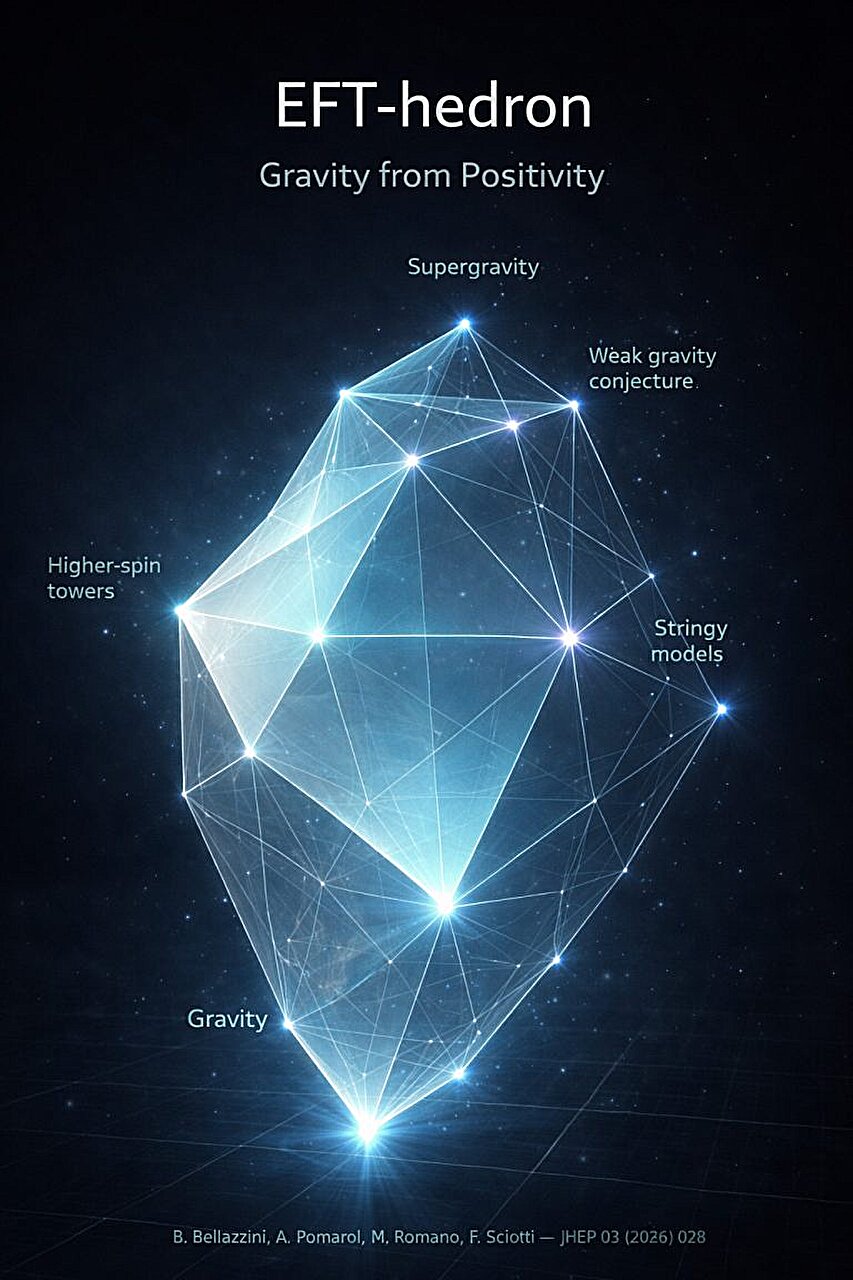
The quest for a “Theory of Everything” usually begins with a grocery list of ingredients: a dash of electromagnetism, a pinch of nuclear forces, and the heavy, difficult-to-blend addition of gravity. For decades, physicists have treated these as separate components that must be carefully stitched together. However, a groundbreaking study by researchers at IPhT and the Universitat Autònoma de Barcelona has turned this recipe on its head. Instead of adding gravity to the mix, they discovered that if you start with one specific, tiny building block, the universe effectively demands that gravity exists just to keep the laws of logic from breaking apart.
The Lonely Particle That Could Not Be
The story begins with a mathematical protagonist known as a massive spin-3/2 particle. In the bestiary of subatomic physics, particles carry a property called spin, which dictates how they interact with the world. Most of the matter we touch is made of spin-1/2 particles, while the forces that hold them together are carried by spin-1 particles. A spin-3/2 particle, often referred to in theoretical circles as a gravitino, is a more exotic creature. It is the hypothesized “superpartner” of the graviton, but in this research, the scientists didn’t assume it had any friends at all. They simply asked: what happens if a single, heavy version of this particle exists in our reality?
When the researchers looked at the math of how these particles would crash into one another—a calculation known as scattering amplitudes—they found a catastrophic problem. As the energy of these collisions increases, the math begins to spiral out of control. Specifically, the amplitudes grow too fast. This isn’t just a technical glitch; it is a sign that the particle is fundamentally “illegal” according to the two most sacred laws of physics: causality and unitarity.
The Guardians of Cosmic Logic
To understand why the particle failed, we have to look at the rules it broke. The first, causality, is the cosmic speed limit. It dictates that no signal or influence can travel faster than the speed of light. If a theory allows information to leak outside what physicists call the light cone, the very fabric of cause and effect unravels. The second rule, unitarity, is the law of probability conservation. In any quantum process, the sum of all possible outcomes must equal exactly 100%. You cannot have a 110% chance of a particle appearing after a collision.
The researchers used positivity inequalities—a sophisticated way of translating these deep philosophical rules into rigid mathematical constraints. They found that a solitary massive spin-3/2 particle creates a “positivity violation” almost immediately. The theory literally breaks down at an energy level barely higher than the mass of the particle itself. It is as if the universe looks at this lone particle and says, “This cannot be.” The particle’s internal logic is so volatile that it threatens to allow effects to precede causes or probabilities to exceed reality.
No Room for Substitutes
Faced with a breaking theory, a physicist’s first instinct is to try to fix it by adding “buffer” particles. Perhaps a few scalars (like the Higgs boson) or some vector bosons (like the particles that carry light) could act as stabilizers, absorbing the excess energy and balancing the scales. The research team meticulously tested these additions, trying to see if they could counteract the mathematical instability of the spin-3/2 particle.
The results were startlingly consistent: every attempt failed. No matter what combination of standard particles they introduced, the contributions to the math always carried the “wrong sign.” Instead of fixing the problem, these particles often made the violation of causality even worse. The researchers were backed into a corner by their own equations. It became clear that the massive spin-3/2 particle could not exist in a vacuum; it required a very specific, very powerful partner to act as a mathematical anchor.
Gravity Enters the Stage
There was only one “escape hatch” left in the mathematics: the graviton. The graviton is the theoretical particle that carries the force of gravity. When the researchers introduced the graviton into their equations, the chaos finally settled. But the graviton couldn’t just be “invited” to the party in any old way. The strict demands of unitarity and causality fixed its interactions with the spin-3/2 particle uniquely.
As the researchers watched the math unfold, something incredible happened. They didn’t have to program the rules of supergravity—a complex theory that marries gravity with supersymmetry—into their model. Instead, the structure of supergravity “bootstrapped” itself into existence. By simply trying to make a spin-3/2 particle logically possible, the equations reconstructed the entire framework of one of the most sophisticated theories in modern physics. Gravity was no longer an optional ingredient; it was a logical necessity.
The Birth of Symmetry from Necessity
This discovery changes how we view supersymmetry, a concept that suggests every known particle has a “super” twin. Usually, physicists treat supersymmetry as a postulate—a “what if” scenario that they hope is true. But this study suggests it is a requirement. If a massive spin-3/2 particle exists, then supersymmetry must also exist to prevent the universe from becoming an illogical mess.
This chain reaction of logic even revealed the secret connections between the most fundamental scales of nature. The math automatically produced the famous relationships between the gravitino mass, the Planck mass (the scale where gravity becomes incredibly strong), and the supersymmetry-breaking scale. These aren’t just random numbers; they are tied together by the simple demand that effects stay within the light cone and probabilities stay positive.
The Electric Connection and the Swampland
The researchers didn’t stop at gravity. They decided to see what happened if their spin-3/2 particle also carried an electric charge. The results were just as rigid. To remain consistent with the laws of the universe, the charge had to be “gauged,” meaning it had to be part of a fundamental force field. Furthermore, the math dictated a very specific gyromagnetic factor of g = 2, a value that aligns perfectly with how real fundamental particles behave.
Perhaps most significantly, this work provides a bridge to the Swampland program. This is a major initiative in physics aimed at distinguishing “good” theories that can coexist with gravity from “bad” theories that look okay on paper but are actually impossible. The study’s results “saturated” the Weak Gravity Conjecture, a famous idea in the Swampland program which suggests that gravity must always be the weakest force. What was once a complex conjecture now appears as a simple consequence of the fact that the universe must be causal and consistent.
Why This Scientific Journey Matters
This research is a profound shift in how we understand the architecture of reality. For a long time, we wondered why the universe has the specific forces and particles it does. We wondered if gravity was just a happy accident or a fundamental truth. This study tells us that the ingredients of our universe are not a random collection; they are a tightly woven web where one thread cannot exist without the others.
By showing that gravity and supersymmetry emerge naturally from the basic requirements of causality and unitarity, scientists have found a new way to “predict” the existence of gravity itself. It suggests that if we ever find a massive spin-3/2 particle in a laboratory or out in the cosmos, we will have definitive proof that gravity and the complex symmetries associated with it are not just additions to the world—they are the very things that keep the world logical. We are learning that the universe isn’t just a place where things happen; it is a system that must follow its own rules of consistency, and gravity is the ultimate enforcer of those rules.
Study Details
Brando Bellazzini et al, (Super) gravity from positivity, Journal of High Energy Physics (2026). DOI: 10.1007/jhep03(2026)028