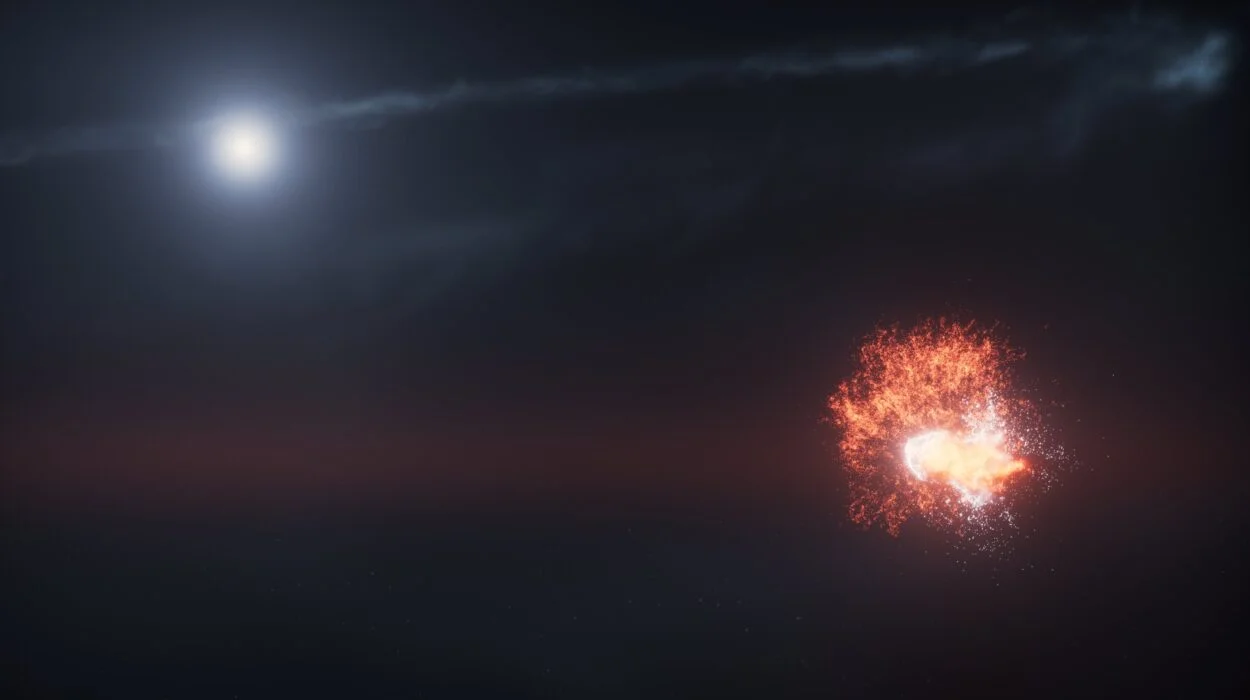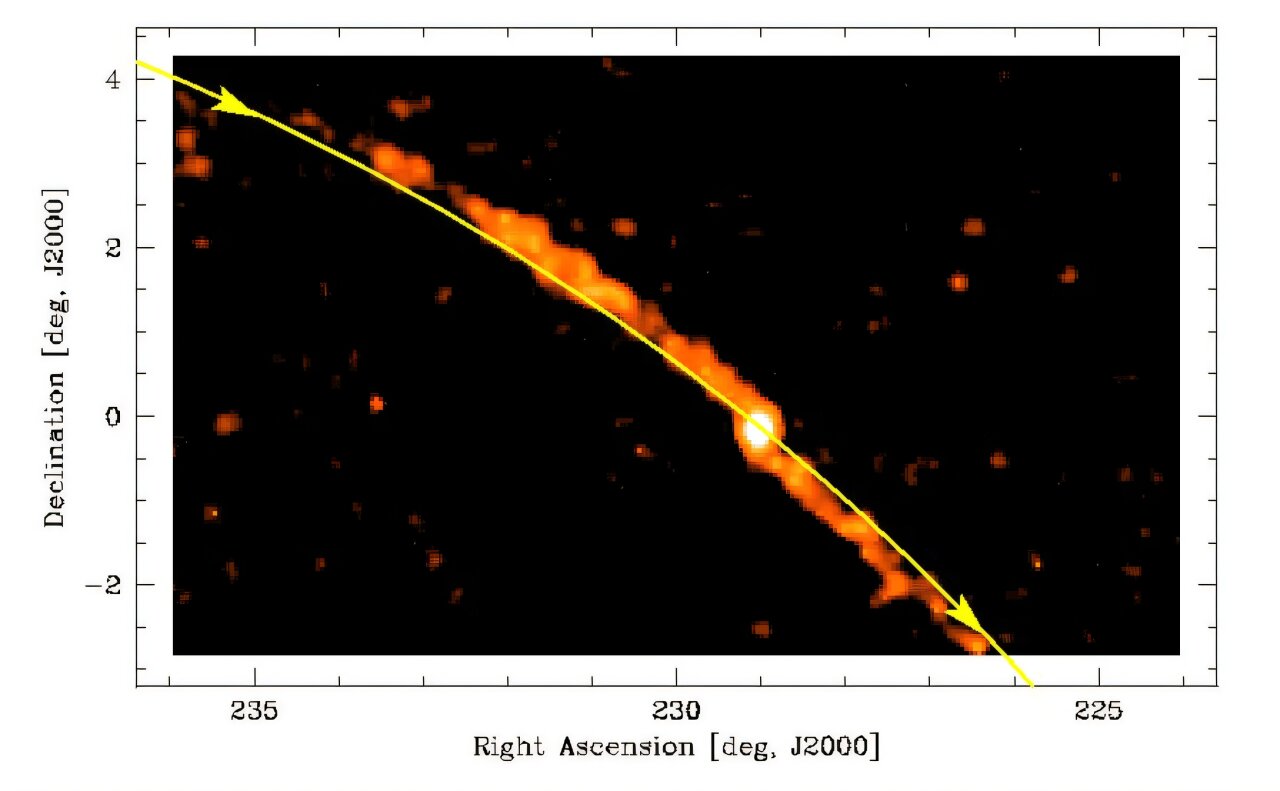
Imagine the Milky Way as a grand, swirling metropolis of light, a city of hundreds of billions of stars. In this vast urban sprawl of the cosmos, it is easy to lose track of the smaller neighborhoods—the dwarf galaxies and globular clusters that orbit our galaxy like tiny satellites. For eons, these small congregations of stars have been dancing around the Milky Way, but the dance is a perilous one. The immense gravitational energy of our galaxy acts like a silent predator, slowly plucking stars away from these smaller groups and scattering them into long, thin trails known as stellar streams.
Until recently, these cosmic breadcrumbs were incredibly difficult to find. They are the ghosts of the galaxy’s history, thin ribbons of light that often mark the path of a cluster that has already “petered out” of existence. However, a groundbreaking discovery by astronomers at the University of Michigan has suddenly illuminated dozens of these hidden pathways, offering a new map to the secrets of our celestial home.
The Trail of Sand in the Galactic Wind
To understand what a stellar stream actually is, one might imagine a cyclist pedaling through a park with a bag of sand strapped to the back of the bike. If that bag has a small hole in it, a thin, continuous line of sand will be left behind on the pavement, marking exactly where the cyclist has been. In this analogy, the globular clusters are the bags of sand, and the stars they lose are the individual grains.
The “hole” in the bag is created by tidal interplay. As a small cluster of stars orbits the massive Milky Way, the larger galaxy’s gravity pulls more strongly on the stars on one side of the cluster than the other. This tension stretches the cluster until stars begin to leak out, falling into their own orbits but following the same general trajectory as their parent group. These resulting stellar streams are more than just pretty trails; they are high-fidelity records of gravity. Because their shapes and sizes are dictated by the environment they move through, they reveal how the mass of the Milky Way is distributed, including the invisible, mysterious presence of dark matter.
A New Eye for the Invisible
For decades, finding these streams was largely a matter of luck. Astronomers would stumble upon them by accident while looking at images from missions like the European Space Agency’s Gaia spacecraft. Because these streams are so faint and sparse compared to the dense background of the Milky Way’s spiral arms, they were easily missed. Before this new research, the scientific community knew of fewer than 20 streams originating from still-extant globular clusters—those rare clusters that are currently in the process of being torn apart but haven’t disappeared yet.
Yingtian “Bill” Chen, a doctoral student in astronomy, decided that luck was no longer enough. He developed a systematic approach to the hunt, moving away from serendipity and toward a rigorous physical model. By creating a theoretical expectation of what a stream should look like based on physics, Chen and his team gave their computers a “search image” to follow.
They created an algorithm called StarStream, designed specifically to sift through the mountain of data provided by Gaia. Between 2014 and 2025, Gaia observed billions of stars, providing a treasure trove of information that was simply too vast for human eyes to scan effectively. By applying the StarStream algorithm to this data, the team more than quadrupled the number of known candidates, leaping from a handful of streams to a staggering 87 potential new trails.
The Next Generation of Cosmic Detectives
While the discovery of these 87 candidates is a monumental leap forward, the work is far from over. Science is a process of refinement, and the team acknowledges that not every candidate will turn out to be a true stellar stream. Some may simply be background contamination—random alignments of stars that look like a stream from our perspective but are actually unrelated.
“Of these 87 candidates, we have relatively low confidence in some of them,” Chen noted, pointing out that while Gaia was a revolutionary tool, it is now considered “relatively old” in the fast-moving world of astronomical technology. To confirm these findings, the team is looking toward a new fleet of “cosmic detectives” currently coming online.
The Dark Energy Spectroscopic Instrument, or DESI, began its survey in 2021, and the Vera Rubin Observatory started collecting data just last summer. Looking slightly further ahead, NASA’s Roman Space Telescope (also known as the Nancy Grace Space Telescope) is scheduled to launch in 2027. These more powerful tools will allow astronomers to zoom in on the candidates identified by the Michigan team, verifying which ones are genuine signatures of our galaxy’s past.
Why the Hunt for Ghostly Trails Matters
You might wonder why astronomers are so invested in tracking down these thin, fading ribbons of stars. The answer lies in the invisible architecture of the universe. We know the Milky Way is far heavier than the visible stars and gas would suggest, a discrepancy accounted for by dark matter. Because we cannot see dark matter directly, we must study its “shadow”—the way its gravity affects the things we can see.
Stellar streams are the perfect sensors for this. Because they are so thin and delicate, they are incredibly sensitive to the gravitational pull of anything they pass near. If a clump of dark matter is lurking in a particular part of the galaxy, it will tug on the stream, leaving a “kink” or a gap in the trail of stars. By mapping these 87 candidates, astronomers are essentially creating 87 different probes to test the gravitational field of the Milky Way.
This research isn’t just about finding new stars; it is about reconstructing the life story of our galaxy. Each stream tells a tale of a globular cluster or dwarf galaxy that was swallowed or dismantled by the Milky Way. By studying these remnants, we can understand how our galactic home grew to its current size and how the invisible hand of dark matter continues to shape its future. The algorithm-driven approach of the Michigan team has opened a new door, ensuring that as our telescopes get better, our ability to read the history written in the stars will grow alongside them.
Study Details
Yingtian Chen et al, StarStream on Gaia: Stream Discovery and Mass-loss Rate of Globular Clusters, The Astrophysical Journal Supplement Series (2026). DOI: 10.3847/1538-4365/ae471f