Far beyond the glow of our night sky, about 52,200 light years from Earth in the constellation Boötes, a dim and ancient star cluster drifts through the Milky Way. It is called NGC 5466, and at first glance, it might seem like just another faint gathering of stars. But this cluster carries a secret — a long, fragile thread of stars stretching out into space, like a memory unraveling in slow motion.
Recently, astronomers from the National Astronomical Observatory of Japan (NAOJ) and their collaborators turned the powerful Subaru Telescope toward this distant object. What they found, published on February 4 on the arXiv preprint server, reveals new details about the cluster’s mysterious tidal stream — and about the invisible forces shaping its fate.
The Ghostly Trails Left Behind
In the grand ballet of galaxies, nothing stands completely still. Smaller systems such as globular clusters and satellite galaxies orbit massive hosts like the Milky Way. Over time, gravity pulls and stretches them. Stars are gently but relentlessly torn away, forming long, thin rivers of light known as stellar tidal streams.
These streams are more than debris. They are cosmic archives. Even after billions of years, they can preserve traces of their origins — their chemical fingerprints and the memory of how they once moved through space.
NGC 5466 is one of the clearest examples of this phenomenon. Discovered in 1784, the cluster is vast yet faint, with a tidal radius of 238 light years and a mass of about 179,000 solar masses. It is also incredibly old — roughly 12 billion years in age. Long before Earth formed, this cluster was already shining.
But what truly set NGC 5466 apart came in 2006, when astronomers discovered it hosts a remarkably long, massive, and thin stellar stream. This discovery placed it among the earliest and clearest known cases of a globular cluster tidal stream. And yet, despite nearly two decades of awareness, much about its structure remained uncertain.
Its shape was poorly constrained. Its properties were elusive. The stream was visible — but not fully understood.
Turning a Sharper Eye to the Stars
Curiosity drove a team led by Itsuki Ogami of NAOJ to look again. They turned to the Hyper Suprime-Cam (HSC) mounted on the Subaru Telescope, a powerful instrument capable of capturing extraordinarily deep images of the sky.
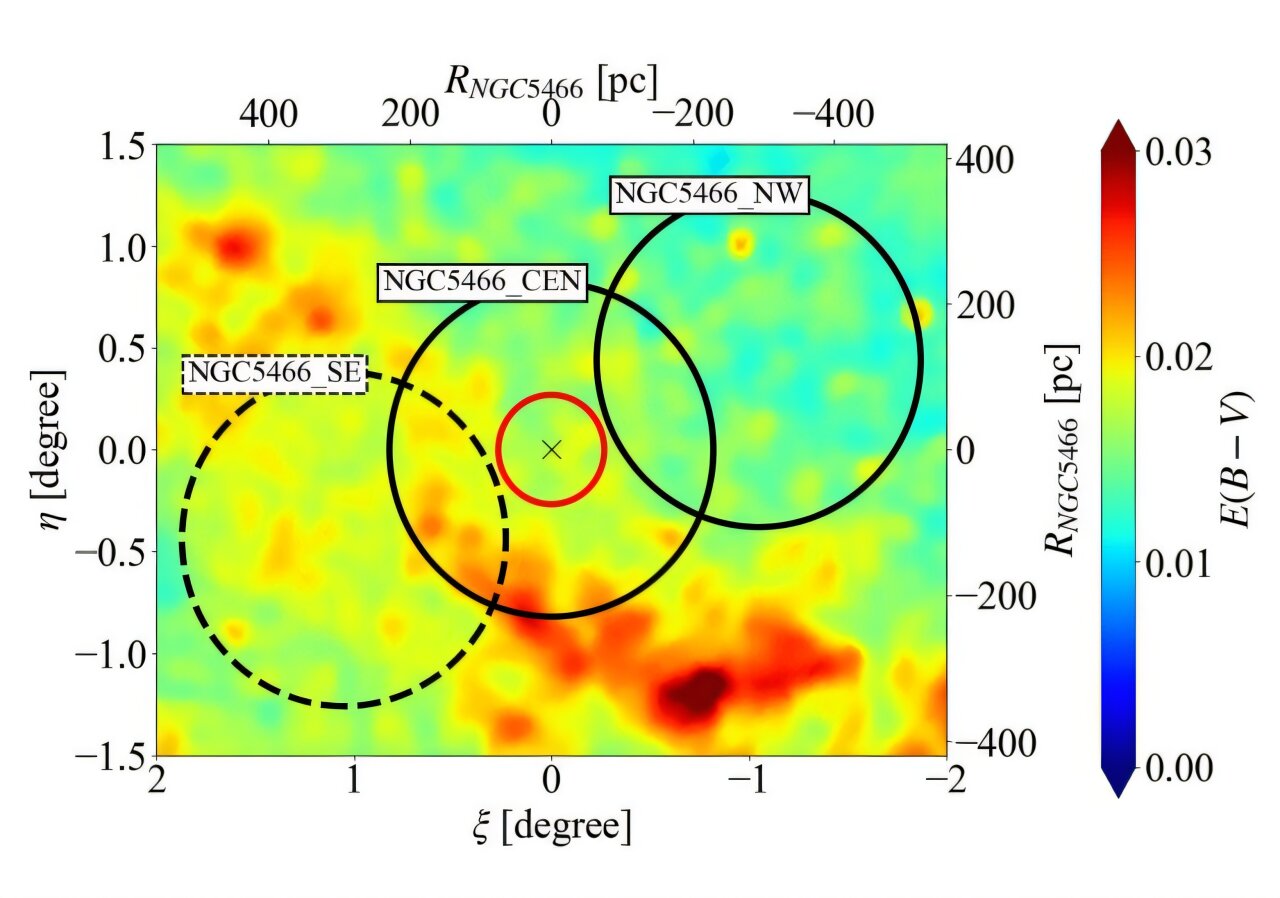
Using the NB395 filter, the team performed deep imaging observations that reached 1–2 magnitudes fainter than previous CaHK surveys. Their observations extended out to a projected distance of 400 parsecs from the cluster’s center, carefully tracing the stellar stream farther than before.
This was not just another glance. It was a deeper dive into the faint edges of the cluster’s structure — into regions where stars are barely detectable, where gravity’s quiet fingerprints become visible.
And what emerged was surprising.
An Ellipse in the Darkness
The new observations revealed that NGC 5466 exhibits an elliptical morphology. Rather than appearing perfectly round and serene, the cluster shows tidal distortions extending out from both sides. It is being stretched.
By analyzing the surface density distribution of stars belonging to the cluster, the astronomers uncovered something even more intriguing — a local decrease in stellar density along the stream. In simpler terms, there is a gap in the flow of stars.
This gap lies about 650 light years from the cluster’s center.
Imagine a river of stars flowing outward — and then, unexpectedly, thinning into a hollowed stretch before continuing again. The stream is not uniform. It has been interrupted.
A Gap Carved by Motion
What could have created such a break?
According to the researchers, this gap can be reproduced by considering the orbital evolution of NGC 5466 alone. In other words, no external intruder is required to explain it. The cluster’s own journey through the Milky Way may have sculpted this feature.
The team suggests that a recent pericentric passage, when the cluster moved closest to the Galactic center, and a possible crossing of the Galactic disk, could have contributed to the formation of the observed gap. One or both of these gravitational encounters may have shaken the cluster enough to disturb the smoothness of its tidal stream.
It is a reminder that motion through a galaxy is not gentle. Each orbit brings changing gravitational tides. Each close approach leaves a mark.
NGC 5466 is not merely drifting — it is interacting, responding, reshaping.
The Quiet Exodus of Lightweights
The study revealed another subtle but important pattern. The astronomers examined the mass function profile of stars along the stream. They compared stars distributed along the stream’s major axis — the direction of stretching — with those along the minor axis, perpendicular to it.
They found that beyond the cluster’s tidal radius, the mass function slope along the stream direction is flatter than perpendicular to it.
This detail carries a story of internal dynamics. Within globular clusters, stars do not remain evenly mixed forever. Through processes known as internal relaxation and mass segregation, lighter stars gradually migrate outward toward larger radii.
Once there, they become vulnerable.
The study indicates that these low-mass stars have been preferentially removed by tidal stripping. In other words, the galaxy’s gravitational pull is more effective at peeling away the lighter stars that have drifted to the outskirts.
Over time, the cluster loses its lightest members first.
This quiet exodus reshapes both the cluster and its stream. The structure we see today is not random; it reflects a history of internal evolution and external gravitational stress.
A Telescope That Sees the Invisible
Beyond the astrophysical findings, the study also highlights the remarkable capability of the Hyper Suprime-Cam and the NB395 photometric technique.
The researchers emphasize that HSC/NB395 photometry is powerful for identifying metal-poor populations and deriving photometric metallicities. This ability is crucial for studying ancient stellar systems like NGC 5466, whose stars formed in the early universe and often contain fewer heavy elements.
By capturing faint stars and distinguishing subtle chemical signatures, HSC opens the door to future wide-field surveys that can map similar structures across the sky.
In essence, the telescope is not just observing — it is revealing populations that would otherwise remain hidden in the darkness.
Why This Matters
At first glance, a faint cluster tens of thousands of light years away might seem distant from everyday concerns. But studies like this reshape how we understand the Milky Way itself.
Stellar tidal streams are natural tracers of galactic gravity. They preserve the memory of where they came from and how they moved. By studying their shape, density, and composition, astronomers can reconstruct the past orbits and interactions of star clusters.
The discovery of an intrinsic gap in the stream of NGC 5466 shows that even subtle structural features can carry clues about a cluster’s orbital history. The finding that low-mass stars are preferentially stripped reveals how internal cluster evolution interacts with galactic tides. Together, these insights refine our understanding of how globular clusters gradually dissolve into the galaxy.
NGC 5466 is not static. It is slowly being pulled apart. Its stars are dispersing, becoming part of the Milky Way’s broader stellar halo. By capturing this process in detail, astronomers are witnessing a transformation billions of years in the making.
And perhaps most importantly, this work demonstrates the power of modern instruments like Subaru’s Hyper Suprime-Cam to probe faint and ancient structures with unprecedented depth. Each improvement in sensitivity allows us to read more clearly the gravitational handwriting written across the sky.
In the delicate arc of NGC 5466’s tidal stream, in its elliptical distortion, and in the quiet gap carved 650 light years from its center, we see a story of motion, memory, and cosmic erosion. It is a reminder that even the oldest star clusters are not eternal monuments. They are living systems, shaped by time and gravity.
And by studying them, we learn not just about a single cluster in Boötes, but about the restless, evolving galaxy we call home.
Study Details
Itsuki Ogami et al, Subaru/HSC NB395 view of NGC 5466: metallicity, mass function, and the nature of its tidal stream, arXiv (2026). DOI: 10.48550/arxiv.2602.03014