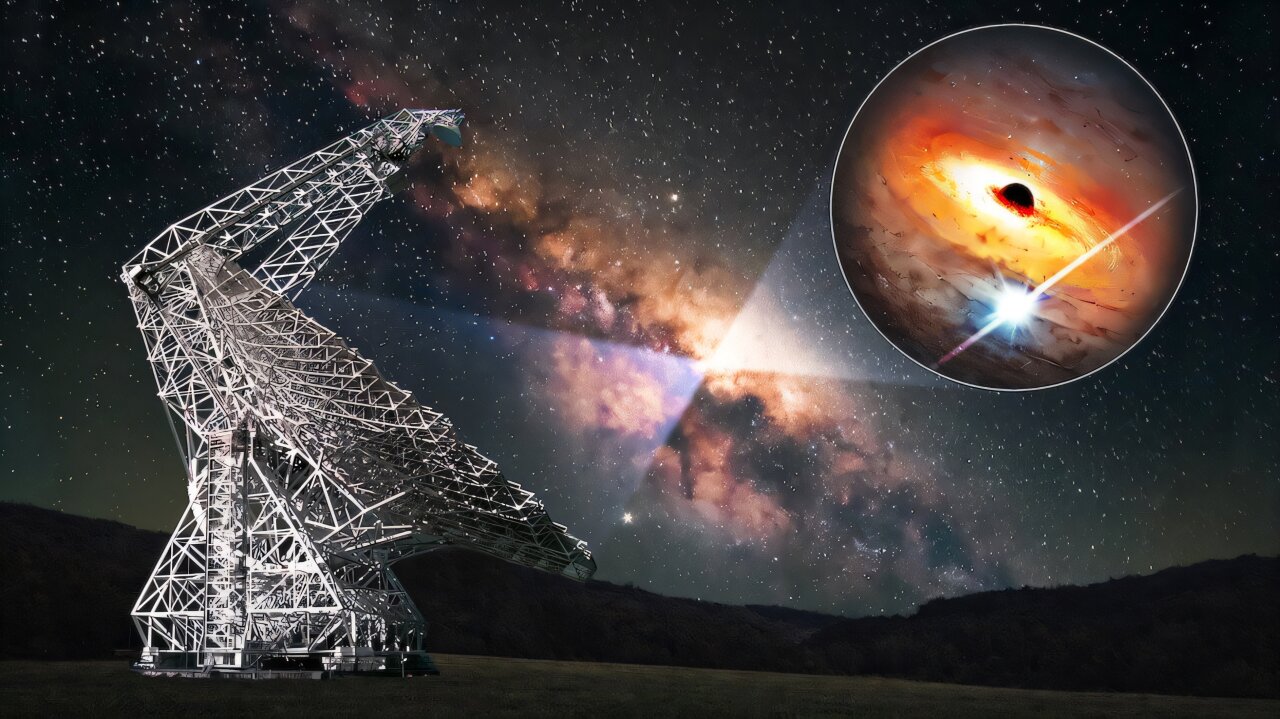
At the very center of our galaxy, in a region so crowded and chaotic that even light struggles to move cleanly through it, something has begun to whisper.
Researchers from Columbia University and Breakthrough Listen, a scientific program dedicated to searching for evidence of civilizations beyond Earth, have been listening carefully to the sky. Their tool is not a spacecraft or a probe, but something quieter and more patient: a deep and extraordinarily sensitive radio survey of the Galactic Center.
Now, from that dense and turbulent region surrounding our galaxy’s core, they have reported an intriguing discovery. Buried in the data of what is described as one of the most sensitive radio searches ever conducted in this part of the Milky Way, they have identified a potential 8.19-millisecond pulsar candidate.
It is not just any candidate. It appears to sit near Sagittarius A* — the supermassive black hole that anchors our galaxy.
The findings, led by recent Columbia Ph.D. graduate Karen I. Perez, have been published in The Astrophysical Journal. But beyond the formal paper lies something far more gripping: the possibility of using a spinning star as a precision tool to test the fabric of space and time itself.
The Cosmic Lighthouses That Keep Perfect Time
To understand why this signal matters, we have to understand what a pulsar is.
Pulsars are rapidly spinning, highly magnetized neutron stars. These are dense remnants of once-massive stars, compact objects that emit beams of radio waves from their magnetic poles. As they spin, these beams sweep across space. When one of those beams crosses Earth, our telescopes detect a pulse. Then another. And another.
To us, they appear like cosmic lighthouses.
In the absence of outside interference, the pulses from a pulsar arrive with astonishing regularity. Their timing is so steady that astronomers often compare them to incredibly accurate clocks. Each pulse arrives when it should. No surprises. No drift.
Some pulsars rotate especially fast. These are known as millisecond pulsars, spinning hundreds of times per second. Because of this rapid rotation, they display extraordinarily stable, clock-like behavior. Their predictability makes them not just astronomical curiosities, but precision instruments scattered across the galaxy.
And the candidate discovered in this new survey? It spins once every 8.19 milliseconds.
That means it rotates more than a hundred times every second.
A Black Hole’s Invisible Grip
On its own, a millisecond pulsar is remarkable. But this one may be located near Sagittarius A* — the black hole at the center of the Milky Way.
Sagittarius A* is no ordinary black hole. It contains a mass roughly 4 million times that of our Sun. That immense mass creates an extraordinary gravitational influence on everything nearby. Space and time themselves bend in response.
And this is where the story becomes even more compelling.
According to Einstein’s General Theory of Relativity, massive objects warp the fabric of space-time. The stronger the gravity, the more dramatic the distortion. A supermassive black hole represents one of the most extreme laboratories for testing these ideas.
If a pulsar is orbiting near Sagittarius A*, its pulses would not arrive at Earth in perfectly steady intervals anymore. Instead, subtle irregularities would begin to appear.
As Slavko Bogdanov, a research scientist at the Columbia Astrophysics Laboratory and co-author of the study, explains, any external influence on a pulsar — such as the gravitational pull of a massive object — would introduce measurable anomalies in the arrival times of its pulses. These variations can be carefully modeled and studied.
Even more intriguingly, when the pulses travel near a very massive object, they may be deflected and delayed due to the warping of space-time itself.
Imagine a perfectly ticking clock carried close to an immense gravitational well. The ticking would subtly shift. Not because the clock is broken, but because space and time are behaving differently.
A pulsar near Sagittarius A* could act as precisely such a clock.
Listening in One of the Galaxy’s Noisiest Neighborhoods
The central region of the Milky Way is not a quiet place. It is dynamically complex, crowded with stars, gas, dust, and extreme gravitational forces. Detecting faint radio signals there is extraordinarily challenging.
That is why the Breakthrough Listen Galactic Center Survey stands out. It represents one of the most sensitive radio searches ever conducted in this region. The effort was not casual. It was deliberate, patient, and technologically refined.
Breakthrough Listen is widely known for searching for signs of intelligent civilizations beyond Earth. Yet its instruments and techniques also enable powerful explorations of astrophysical phenomena. In this case, their search for signals has revealed something perhaps just as profound: a possible new tool for probing gravity at its most extreme.
Within that sea of data, the 8.19-millisecond pulsar candidate emerged.
It is important to emphasize the word candidate. Detection is only the beginning. Confirmation requires careful follow-up observations, further analysis, and repeated measurements. Scientists must ensure that the signal truly originates from a pulsar and that it indeed lies near Sagittarius A*.
What Happens If It’s Confirmed?
If follow-up observations confirm the candidate as a millisecond pulsar in close proximity to Sagittarius A*, the implications would be extraordinary.
Such a system would enable unprecedented tests of General Relativity. By precisely measuring the arrival times of the pulsar’s radio pulses, astronomers could map how space-time behaves in the intense gravitational field of a supermassive black hole.
They could measure deflections, delays, and other subtle effects predicted by Einstein’s theory. These would not be indirect hints or distant approximations. They would be precision measurements, drawn from the steady ticking of a cosmic clock orbiting one of the most extreme objects in our galaxy.
Karen I. Perez expressed anticipation about what lies ahead. Follow-up observations are already underway. The scientific community is waiting to see whether this candidate withstands scrutiny.
If it does, it could deepen our understanding of both the structure of our galaxy and the nature of gravity itself.
Opening the Data to the World
In a move designed to maximize scientific impact, Breakthrough Listen is releasing the observations publicly. This decision allows researchers worldwide to conduct independent analyses and pursue complementary science cases.
Rather than keeping the discovery confined to one team, the data are being shared openly. That openness transforms the discovery from a single research effort into a global scientific opportunity.
Astronomers around the world can now examine the signal, test its validity, explore its properties, and perhaps uncover even more hidden within the same dataset.
The Galactic Center has long been a region of mystery. By opening the data, the researchers are inviting the broader scientific community to help decode it.
Why This Discovery Matters
At first glance, a faint radio signal repeating every 8.19 milliseconds may not sound dramatic. But in astronomy, timing is everything.
A confirmed millisecond pulsar near Sagittarius A* would be far more than a new point on a star map. It would be a precision instrument placed by nature in exactly the right location to probe one of the most extreme gravitational environments known.
Because pulsars are such stable clocks, even tiny disturbances in their timing can reveal powerful truths. In the presence of a supermassive black hole, those disturbances become a window into the behavior of space-time itself.
This research matters because it bridges observation and theory. It brings Einstein’s equations out of textbooks and into the sky. It transforms abstract curvature of space-time into measurable delays and deflections. It connects the center of our galaxy to fundamental physics.
It also demonstrates the power of deep, sensitive listening. A program initially designed to search for evidence of distant civilizations has instead uncovered a candidate that may help us understand gravity at its most extreme.
If confirmed, this pulsar could help us better understand both the Milky Way’s heart and the laws that govern the universe.
And it all began with a faint, steady pulse — ticking patiently in the darkness, waiting to be heard.
Study Details
Karen I. Perez et al, On the Deepest Search for Galactic Center Pulsars and an Examination of an Intriguing Millisecond Pulsar Candidate, The Astrophysical Journal (2026). DOI: 10.3847/1538-4357/ae336c