Deep in the cold, silent expanse of the solar system, a constant rain of invisible fire falls upon everything in its path. These are galactic cosmic rays, or GCRs, high-energy particles that act as tiny, subatomic bullets traveling at nearly the speed of light. For an unprotected object in space, this bombardment is relentless, capable of tearing through delicate electronics and damaging the very DNA of living organisms. On Earth, we live in a state of blissful ignorance regarding this cosmic storm, shielded by a massive, invisible bubble known as the magnetosphere. This magnetic field acts as a protective shell, deflecting the dangerous charged particles away from our atmosphere.
The moon, our closest celestial neighbor, has long been thought to be far less fortunate. Without an atmosphere or a global magnetic field of its own, the lunar surface is generally considered a shooting gallery for radiation. Scientists have known for some time that the moon receives a brief reprieve when its orbit takes it directly behind Earth, tucked into the long, tail-like portion of our planet’s magnetosphere. However, a startling discovery recently published in Science Advances has revealed that the moon’s relationship with Earth’s protection is far more complex and mysterious than we ever imagined. It appears that even when the moon is seemingly “out in the open,” Earth’s magnetic reach is still standing guard.
An Invisible Shadow on the Far Side
The revelation began with a set of numbers that simply didn’t add up. Researchers were meticulously analyzing data provided by the Lunar Lander Neutron and Dosimetry instrument, or LND, which is currently stationed on the far side of the moon aboard China’s Chang’E-4 lander. For years, the prevailing scientific assumption was that galactic cosmic rays were distributed evenly throughout the void between Earth and the moon. If you were outside the direct shield of the magnetosphere, you were expected to be hit by a consistent, predictable amount of radiation from every direction.
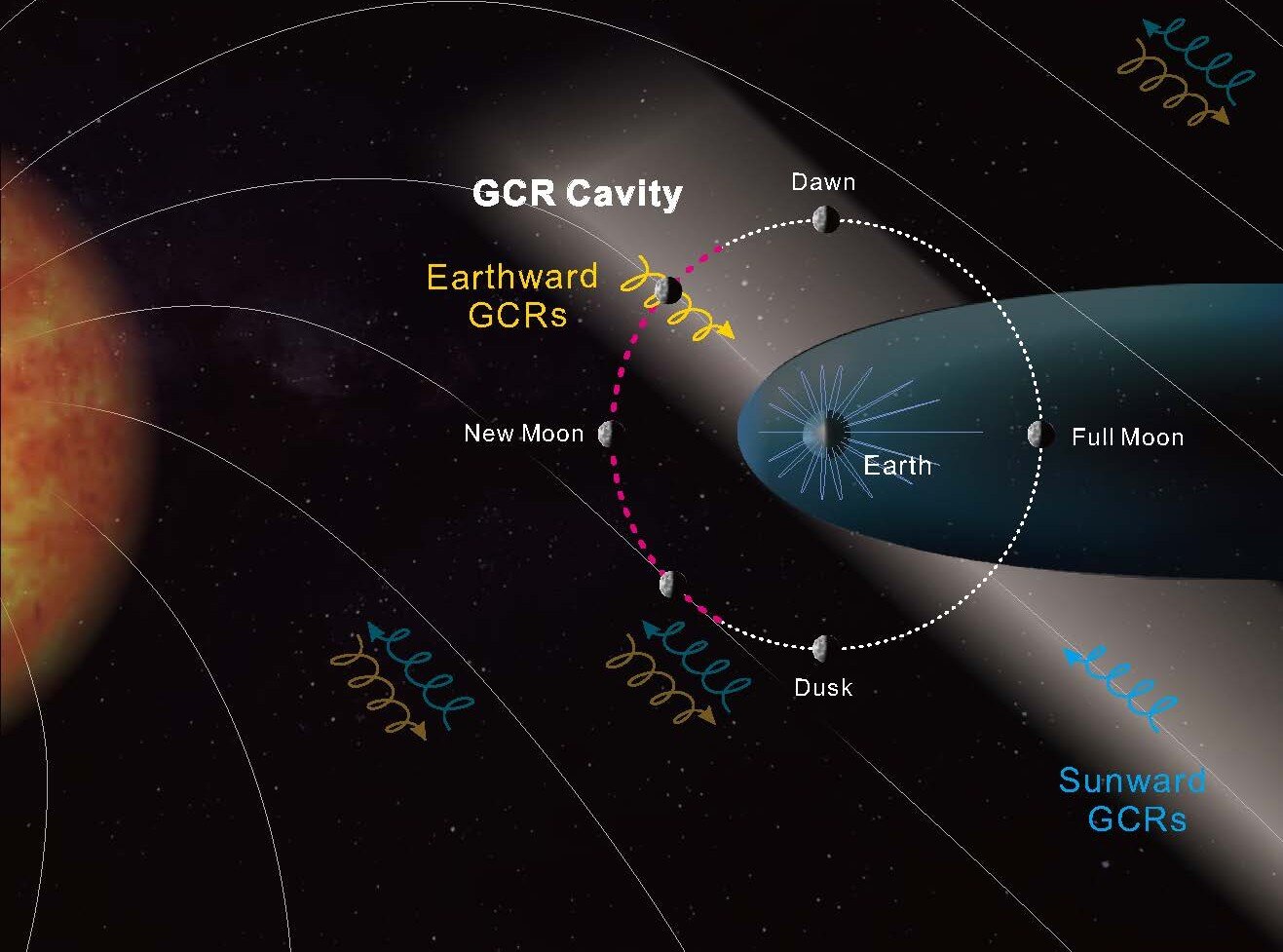
But as the team looked at the data from the LND, they noticed a strange, recurring dip. At a very specific time during the lunar “morning,” the particle counts hitting the detectors didn’t stay steady; they dropped. Specifically, the lander recorded a 20% dip in the number of GCR particles reaching the surface. This wasn’t a random flicker or a sensor error. Because the LND recorded data over 31 lunar cycles, the researchers could see a clear, rhythmic pattern. For about two days of every single month, a pocket of protection manifests, shielding the far side of the moon from the full force of the galaxy’s radiation.
This discovery was as baffling as it was exciting. At the time these dips occurred, the moon was officially outside of Earth’s magnetosphere. By all standard definitions, it should have been fully exposed. Yet, the data proved otherwise. Something was carving out a cavity in the radiation field, a “missing” chunk of cosmic rays that suggested Earth’s influence travels much further into the dark than anyone had dared to map.
The Physics of a Cosmic Shield
To understand how this invisible barrier works, the scientists had to look at the anatomy of the cosmic rays themselves. These high-energy travelers are not all created equal. About 85% of them are protons, while 12% are helium atoms, and a tiny 1% consist of heavier nuclei. When the research team looked closer at the 20% dip in the data, they found that the reduction wasn’t uniform across all particle types.
The protection was most effective against lower-energy protons. While higher-energy particles were also reduced, the effect on them was notably weaker. This clue pointed directly toward the mechanics of electromagnetism. Magnetic fields do not have a hard “edge” where they simply stop; instead, their strength and influence gradually fade as you move away from the source. Even though the moon had exited the main “bubble” of the magnetosphere, it was still drifting through a region where Earth’s magnetic force remained strong enough to nudge the incoming particles.
The researchers explained this phenomenon through a concept called the gyroradius. When a charged particle enters a magnetic field, it doesn’t move in a straight line; it begins to spiral in a circular motion. The radius of that circle—the gyroradius—is determined by the particle’s mass, velocity, and charge. Because Earth’s magnetosphere on the dayside extends roughly 6 to 10 Earth radii, its scale is remarkably similar to the gyroradius of lower-energy protons. As these particles attempt to stream toward the moon, the lingering magnetic influence of Earth catches them, causing them to swerve and deflect. Like a massive cosmic shepherd, Earth’s field gently steers the slower, lighter particles away, creating a temporary zone of relative calm on the lunar surface.
Mapping the Unknown Cavity
To ensure that the Chang’E-4 data wasn’t an anomaly, the research team turned to the world of digital recreation. They conducted sophisticated particle simulations to model exactly how Earth’s magnetic field interacts with the propagation of GCRs through deep space. By plugging in the known variables of particle energy and magnetic strength, the simulations began to mirror the real-world observations. The models confirmed that the reduction in radiation at those specific orbital locations was not only possible but a mathematical certainty.
The team didn’t stop at simulations; they also cross-referenced their findings with previous spacecraft data. This historical evidence helped confirm that the “cavity” of reduced radiation was a permanent, predictable feature of the Earth-Moon system. While the researchers admit that they haven’t yet determined the full spatial extent of this protective pocket—how wide it is or exactly how far it reaches—the existence of the “dip” is now a verified scientific fact.
This finding challenges the old view of space as a uniform environment. Instead, it reveals a landscape of “weather” and “terrain” created by magnetic forces. The area between planets is not just empty; it is a complex web of influence where a planet’s magnetic heartbeat can protect a moon hundreds of thousands of miles away.
A New Map for Human Exploration
This discovery is far more than a mere scientific curiosity; it is a potential lifesaver for the next generation of explorers. As humanity prepares to return to the lunar surface with manned missions, radiation remains one of the greatest hurdles. Galactic cosmic rays are seriously detrimental to human health and are notorious for causing “soft resets” or permanent damage to equipment.
By identifying these “quiet zones,” mission planners now have a brand-new strategy for keeping astronauts safe. The study authors suggest that future manned lunar missions and extravehicular activities—the high-stakes moments when astronauts leave their lunar modules to walk on the surface—could be timed to coincide with these lower radiation periods. By scheduling the most dangerous work during those two days of the lunar cycle when the 20% dip occurs, we can significantly reduce exposure risk.
Furthermore, this research opens a door to understanding other corners of our solar system. The team believes that by studying how Earth protects the moon, we can gain deeper insights into how other magnetized bodies in our solar system might create similar pockets of safety for their own moons or nearby spacecraft. As we look toward Mars or the moons of Jupiter, these “magnetic shadows” could become the designated rest stops of the cosmic highway, providing the vital protection needed for humanity to survive the journey into the stars.
Study Details
Wensai Shang et al, A galactic cosmic ray cavity in Earth-Moon space, Science Advances (2026). DOI: 10.1126/sciadv.adv1908