For decades, we have lived in a universe that seemed to make sense, at least on paper. We looked at the stars and saw them rushing away from us, and we built a mathematical story to explain why. This story, known as the ΛCDM model, has been the bedrock of cosmology. It describes a cosmos governed by three main ingredients: the cosmological constant (a steady push of dark energy), a massive amount of invisible cold dark matter, and the small sliver of ordinary matter that forms everything we can actually see.
But recently, the cracks in this bedrock have begun to widen. Like a map that no longer matches the terrain, our best theories are struggling to keep up with what our telescopes are showing us. The expansion of the universe is not behaving as the old rules dictated, and the very nature of the “glue” holding the cosmos together is being called into question.
The Cracks in the Cosmic Foundation
The trouble started with a measurement problem that scientists call the Hubble tension. For years, astronomers have used two different methods to determine how fast the universe is growing. One group looks at the Cosmic Microwave Background (CMB)—the afterglow of the Big Bang—to calculate the expansion rate from the dawn of time. Another group uses the “distance-ladder,” measuring the light from type Ia supernovae and nearby galaxies to see how fast they are moving today.
In a perfect world, these two numbers should match. Instead, they are in a “stark tension.” The universe seems to be expanding at different speeds depending on which ruler you use. It is a persistent, stubborn discrepancy that refuses to go away even as our tools get better.
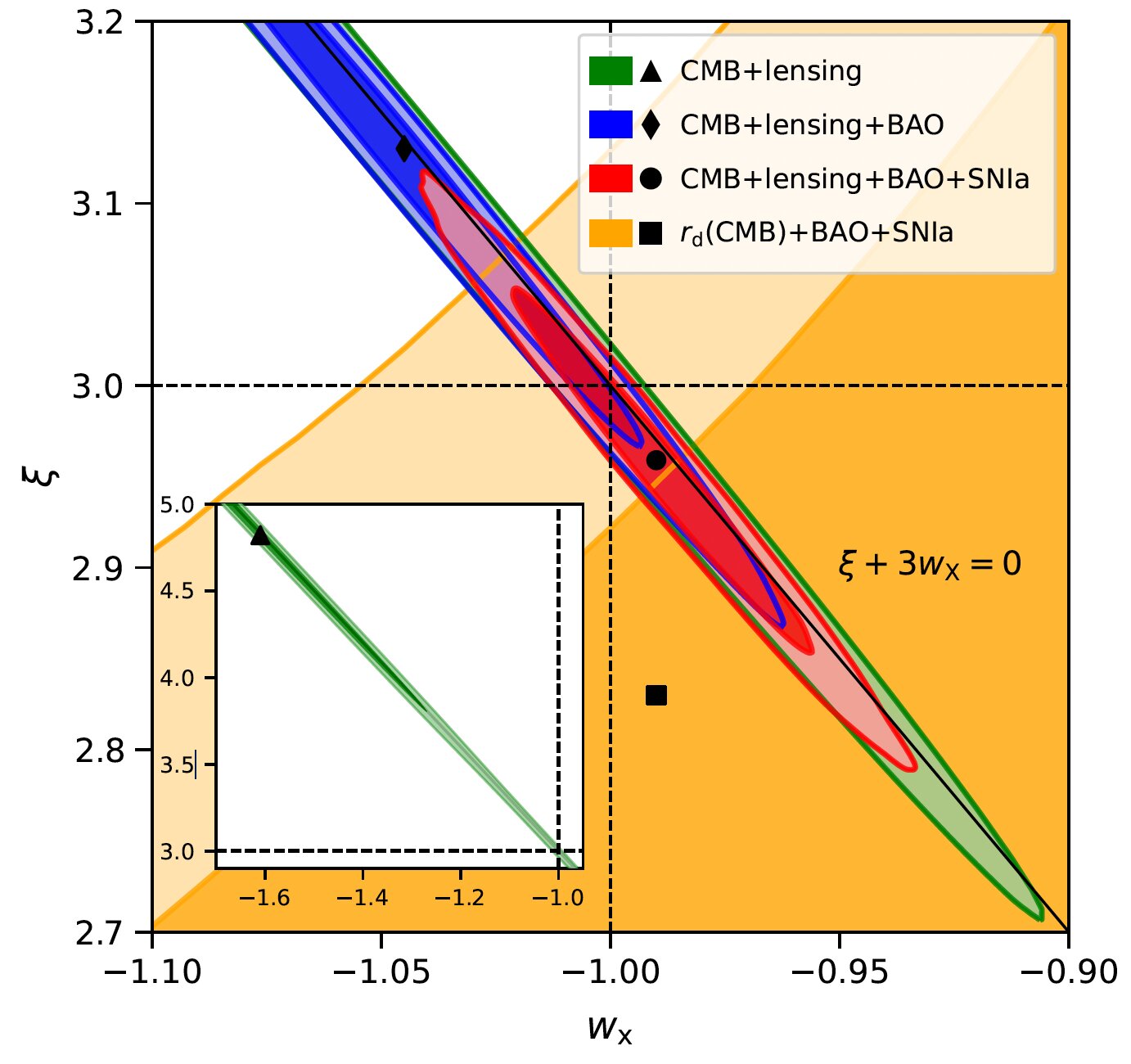
Adding to this mystery, new data from the Dark Energy Spectroscopic Instrument (DESI) has thrown a wrench into our understanding of dark energy. For a long time, we assumed dark energy was a constant, unchanging force. But these new observations suggest that the “constant” might not be so constant after all, fundamentally challenging the basic tenets of the ΛCDM framework.
A New Way to Read the History of Time
Faced with these dual mysteries, a team of cosmologists led by Yun Chen at the Chinese Academy of Sciences decided that we couldn’t keep looking at these problems in isolation. To find the truth, they argued, we need a unified framework that can investigate both the Hubble tension and the nature of dark energy at the same time.
Their approach is a clever bit of cosmic detective work. Instead of taking all the data from different eras of the universe and mashing it together into one average, the team—including Tengpeng Xu and Zhuoming Zhang—developed a system that allows different “probes” to speak for themselves.
The universe is a vast timeline, and different tools see different chapters. The CMB is a probe of the high-redshift universe, showing us the ancient past. Meanwhile, Baryon Acoustic Oscillations and supernovae are better at showing us the “nearby” universe of more recent history. By allowing each probe to independently predict its own best-suited time period, the researchers can break degeneracies—untangling variables that usually get blurred together. This multi-probe strategy acts like a high-definition lens, revealing the distinct signatures of how the universe’s behavior might have shifted over eons.
Searching for a Champion Among the Stars
With their new framework ready, the team put five different dark energy models to the test, including the traditional ΛCDM model. They wanted to see if any of these alternative theories could finally solve the Hubble tension or provide a better fit for the new data.
The results were a humbling reminder of how much we have yet to learn. First, they found that the Hubble tension remains a “persistent challenge” across every single model they tested. This suggests the problem isn’t just a math error in one theory; it likely points to something deeper in our understanding of fundamental physics or hidden systematic errors in our measurements.
Second, they discovered that there is currently “no clear winner.” None of the alternative models held a significant statistical advantage over the standard ΛCDM model. Even with our most precise instruments, the data isn’t yet strong enough to definitively pick a “best” theory of dark energy. However, the investigation did turn up some “tentative hints” of something revolutionary: the possibility of interactions between dark matter and dark energy. If these two mysterious forces are actually talking to each other, it would rewrite everything we think we know about the vacuum of space.
Why This Cosmic Quest Matters
This research is more than just a struggle with numbers; it is a search for the “mechanism driving cosmic acceleration.” By proving that the properties of dark energy have likely evolved since the early universe, Chen and his team have mapped out the path forward for the next generation of scientists.
This work matters because it tells us exactly what we need to do next. We are at a crossroads where the old models are no longer sufficient, but the new ones are not yet fully formed. To solve the mysteries of the Hubble tension and the true nature of the cosmos, we need a new era of multi-probe surveys and even more sophisticated theoretical frameworks.
Understanding these forces is the key to understanding the ultimate fate of our universe. Whether the cosmos will expand forever, accelerate into a void, or behave in ways we haven’t yet imagined depends on the secrets hidden within dark energy. By creating a way to test these ideas side-by-side, researchers are bringing us one step closer to a satisfying solution for the long-standing puzzles of the stars.
Study Details
Zhuoming Zhang et al, Dynamical Dark Energy and the Unresolved Hubble Tension: Multi-model Constraints from DESI 2025 and Other Probes, The Astrophysical Journal (2026). DOI: 10.3847/1538-4357/ae4738