For decades, the sixth planet from our sun has been hiding a secret that seemed to defy the very laws of physics. When astronomers turned their instruments toward Saturn, they encountered a riddle that didn’t make sense: the planet appeared to be changing the speed of its own rotation. To put that into perspective, imagine the Earth suddenly decided to make a day last twenty-five hours instead of twenty-four, only to shift back again a few months later. Huge, gaseous worlds like Saturn possess immense angular momentum; they simply cannot speed up or slow down their spin on a whim. Yet, the data coming back from spacecraft like NASA’s Cassini in 2004 insisted that the planet’s heartbeat—its rotational pulse—was drifting. This inconsistency became one of the most stubborn puzzles in planetary science, leaving researchers wondering if they truly understood the mechanics of the gas giants at all.
A Ghost in the Rotational Machine
The mystery centered on how we measure a gas giant’s day. Unlike Earth, which has a solid crust you can stick a flag into, Saturn is a swirling ball of hydrogen and helium. You cannot simply watch a mountain pass by to time a rotation. Instead, scientists rely on radio signals and magnetic signatures emitted from the planet’s interior. For years, these signals were thought to be the gold standard, a direct link to the planet’s core. But the Cassini spacecraft revealed that these “clocks” were out of sync with previous measurements. It was as if the planet was wearing several different watches, and none of them agreed on the time.
In 2021, Professor Tom Stallard and his team at Northumbria University made a breakthrough that shifted the perspective of the entire field. They realized the problem wasn’t with the planet’s core at all. Saturn wasn’t spinning differently; rather, something in its upper atmosphere was tricking our instruments. They discovered that powerful atmospheric winds were generating electrical currents. These currents created a misleading signal that mimicked the planet’s rotation, effectively masking the true spin of the world beneath. While this explained why the measurements were wrong, it birthed an even deeper question: what could possibly be powerful enough to drive those massive, consistent winds in the frozen reaches of the outer solar system?
The Natural Thermometer in the Sky
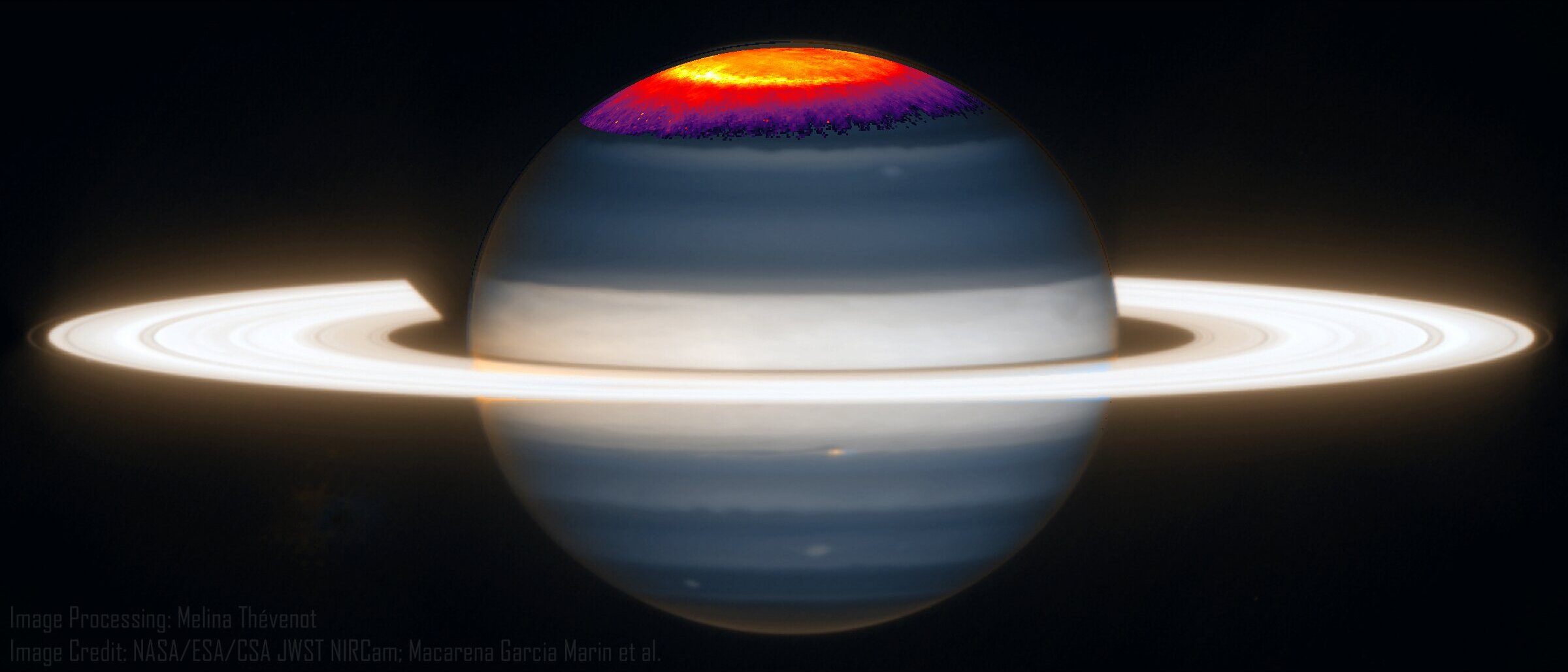
To find the engine behind these winds, the researchers needed a closer look than any traditional telescope could provide. They turned to the James Webb Space Telescope (JWST), the most powerful observatory ever launched into space. In a marathon observation session, the team tracked Saturn’s northern auroral region for a full Saturnian day. They weren’t just looking for the haunting glow of the northern lights; they were looking for heat.
The team focused their gaze on a specific molecule called the trihydrogen cation. This molecule forms high up in the stratosphere and acts as a natural thermometer. By measuring the infrared glow emitted by these molecules, the JWST allowed the scientists to create the first-ever high-resolution maps of temperature and particle density across the polar region. The precision was unprecedented. Previous attempts to measure these temperatures had a margin of error of about 50 degrees Celsius, which was roughly the same size as the temperature changes the scientists were trying to find. It was like trying to read a fine-print book through a foggy window. The JWST data, however, was ten times more accurate, stripping away the fog and revealing the thermal landscape of a distant world in exquisite detail.
The Self Sustaining Planetary Heat Pump
When the maps were finally rendered, the researchers saw something remarkable. The patterns of heating and cooling weren’t random. They matched computer models developed over a decade ago with startling accuracy, but only under one specific condition: the heat had to be coming from the aurora itself. This was the “smoking gun” the team had been searching for. It revealed that the aurora is far more than just a beautiful light show caused by solar particles; it is a violent, active participant in the planet’s climate.
The discovery revealed a self-sustaining feedback loop, which Professor Stallard describes as a planetary heat pump. It begins with the aurora dumping massive amounts of energy into the atmosphere, causing localized heating. This sudden rise in temperature creates a pressure imbalance that triggers fierce atmospheric winds. As these winds whip through the upper atmosphere, they interact with the planet’s magnetic field to generate new electrical currents. These currents, in turn, provide the very power needed to sustain the aurora. The system is a closed circle: the lights create the wind, and the wind powers the lights. This internal engine is so powerful and stable that it explains why the misleading rotational signals have persisted for decades.
Bridging the Gap Between World and Space
This research does more than just solve a local mystery about Saturn; it redefines our understanding of how a planet interacts with the void around it. The study shows a direct, two-way relationship between Saturn’s atmosphere and its magnetosphere—the vast bubble of space governed by the planet’s magnetic pull. This connection means that the weather happening in the clouds can actually influence the space environment millions of miles away.
By proving that an atmosphere can drive its own electrical currents out into space, the findings suggest that other worlds might be operating under similar rules. We are no longer looking at planets as isolated spheres, but as complex systems where the sky and the vacuum of space are constantly whispering to one another.
Why This Research Matters
Understanding the planetary heat pump on Saturn is a vital piece of the puzzle in our quest to understand the universe. For years, the discrepancy in Saturn’s rotation was a “missing link” that prevented scientists from accurately modeling the interiors and lifespans of gas giants. By “closing the loop,” this research provides a definitive answer to a decades-old mystery, proving that the laws of physics remain intact—we just needed a better telescope to see how they were being applied.
Furthermore, this discovery changes the way we look at exoplanets orbiting distant stars. If Saturn can generate such a powerful internal feedback loop, it is highly likely that gas giants across the galaxy are doing the same. As we use the James Webb Space Telescope to peer into the atmospheres of worlds far beyond our own, we now know to look for these invisible connections between auroral heating, atmospheric winds, and magnetic currents. This research provides a new blueprint for planetary science, reminding us that even the most distant, cold planets are dynamic, self-powering engines of incredible complexity.
Study Details
Tom S. Stallard et al, JWST/NIRSpec Reveals the Atmospheric Driver of Saturn’s Variable Magnetospheric Rotation Rate, Journal of Geophysical Research: Space Physics (2026). DOI: 10.1029/2025ja034578