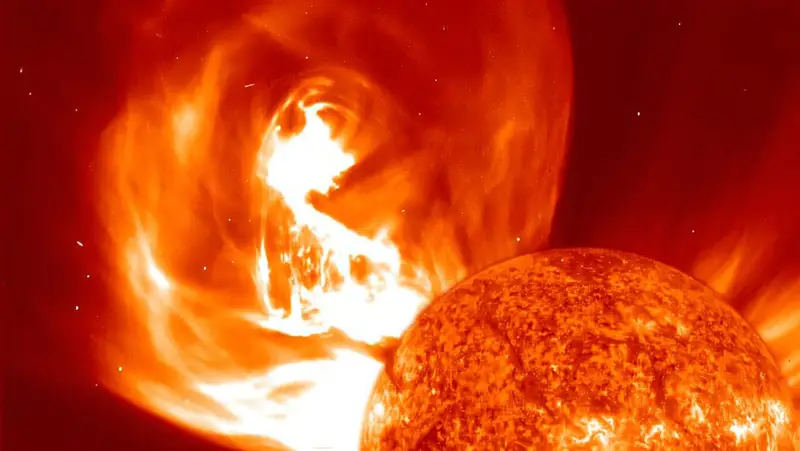
For centuries, humanity has watched the sun with a mix of awe and caution, knowing that this glowing sphere in the sky is both the giver of life and a source of cosmic disruption. Yet for all our telescopes and satellites, one of the sun’s most important features has remained stubbornly hard to see. Its magnetic field, the invisible engine behind solar storms, flares and eruptions, has never been fully mapped in three dimensions with the clarity scientists crave.
Now a team at the University of Hawaiʻi Institute for Astronomy believes that is finally beginning to change. Their newly developed artificial intelligence tool is giving researchers the rare ability to view the sun’s magnetic structures in ways once thought impossible. And in doing so, it could dramatically improve how we forecast the solar events that threaten modern technology on Earth.
The Challenge Hidden in Sunlight
Every solar eruption that reaches us begins inside the sun’s magnetic field. That field twists, loops and tangles across the surface until something snaps and energy explodes outward. Yet for decades, scientists have struggled to read that magnetic terrain with precision.
“The sun is the strongest space weather source that can affect everyday life here on Earth, especially now that we rely so much on technology,” said Kai Yang, an IfA postdoctoral researcher who led the work. “The sun’s magnetic field drives explosive events like solar flares and coronal mass ejections. This new technique helps us understand what triggers these events and strengthens space weather forecasts, giving us earlier warnings to protect the systems we use every day.”
But measuring the field has never been simple. Instruments can reveal the tilt of magnetic lines, but not their direction. It is like staring at a rope from the side, knowing it stretches away from you but having no clue whether the near end or the far end is closest. To make things harder, scientists view several layers of the sun at once, all stacked and shifting. Sunspots distort the solar surface even more, bending it downward and creating a magnetic depression that further confuses the picture.
For solar physicists, it has often felt like trying to understand a landscape from a single blurry photograph.
The AI That Learned the Sun’s Language
The breakthrough began when IfA scientists partnered with the National Solar Observatory and the High Altitude Observatory of the NSF National Center for Atmospheric Research. Their goal was bold but clear: teach a machine to decode the magnetic field by combining real observations with the laws of physics.
They built the Haleakalā Disambiguation Decoder, a machine-learning system grounded in one elegant rule of nature. Magnetic fields form loops and never start or end. The algorithm uses that principle as a guide, allowing it to determine which direction each magnetic line must be pointing and how high a structure must sit above the solar surface.
By blending physical law with data, the AI essentially learned to see the sun in 3D, layer by layer.
Tests showed that the method works across many solar environments, from quiet regions to blazing active areas to the dark, intense cores of sunspots. It performs especially well on the ultra-detailed images coming from the Daniel K. Inouye Solar Telescope, the most powerful solar telescope ever built.
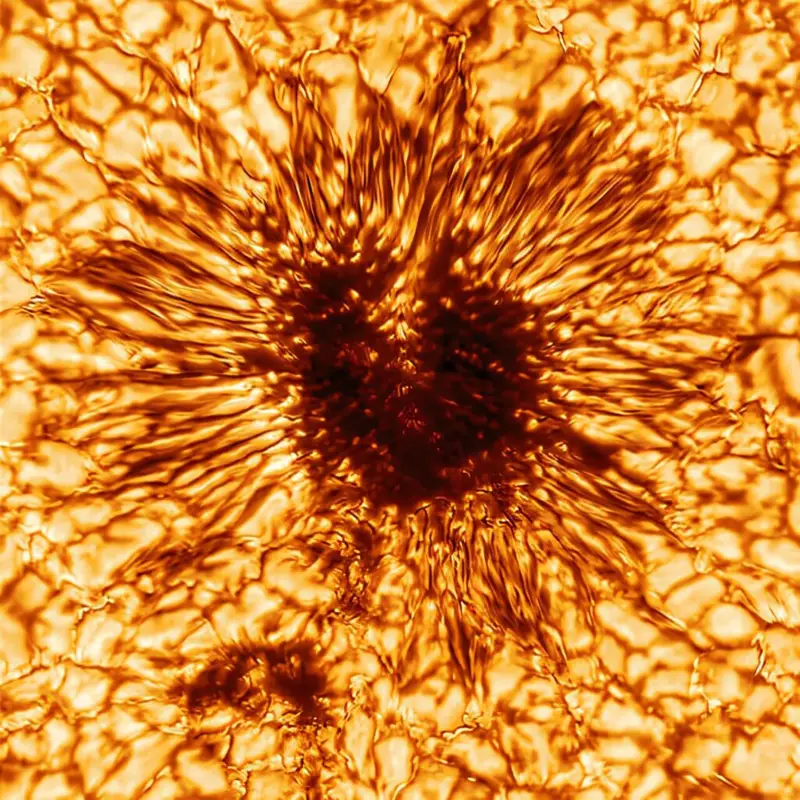
“With this new machine-learning tool, the Daniel K. Inouye Solar Telescope can help scientists build a more accurate 3D map of the sun’s magnetic field,” said Yang. “It also reveals related features, like vector electric currents in the solar atmosphere that were previously very hard to measure. Together, this gives us a clearer picture of what drives powerful solar eruptions.”
What was once hidden is beginning to come into view.
What was once guessed can now be measured.
When the Sun’s Secrets Become Predictable
The implications ripple far beyond astronomy. Solar storms can disrupt satellites, harm astronauts, interfere with aircraft communication and even overload power grids. As society grows increasingly dependent on technology, the stakes only rise.
The new AI tool helps scientists build a more complete picture of what the sun is preparing to do. With a clearer map of magnetic structures, researchers can more confidently anticipate when a region is primed to erupt or when a tangle of magnetic lines is ready to snap. Better forecasts mean earlier warnings, and earlier warnings mean safer infrastructure on Earth.
Solar physics is often portrayed as distant and abstract, but this advancement brings it directly into daily life. A more predictable sun means more stable power, safer communication systems and better protection for technologies orbiting high above us.
Why This Research Matters
This project is more than an upgrade in solar observation. It is a shift in how scientists understand the star that governs Earth’s space environment. By delivering a true 3D view of the sun’s magnetic field, the Haleakalā Disambiguation Decoder gives researchers a new level of clarity into the forces that drive solar eruptions.
It translates the sun’s magnetic whispers into something scientists can read, analyze and predict. It empowers the Daniel K. Inouye Solar Telescope to fulfill more of its potential. And it brings us one step closer to forecasting the sun with the same confidence that we forecast weather on Earth.
In a world where a single solar flare can disturb satellites, disrupt navigation and ripple through power grids, this research matters because it transforms uncertainty into understanding. It lets us prepare for the sun’s next move. And it deepens our connection to the star that shapes our world every moment of every day.
More information: Kai E. 凯 Yang 杨 et al, Spectropolarimetric Inversion in Four Dimensions with Deep Learning (SPIn4D). II. A Physics-informed Machine Learning Method for 3D Solar Photosphere Reconstruction, The Astrophysical Journal (2025). DOI: 10.3847/1538-4357/ae12ef