For generations, the question of whether humans are truly a monogamous species has hovered over anthropology like a lingering riddle. Fossils, marriage customs, and assumptions about prehistoric life have long guided the debate, but none of these clues ever quite settled it. Now, a new study from the University of Cambridge reframes the mystery by looking not at bones or rituals, but at the quiet mathematics of siblings.
Dr. Mark Dyble, an evolutionary anthropologist from Cambridge’s Department of Archaeology, has developed a way of interpreting family structures that turns the sibling relationships found in genetic datasets into a kind of evolutionary signal. Instead of observing mating rituals in the wild or relying on marriage records from ethnographers, he followed full siblings and half-siblings across species and across human history. The idea is simple but powerful: species in which most offspring share both parents are more monogamous; those with large numbers of half-siblings are more likely to follow polygamous or promiscuous patterns.
Dyble describes the logic succinctly. Species and societies with higher monogamy “are likely to produce more siblings that share both parents,” he explains, while those with more varied mating patterns produce more half-siblings. The result is a computational model that maps sibling data from recent genetic analyses onto known reproductive strategies, producing a rough but concrete measure of monogamy across mammals, including humans.
A League Table No One Expected
When Dyble ran the numbers, humans emerged in surprising company. “There is a premier league of monogamy, in which humans sit comfortably, while the vast majority of other mammals take a far more promiscuous approach to mating,” he says. The model places humans at a 66% rate of full siblings, a level that situates our species seventh among eleven mammals known for forming long-term pair bonds.
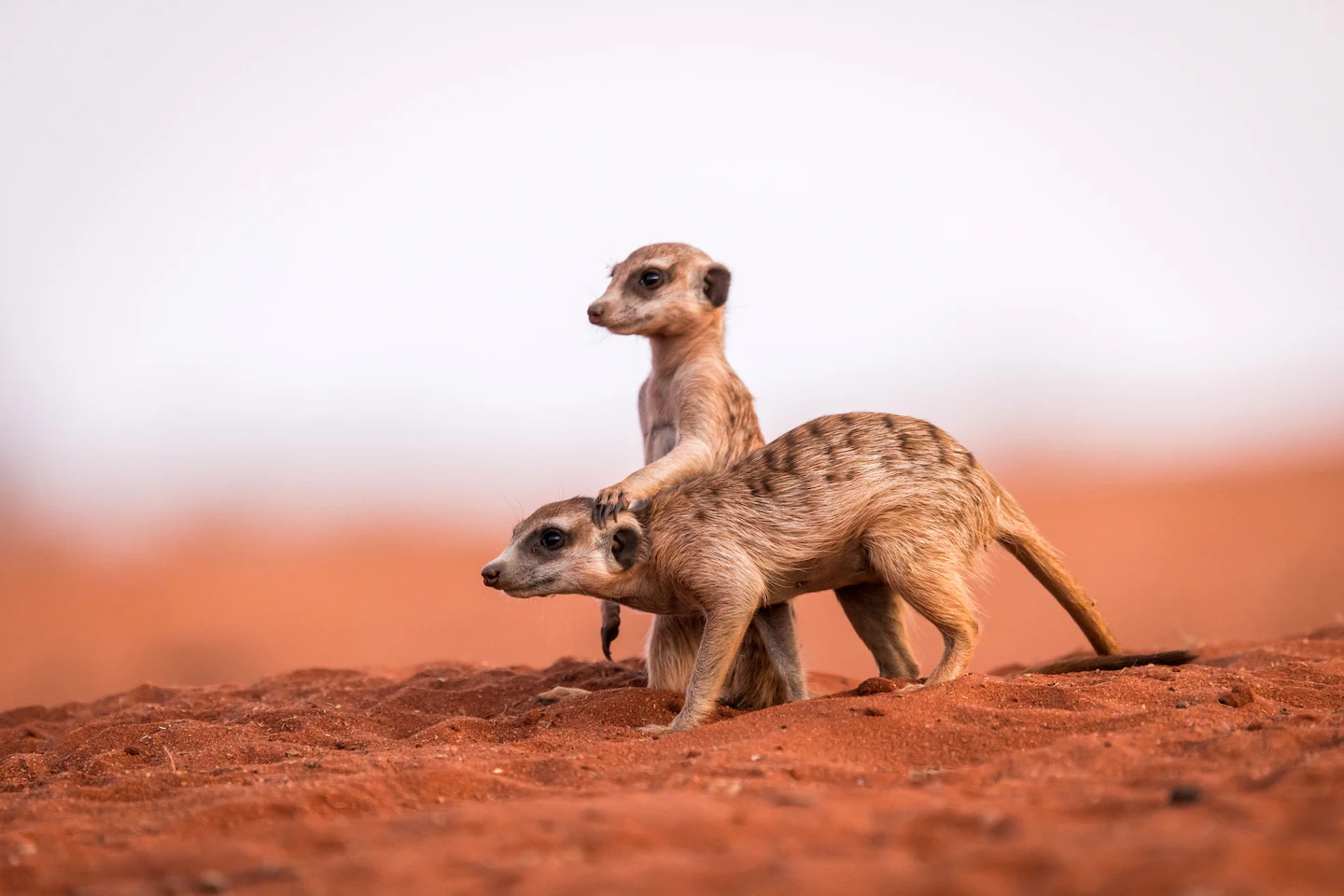
In this unlikely ranking, humans share the field with meerkats and beavers, both of which show monogamy-related sibling patterns remarkably close to ours. Meerkats come in with a 60% full sibling rate, while beavers edge us out at 73%. All three species, Dyble notes, show strong tendencies toward exclusive pair bonds but also maintain a healthy degree of flexibility.
One of the closest parallels to humans is the white-handed gibbon, a primate famous for stable pair bonds. Its full sibling rate sits at 63.5%, essentially overlapping with the human range. Only one other non-human primate manages to climb into the top rankings: the mustached tamarin of the Amazon, which typically raises twins or triplets and reaches nearly 78% full siblings.
Much of the rest of the primate world, however, tells a different story. Mountain gorillas generate full siblings only 6% of the time, chimpanzees just 4%, placing them alongside dolphins. And macaques sit near the bottom of the table, with full sibling rates ranging from 2.3% in Japanese macaques to just 1% in Rhesus macaques.
These contrasts show just how unusual humans are among our closest relatives. As Dyble puts it, “Based on the mating patterns of our closest living relatives, such as chimpanzees and gorillas, human monogamy probably evolved from non-monogamous group living, a transition that is highly unusual among mammals.”
Tracing Human Patterns Across Millennia
To calculate the monogamy levels of human societies past and present, Dyble drew from a wide span of genetic data. His analysis included remains from Bronze Age burials in Europe, Neolithic sites in Anatolia, and ethnographic records from 94 societies around the world—from the hunter-gatherer Hadza of Tanzania to the agricultural Toraja of Indonesia.
This sweeping dataset captures the extraordinary diversity of human mating customs. Previous research has shown that 85% of pre-industrial societies permitted polygynous marriage, where one man takes multiple wives. Yet despite this variation, the overall human ranking remained consistently higher than most species with permissive mating norms. Dyble emphasizes this point: “There is a huge amount of cross-cultural diversity in human mating and marriage practices, but even the extremes of the spectrum still sit above what we see in most non-monogamous species.”
In other words, even among societies in which polygynous marriage is allowed, the actual patterns of parenthood often resemble monogamy more than promiscuity. This makes sibling-based data a revealing window into the dynamics that shape human families beneath the surface of formal traditions.
The Strange Company We Keep
Humans, as Dyble notes, seem to share an evolutionary trajectory with a handful of species that made an unlikely transition from group-living and polygynous ancestors to more monogamous descendants. Wolves and foxes are prominent examples. Their modern relatives, such as the gray wolf and red fox, show moderate levels of social monogamy, with full sibling rates of 46% and 45%. African canids, such as the Ethiopian wolf at 76.5% and the African wild dog at 85%, score much higher.
At the top of the table stands an unassuming champion: the California deermouse, which “stays paired for life once mated,” earning a perfect 100% rating. At the other extreme is Scotland’s Soay sheep, with a strikingly low 0.6% rate of full siblings because each ewe mates with several rams.
Yet humans remain a distinct case. Dyble highlights that “almost all other monogamous mammals either live in tight family units of just a breeding pair and their offspring, or in groups where only one female breeds. Whereas humans live in strong social groups in which multiple females have children.” Only one other mammal appears to mirror this structure—the Patagonian mara, a large rodent whose warrens contain several long-term bonded pairs living together.
This unusual combination of monogamy and group living distinguishes humans more sharply than any ranking could. It suggests that our species maintains exclusive pair bonds while simultaneously thriving in multi-adult, mixed-sex communities. Such a social arrangement is extremely rare in nature.
The Complications of Human Choice
Dyble also stresses that these measurements reflect reproductive monogamy rather than sexual behavior. “In most mammals, mating and reproduction are tightly linked,” he notes. Human societies, however, introduce contraception, cultural rules, and personal choices that complicate this connection.
As a result, humans can produce patterns of full and half-siblings through many arrangements—from long-term monogamy to serial partnerships or stable forms of polygamy. This breadth makes humans flexible yet still consistently more monogamous than most species on the mammalian spectrum.
Why This Research Matters
Understanding where humans sit on the spectrum of mammalian mating systems offers more than a curious ranking. It reframes the deep evolutionary origins of cooperation, parenting, and social life. If humans belong to a “premier league of monogamy,” as Dyble puts it, then pair bonding may have played a significant role in shaping how our societies form alliances, share resources, and raise children.
By grounding the analysis in sibling data rather than assumptions about ancient customs, this study provides new, concrete evidence that human family structures have leaned toward monogamy for thousands of years, even amid vast cultural diversity. It helps explain how large, cooperative communities emerged from ancestors who were far less exclusive in their mating patterns.
Most importantly, the findings illuminate a central feature of the human story: our unusual ability to form enduring partnerships within large, interconnected groups. This rare social combination may have been one of the quiet evolutionary engines that propelled our species toward its remarkable collective achievements.
More information: Human monogamy in mammalian context, Proceedings of the Royal Society B: Biological Sciences (2025). DOI: 10.1098/rspb.2025.2163