For as long as humans have lived alongside domestic cats, the soft, steady rumble of a purr has been treated as a kind of emotional shorthand. It signals comfort, trust, and a mysterious inner calm that seems to radiate through fur and bone. Yet a new study by researchers from the Museum für Naturkunde Berlin and the University of Naples Federico II suggests that the purr contains something far more surprising. Beneath its soothing surface lies an acoustic signature so stable and distinct that it reveals a cat’s individual identity more reliably than the far more conspicuous meow.
This finding emerges from an investigation that began not with human intuition but with machines trained to listen. Drawing on vast recordings stored in the Animal Sound Archive at the Berlin Natural History Museum, the team set out with a simple but bold question: Could a computer, using techniques borrowed from automatic speech recognition, determine which cat produced a particular sound? The answer was yes—especially when that sound was a purr.
When Familiar Sounds Take on New Meaning
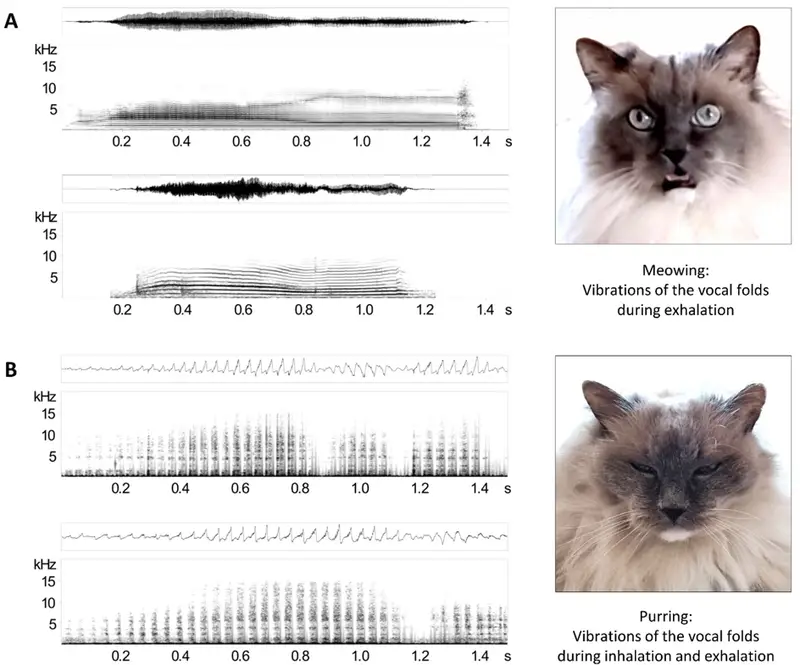
The researchers discovered that one of the most overlooked feline vocalizations is also one of the most informative. While humans are accustomed to responding to meows—after all, cats tend to direct these calls specifically at us—the study revealed that meows are slippery and context-dependent. As first author Danilo Russo explains, “People pay most attention to meowing because cats mainly use these vocalizations toward us.” But the deeper the team looked into the acoustic structure of each call, the clearer the picture became. “But once we examined the acoustic structure closely, the even, rhythmic purr turned out to be the better cue for identifying individual cats.”
Purrs proved remarkably consistent from one moment to the next. Their low-frequency rhythm, almost metronomic in its steadiness, shaped a kind of vocal fingerprint. Even sophisticated variations that might accompany changes in mood or environment did not erase the underlying individuality. In the study, computers trained to sort recordings by cat rarely made mistakes when working with purrs.
Co-author Anja Schild underscored the intimacy of the behavior that produces these signals: “Every cat in our study had its own characteristic purr.” She noted that purring frequently arises in relaxed, trusting contexts—moments of petting, gentle contact, or the warm exchanges between a mother cat and her newborn kittens. These are settings where social familiarity matters, and where recognizing an individual quickly and reliably could offer an evolutionary advantage.
The Mutable Voice of the Meow
Meows, on the other hand, seemed to behave almost like a different language. Designed not for stability but for adaptability, they shifted and stretched depending on a cat’s needs. Whether begging for food, seeking affection, or voicing irritation, the same individual could produce dramatically varied meows.
The researchers found that this variability is not merely a behavioral quirk—it has deep evolutionary roots. When they compared the meows of domestic cats to those of five wild relatives—the African wildcat, European wildcat, jungle cat, cheetah, and cougar—the contrast was stark. Wild cats showed far more consistency in their meows, while domestic cats exhibited a striking degree of acoustic flexibility.
Senior author Mirjam Knörnschild offered a compelling explanation for this divergence. “Living with humans—who differ greatly in their routines, expectations, and responses—likely favored cats that could flexibly adjust their meows. Our results support the idea that meows have evolved into a highly adaptable tool for negotiating life in a human-dominated world.”
In other words, domestication appears to have fine-tuned the meow into a versatile instrument of interspecies communication. As cats settled into human households across varied cultures, landscapes, and lifestyles, those that could modify their vocalizations to match human responses gained an advantage. Over generations, this adaptability became embedded in the species’ vocal repertoire.
A Tale of Two Voices
Taken together, the findings reveal that cats rely on a dual communication strategy shaped by their evolutionary trajectory. Purrs serve as steady, easily recognizable signals perfectly suited for close social interactions. Their stability allows both cats and humans to identify individuals in moments when trust and familiarity matter most.
Meows, in contrast, function as flexible emotional messages. Their variability allows cats to fine-tune their appeals, complaints, and requests to human companions who may respond differently from one household to the next. Evolution has effectively stretched the meow into an expressive, dynamic tool—highly adaptable, but far less tied to individual identity.
The study thus paints a nuanced portrait of feline vocal life, emphasizing how domestication has not simply altered how cats behave but has shaped the very architecture of their sounds.
Why This Research Matters
This work provides an important window into how human environments can reshape animal communication at a fundamental level. By demonstrating that domestication has exaggerated the variability of the meow while leaving the purr as a stable identity cue, the study offers new insight into the ways cats have adapted to a human-dominated world.
The implications extend beyond curiosity. Understanding the acoustic signals that cats use to navigate their relationships with people may one day improve how shelters identify individual animals, how veterinarians interpret vocal signs of stress or comfort, and how scientists track the long-term effects of domestication on communication. Above all, the work reminds us that even the most familiar animals still hold secrets in their everyday behaviors.
A purr may seem like a simple vibration pressed into our palms, but as this research shows, it carries a story—one written in rhythm, repetition, and the quiet persistence of individuality.
More information: Danilo Russo et al, Meows encode less individual information than purrs and show greater variability in domestic than in wild cats, Scientific Reports (2025). DOI: 10.1038/s41598-025-31536-7