The cosmos is often described as a vast, empty stage, but for decades, physicists have known that the most important actor in the play is one that refuses to step into the light. This invisible substance, known as dark matter, accounts for roughly 85% of all matter in the universe. For years, the prevailing scientific narrative suggested that these particles were “cold” and collisionless, drifting through the void like ghosts that pass through walls—and each other—without so much as a whisper of contact. However, a new narrative is emerging from the work of Hai-Bo Yu, a physicist at UC Riverside, suggesting that dark matter might be far more “social” than we ever imagined.
The Crowded Room of the Cosmos
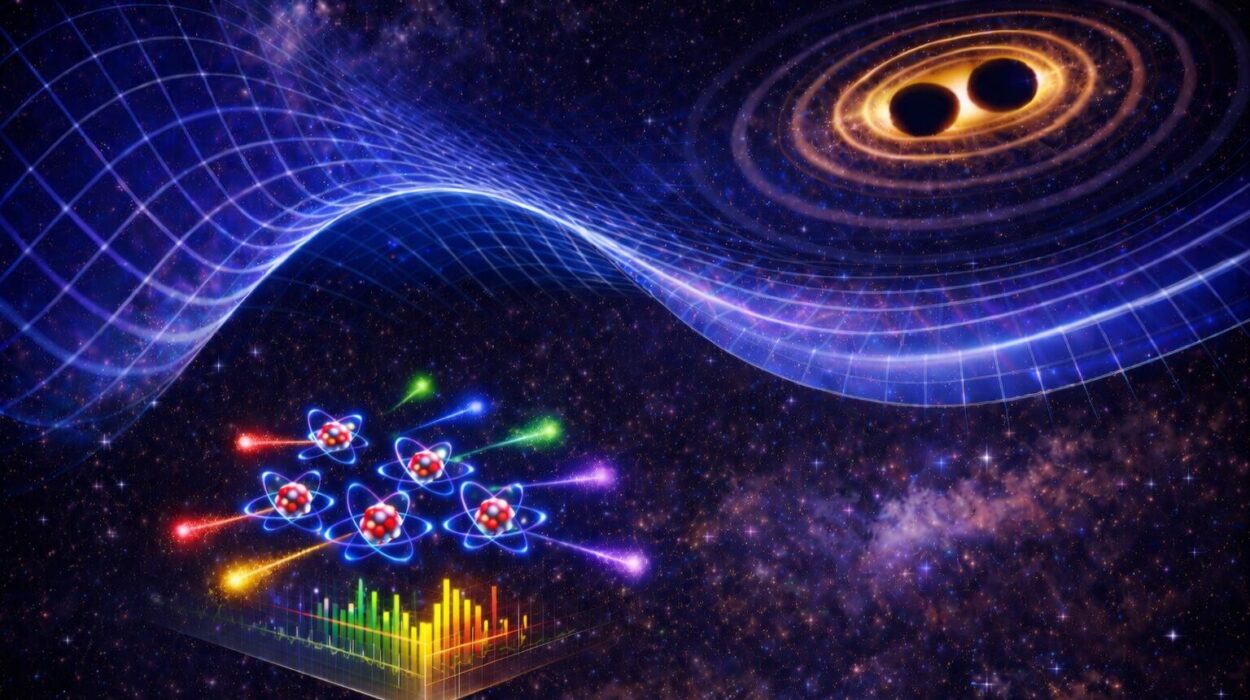
To understand the shift in thinking proposed by Yu and his team, one must first visualize the standard model of the universe. In that version, dark matter particles are like a crowd of people who completely ignore one another, moving through a room without ever making eye contact or bumping shoulders. But Yu’s research, published in Physical Review Letters, introduces a different metaphor: a room where everyone is constantly bumping into one another, exchanging energy and momentum. This is the world of self-interacting dark matter, or SIDM.
When these particles collide, they don’t just bounce away; they exchange energy in a way that can fundamentally reshape the structures they inhabit. Under the right conditions, these interactions trigger a process called gravothermal collapse. Imagine a spinning cloud of gas slowly cooling and contracting until it forms a hard, dense center. In the world of SIDM, these self-interactions allow dark matter to shed energy and fall inward, creating extremely compact, ultra-dense halos or cores. These aren’t just theoretical curiosities; they are the “invisible giants” that Yu believes can solve three of the most persistent puzzles in modern astrophysics.
A Ghostly Lens in the Distant Deep
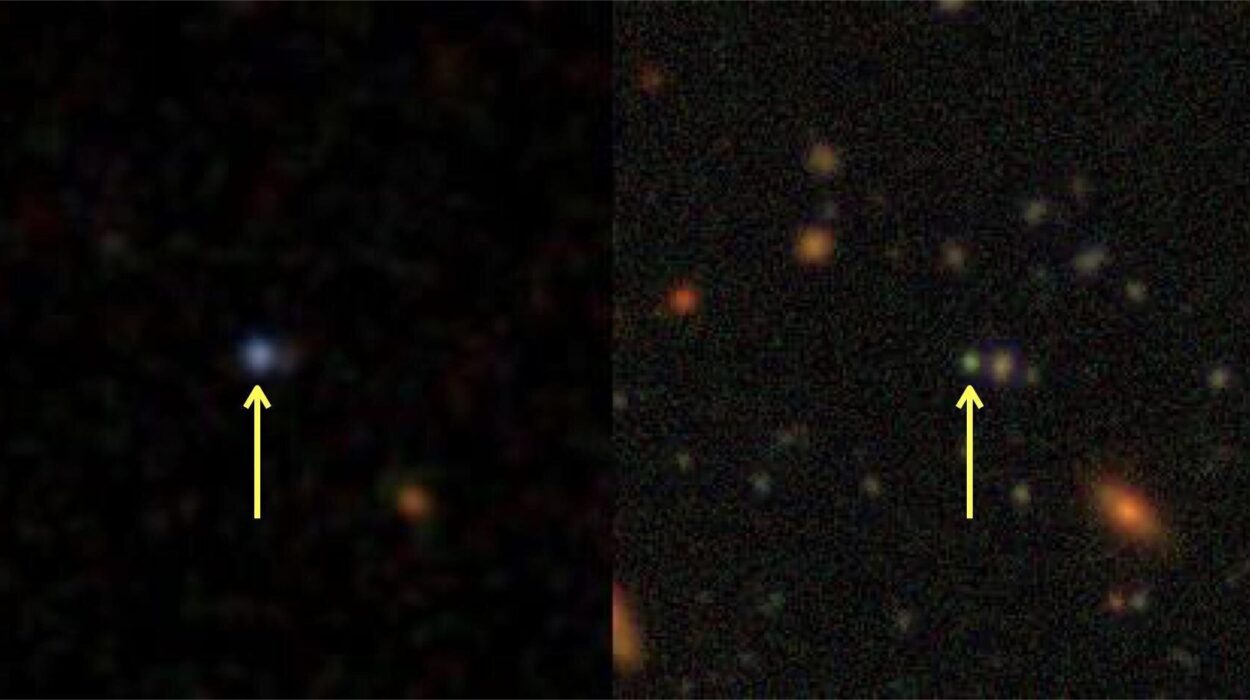
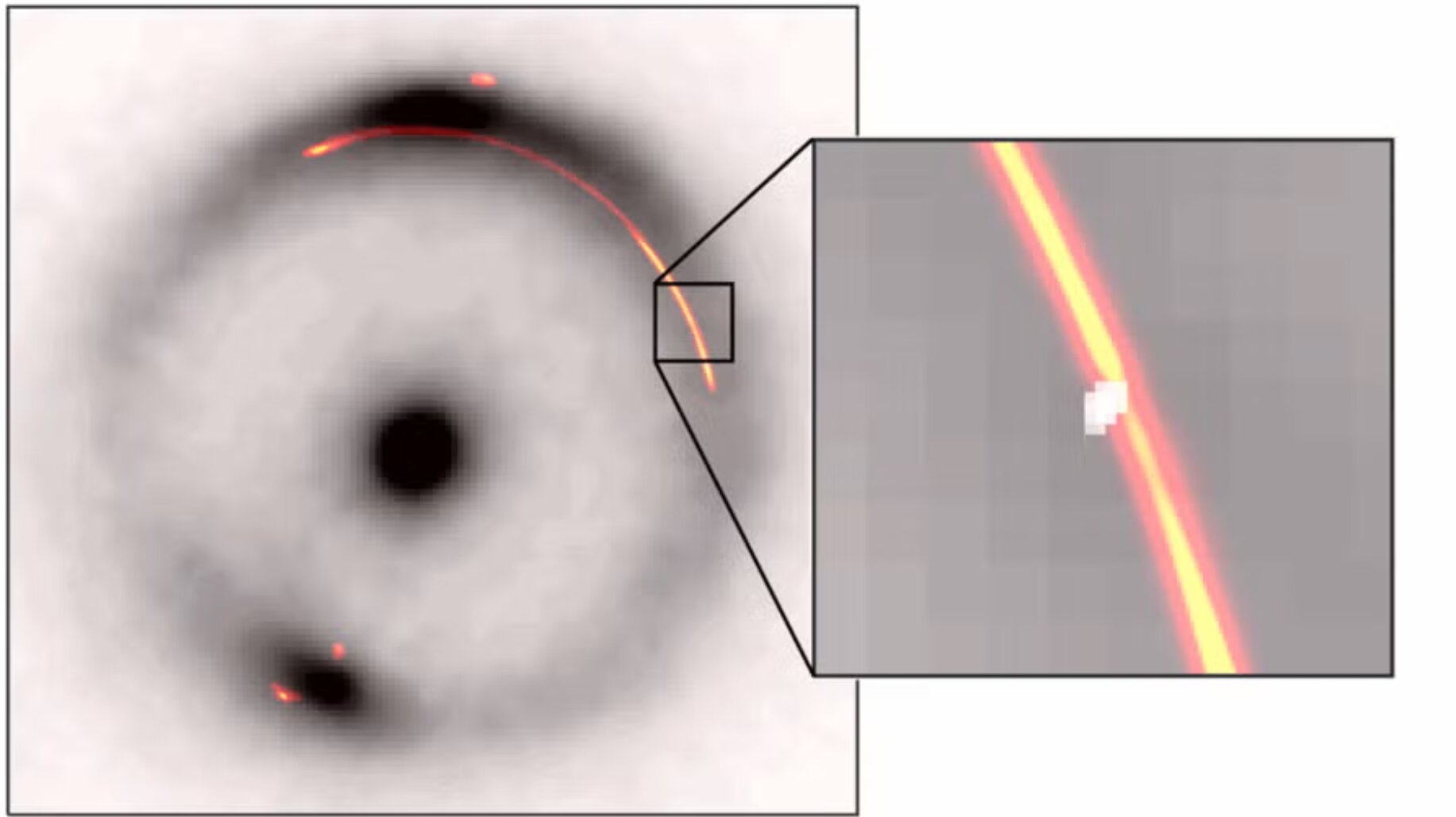
The first clue that something was amiss in the standard model came from a corner of the distant universe known as JVAS B1938+666. This is a gravitational lens system, a cosmic phenomenon where a massive object in the foreground acts like a giant magnifying glass, bending the light from a galaxy far behind it. Usually, these lenses are predictable, but in this specific system, astronomers detected an ultra-dense object that didn’t seem to have enough visible stars to account for its massive gravitational footprint.
Under the traditional rules of collisionless dark matter, it is incredibly difficult to explain how a clump of dark matter could become that concentrated and dense. The particles simply wouldn’t pack together tightly enough. But in the theater of self-interacting dark matter, the explanation becomes elegant and simple. The constant “bumping” of particles leads to that gravothermal collapse, creating a core so dense and heavy—roughly a million times the mass of the sun—that it can bend light with incredible ferocity, even if it remains entirely dark to our telescopes.
The Scar Across the Milky Way
Closer to home, within our own Milky Way, another mystery was etched into the stars. Astronomers studying the GD-1 stellar stream—a long, thin ribbon of stars orbiting our galaxy—noticed something haunting. The stream was not a continuous, smooth line; instead, it featured a striking spur-and-gap pattern. It looked exactly as if a heavy, invisible bullet had torn through the stream, scattering stars in its wake and leaving behind a visible scar in the galactic landscape.
For a long time, scientists struggled to identify what could have caused such a precise and violent disruption. A standard dark matter clump wouldn’t typically be compact or “hard” enough to punch a hole of that specific shape through a delicate stream of stars. However, Yu’s work suggests that a dense SIDM clump is the perfect candidate for this cosmic hit-and-run. Because these self-interacting particles can form such tight, compact cores, they possess the gravitational “sharpness” required to slice through a stellar stream, leaving behind a telltale gap that serves as a fingerprint for an invisible intruder.
The Invisible Trap of the Satellite Galaxy
The third piece of the puzzle lies in a neighboring satellite galaxy called Fornax, which orbits our own. Within this small galaxy sits an unusual cluster of stars known as Fornax 6. In a typical environment, a star cluster like this might be expected to drift apart or follow a different evolutionary path, but Fornax 6 remains remarkably tight and compact. It behaves as if it is being held together by an unseen hand.
Yu proposes that a clump of self-interacting dark matter is acting as a “gravitational trap.” In this scenario, the ultra-dense core created by gravothermal collapse sits at the heart of the galaxy, its powerful gravity sweeping up passing stars like a vacuum. Once caught, these stars are locked into a compact formation, creating the unique cluster we see today. It is a striking example of how the invisible architecture of the universe dictates the fate of the luminous stars we can actually see.
Why the Social Life of Dark Matter Matters
What makes this research so compelling is not just that it solves a single problem, but that it provides a unified explanation for three vastly different phenomena. From the edge of the observable universe to the outskirts of our own galaxy, the same mechanism—self-interacting dark matter—seems to be at work. It bridges the gap between the distant deep and our immediate galactic neighborhood, suggesting that the “social” behavior of dark matter particles is a universal constant rather than a local fluke.
This research matters because it challenges the long-held assumption that dark matter is a passive, lonely substance. By showing that dark matter can interact, collide, and collapse into dense structures, Yu and his team have provided a new toolkit for understanding the “dark” side of our universe. It suggests that the 85% of the universe we cannot see is not just a static background, but a dynamic, evolving environment that actively shapes the history of galaxies, the paths of light, and the very arrangement of the stars in our night sky. Understanding SIDM isn’t just about finding a new particle; it’s about finally learning the rules of the game that the rest of the universe has been playing all along.
Study Details
Hai-Bo Yu, Core-Collapsed SIDM Halos as the Common Origin of Dense Perturbers in Lenses, Streams, and Satellites, Physical Review Letters (2026). DOI: 10.1103/txxx-97ln. On arXiv: DOI: 10.48550/arxiv.2510.11006