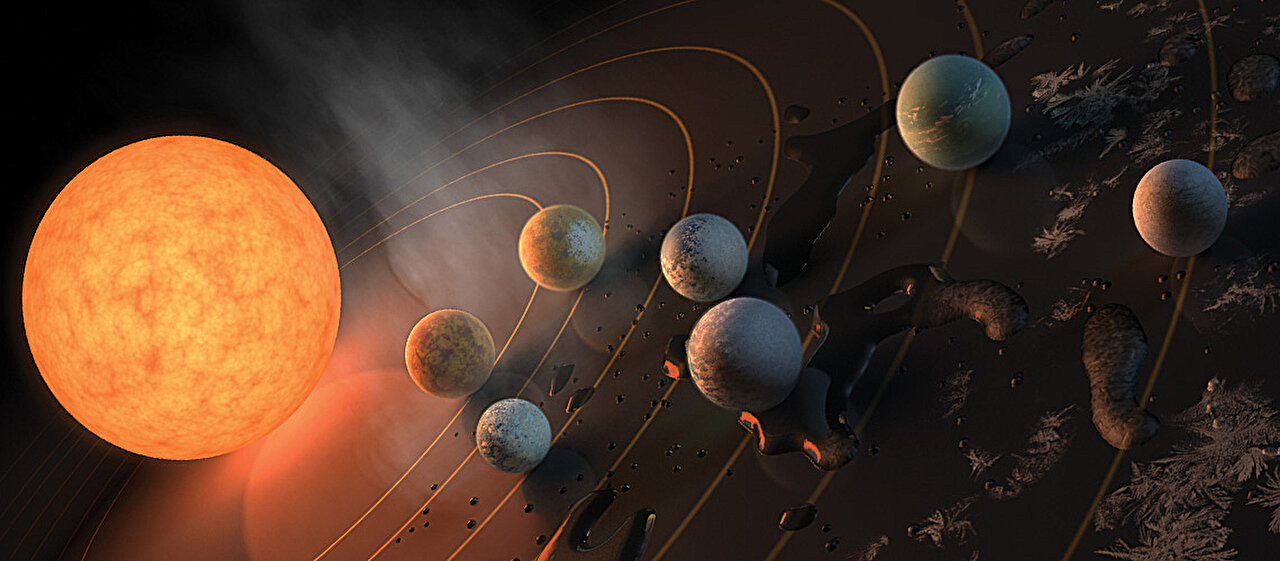
Imagine standing on the surface of a world where the sun never sets, yet the ground beneath your feet is baked to a temperature that would melt lead. Then, imagine walking just a few miles into a shadow that never ends, where the air—if there were any—would freeze solid in an instant. This is not the fever dream of a science fiction novelist; it is the reality of the TRAPPIST-1 system, a cosmic neighborhood that has fascinated astronomers for a decade. Recently, an international team including researchers from the University of Geneva and the University of Bern turned the powerful gaze of the James Webb Space Telescope toward this system, seeking to uncover whether these distant cousins of Earth possess the one thing essential for life as we know it: an atmosphere.
The Seven Sisters of a Crimson Sun
Ten years ago, the discovery of the TRAPPIST-1 system sent shockwaves through the scientific community. It is a compact, crowded family of seven rocky planets, all roughly the size of Earth, orbiting a single red dwarf star. These stars are smaller and cooler than our sun, but they are the most common type of star in the Milky Way, making up more than 75% of the galactic population. Because they are so numerous, scientists have long wondered if the small, rocky worlds circling them could be the most likely places to find life beyond our solar system. The TRAPPIST-1 system is a unique laboratory for this quest because three of its seven planets sit within the habitable zone, the “Goldilocks” region where temperatures are just right for liquid water to pool on a planetary surface.
However, life on these worlds faces a daunting set of challenges. Unlike our Earth, which enjoys a relatively stable relationship with the sun, planets orbiting red dwarfs are often subjected to a violent upbringing. These stars are notorious for their temperaments, frequently erupting with ultraviolet radiation and streams of energetic particles. This constant energy bombardment creates a harsh environment that can determine whether a planet evolves into a lush, blue marble or remains a barren, airless rock. To understand the fate of these worlds, astronomers focused their efforts on the two siblings closest to the star: TRAPPIST-1b and TRAPPIST-1c.
A World of Eternal Day and Frozen Night
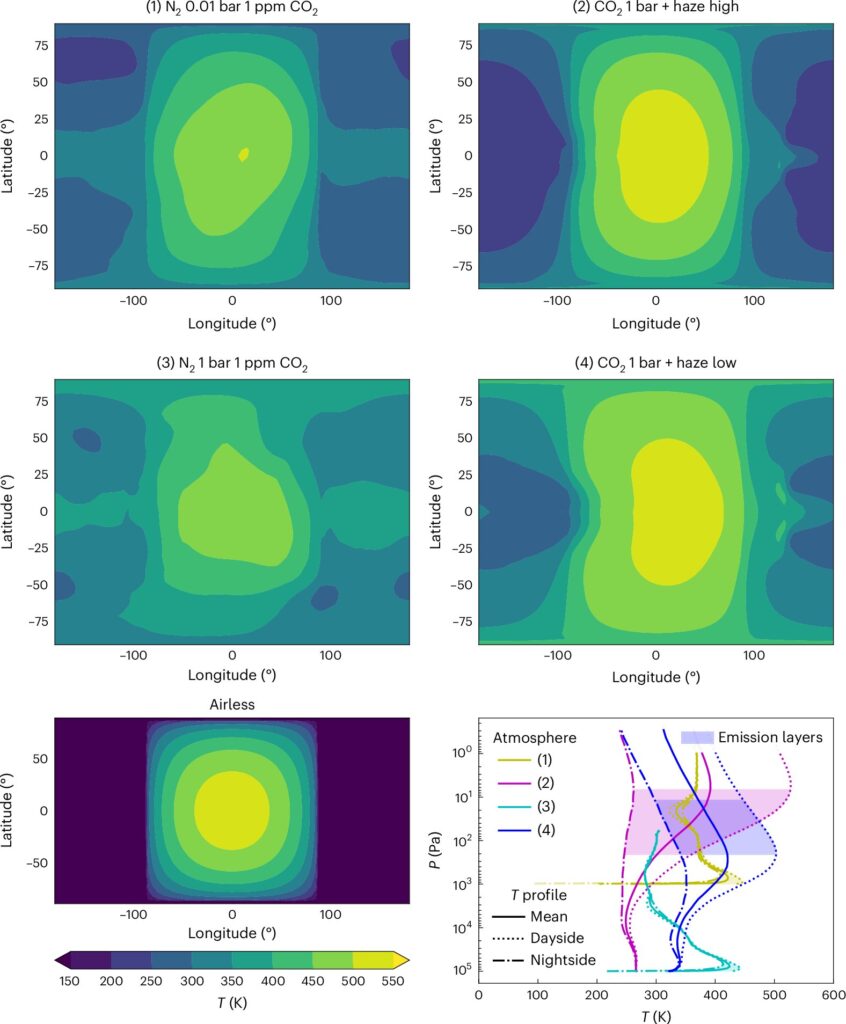
The researchers embarked on an ambitious campaign, dedicating 60 hours of continuous observation time with the James Webb Space Telescope. By tracking the infrared light emitted by the planets as they completed their orbits, the team was able to do something never before achieved: they mapped the climate of Earth-sized exoplanets. This mapping relied on a fundamental principle of planetary science. If a planet has a thick atmosphere, the air acts like a giant conveyor belt, carrying heat from the sun-drenched day side to the dark night side, smoothing out the temperature extremes. If there is no air, there is no way to move that energy, resulting in a planet of radical opposites.
Because these planets are so close to their star, they are tidally locked. Just as the moon always shows the same face to the Earth, one side of these planets is trapped in a permanent day, while the other is lost in a permanent night. The James Webb data revealed a staggering reality for the two innermost worlds. On TRAPPIST-1b, the day side sizzles at temperatures exceeding 200°C, while TRAPPIST-1c reaches nearly 100°C. But as soon as the telescope looked at the night sides, the temperatures plummeted. The darkness of these worlds is plunged into a frigid abyss, dropping below -200°C.
The Stripping of the Skies
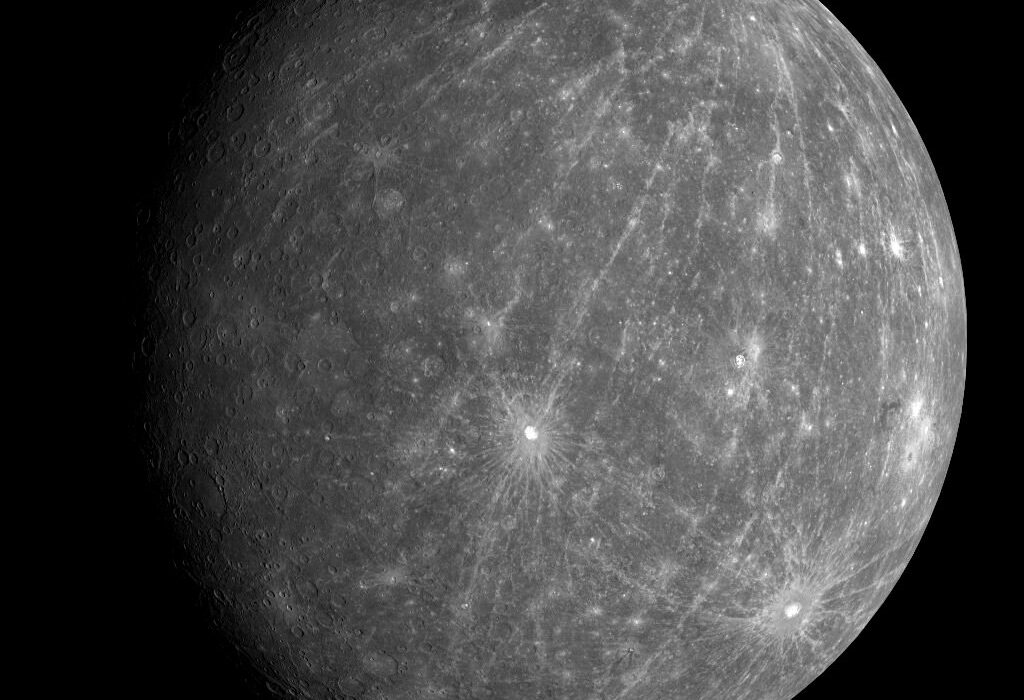
This massive temperature gap—a difference of more than 500 degrees Celsius between the light and the dark—told the researchers everything they needed to know. There is no conveyor belt. There is no air. The observations confirmed that TRAPPIST-1b and TRAPPIST-1c lack dense atmospheres. Whatever air they might have possessed during their violent births was likely clawed away, molecule by molecule, by the intense radiation and particle fluxes from their parent star. Like Mercury in our own solar system, these planets have been stripped bare, leaving behind nothing but scorched and frozen rock.
This finding is a sobering piece of evidence for the theory of comparative planetology. It suggests that the proximity of a planet to a red dwarf is a dangerous game. The same proximity that keeps a planet warm enough for water also exposes it to the full fury of the star’s energy bombardments. For the two innermost planets of this system, the star’s influence was simply too great to overcome. They serve as a stark reminder of how fragile a planetary atmosphere can be when faced with the raw power of a restless star.
A Glimmer of Hope in the Outer Reach
Despite the airless desolation of the inner two worlds, the story of the TRAPPIST-1 system is far from over. In fact, for the researchers involved, the search is only just beginning to get interesting. The loss of air on the inner planets does not necessarily mean the outer planets share the same fate. In our own solar system, Mercury is a barren husk, yet Venus and Earth managed to hold onto their skies. The team is now shifting its focus further out, toward TRAPPIST-1e, a planet that sits squarely in the middle of the habitable zone.
Theoretical models suggest that as the distance from the star increases, the chances of a planet retaining its atmosphere improve significantly. The James Webb Space Telescope is already gathering data on this more distant sibling, looking for signs of the gases that might protect a surface and allow liquid water to exist. The lessons learned from the “b” and “c” planets provide the essential context—the baseline—that scientists need to interpret what they find next. By understanding where the air is missing, they can better understand where it might remain.
Why the Mapping of These Distant Climates Matters
This research represents a historic milestone in our exploration of the cosmos because it marks the first time we have successfully characterized the thermal environment of Earth-sized exoplanets. For years, we could only guess at the conditions on these worlds, but with the James Webb Space Telescope, we are finally moving from the era of discovery to the era of understanding. The TRAPPIST-1 system serves as a reference system for the entire galaxy; it is the benchmark against which we will measure all other rocky worlds orbiting red dwarf stars.
Understanding the habitability of these planets is not just about finding “another Earth.” It is about understanding the fundamental laws of planetary evolution. By studying how stars and planets interact, we learn why some worlds flourish while others are scorched into silence. Every piece of data from this system brings us closer to answering the ultimate question: is the emergence of life a common occurrence in a galaxy filled with red dwarfs, or is our own blue planet even more unique than we ever dared to imagine? As the search continues into the outer reaches of the TRAPPIST-1 system, the answers to those questions are finally within our reach.
Study Details
Michaël Gillon et al, No thick atmosphere around TRAPPIST-1 b and c from JWST thermal phase curves, Nature Astronomy (2026). DOI: 10.1038/s41550-026-02806-9