New research reveals that the mysterious gas clumps orbiting the Milky Way’s central black hole originate from a single, massive binary star system named IRS 16SW. These compact clouds, known as the G-cloud streamer, are formed by colliding stellar winds and provide a consistent source of fuel to sustain the activity of Sagittarius A.*
For decades, the heart of the Milky Way has teased astronomers with a celestial paradox. At the center sits Sagittarius A*, a supermassive black hole with a gravitational pull so intense it dictates the motion of everything nearby. Yet, despite its proximity to vast reservoirs of dust and stars, the black hole often appears relatively quiet. The question of how it actually “eats”—and where its meals come from—has remained one of the most persistent mysteries in galactic archaeology.
Recent observations have finally identified a specific “delivery service” responsible for transporting material into the dark heart of our galaxy. A team of researchers led by the Max Planck Institute for Extraterrestrial Physics (MPE) has successfully traced a trail of enigmatic gas clouds back to their source: a massive, dual-star system located just a short distance away. This discovery suggests that the growth of the galaxy’s most massive object is directly linked to the violent life cycles of the stars that surround it.
The Mystery of the G-Cloud Streamer
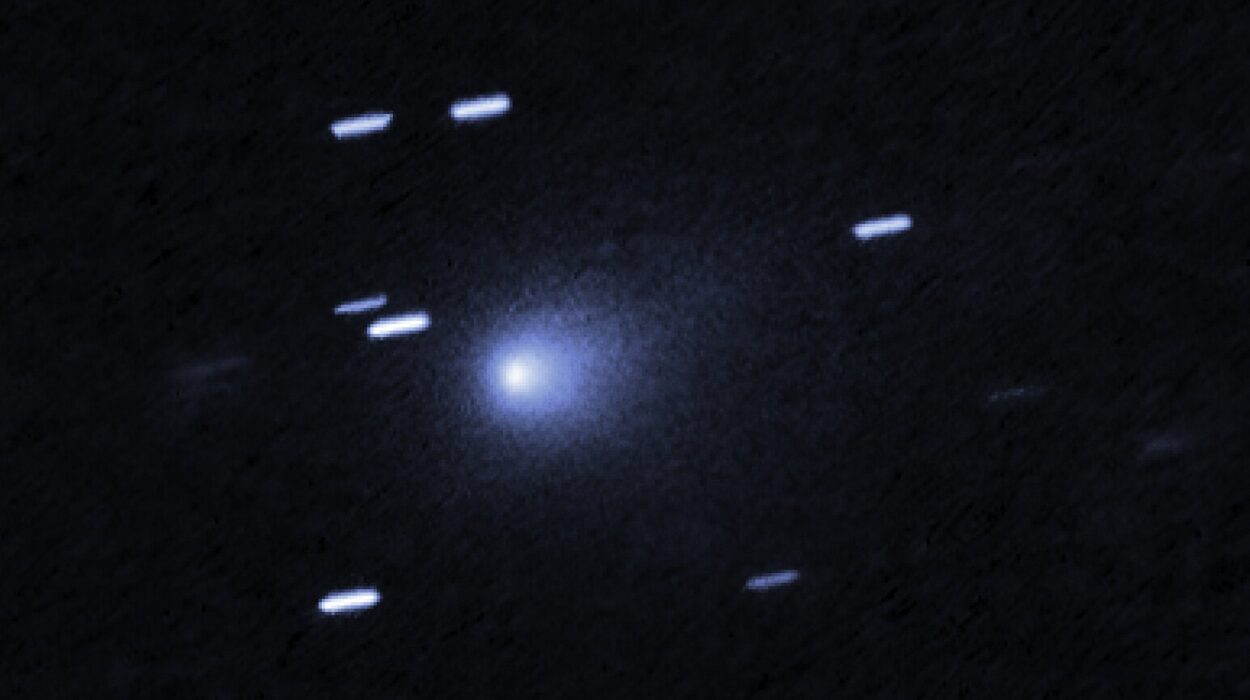
The story begins in 2012, when astronomers first identified a compact, ionized gas cloud they named G2. With a mass equivalent to only a few Earths, G2 was notable for its elongated orbit and the way it emitted light from hydrogen and helium, signals typical of hot, dusty gas. As researchers looked closer, they realized G2 was not alone. They discovered a trailing structure called G2t and, upon reviewing older data, found another similar object named G1 following a nearly identical path.
These objects are part of a family of “compact clumps” that move through the dense, dynamic region of the Galactic Center. Scientists observed that these clouds were not just random debris but seemed to be part of a coherent structure now referred to as the G1–2–3 streamer. Even more recently, researchers noticed that gas from the tail of G2 has condensed into a third clump, further proving that this stream of material is active and evolving.
The significance of these clumps lies in their potential to fuel the black hole. Calculations indicate that if Sagittarius A* consumes just one Earth mass of this gas every decade, it would be enough to sustain its current level of activity. Because these clumps represent a steady supply of “food” for the black hole, identifying their origin became a primary goal for the MPE team.
Tracing the Cosmic Trail
To solve the mystery of where these clumps came from, the international team utilized some of the most advanced technology in modern astronomy. They employed the SINFONI and ERIS spectrographs, which use adaptive optics to cancel out the blurring effects of Earth’s atmosphere. This allowed them to capture sharp infrared images and perform detailed spectroscopy on the hydrogen Brackett-γ emission line.
By measuring the exact positions and radial velocities of the clouds, the team was able to reconstruct their orbits with unprecedented precision. The results were startling: G1, G2, and G2t all travel on orbits with almost identical shapes and orientations. In the chaotic environment of the Galactic Center, the statistical probability of three unrelated objects sharing such specific orbital parameters is vanishingly small.
This orbital alignment provided the “smoking gun” the researchers needed. It proved that the gas clumps were not separate entities formed by random events like novae or the tidal stripping of unrelated stars. Instead, they had to share a common point of origin—a single parent source that was shedding material as it moved through the clockwise disk of young stars orbiting the black hole.
The Binary Star Creator
By mathematically tracing the motions of the gas streamer backward in time and space, the researchers identified a specific culprit: a massive contact binary star system known as IRS 16SW. A contact binary is a pair of stars orbiting so closely that they actually touch or share a common envelope of gas. IRS 16SW is located within the same stellar disk as the black hole, and its own orbital motion perfectly explains the slight differences seen in the paths of the various G-clouds.
To confirm this link, the researchers turned to hydrodynamical simulations. These computer models demonstrated exactly how a star system like IRS 16SW could produce the observed gas clumps. The binary star produces incredibly powerful stellar winds. When these winds collide with the surrounding interstellar medium, or when the winds from the two individual stars crash into one another, they create a shock.
In this high-energy shock zone, gas becomes highly compressed and accumulates into dense pockets. Eventually, these pockets of gas detach from the stellar system and begin their own journey inward toward Sagittarius A*. This process creates a literal trail of breadcrumbs—the G1–2–3 streamer—that traces the path from the binary star directly toward the black hole’s event horizon.
Why This Matters
This discovery is more than just the identification of a few gas clouds; it provides a missing link in our understanding of galactic evolution. It demonstrates a direct, physical connection between stellar evolution and black hole feeding. We now have a clear picture of how the “waste” from massive stars—their powerful winds—becomes the primary fuel source for the supermassive black hole at the center of the Milky Way.
Furthermore, this research shows that the growth of a black hole is not always dependent on rare, violent events like the shredding of a whole star. Instead, it can be a slow, continuous process driven by the everyday dynamics of nearby binary systems. By observing the G1–2–3 streamer, astronomers can study the physics of gas accretion in real-time, using our own galaxy as a natural laboratory to understand how supermassive black holes across the universe stay active and grow over billions of years.
Study Details
S. Gillessen et al, The gas streamer G1–2–3 in the Galactic center, Astronomy & Astrophysics (2026). DOI: 10.1051/0004-6361/202555808