Imagine the entire universe as a crowded, Olympic-sized swimming pool. Every galaxy is a swimmer, and every movement they make sends a ripple through the water. For decades, scientists have known that these ripples—distortions in the very fabric of space and time known as gravitational waves—must be crisscrossing the cosmos. However, when they finally managed to hear the “hum” of these waves in 2023, the sound was much louder and more powerful than anyone had predicted.
The universe was jiggling like Jell-O, as Julie Comerford, an astrophysicist at the University of Colorado Boulder, describes it. But the intensity of this cosmic vibration presented a frustrating puzzle. The waves were too big. The math didn’t add up. Now, a new study published in The Astrophysical Journal suggests that the secret to this cosmic discord lies in the “growth spurts” of the universe’s smaller inhabitants. By looking at how supermassive black holes feast during the chaotic process of galactic mergers, researchers may have finally found the missing mass that explains why our universe is such a noisy place.
The Invisible Symphony of Cosmic Collisions
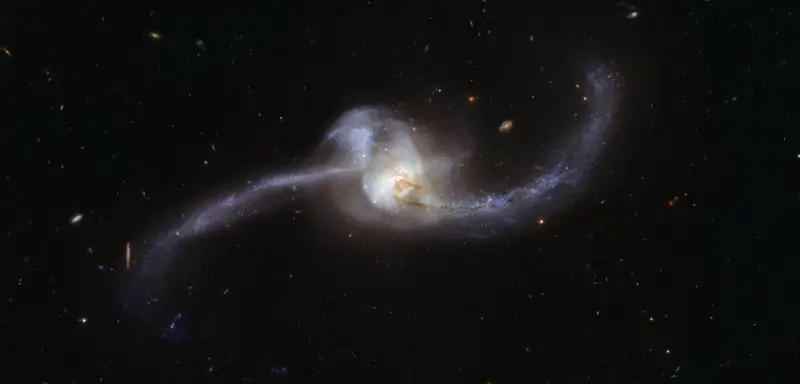
To understand the mystery, one must first visualize the scale of the players involved. At the heart of nearly every galaxy, including our own Milky Way, sits a supermassive black hole. These are not just ordinary celestial objects; they are titans with masses ranging from millions to billions of times that of our sun. When galaxies inevitably drift toward one another and begin to merge, these central black holes are drawn into a high-stakes dance.
As the galaxies coalesce, the two black holes begin to orbit one another, whipping around in ever-tightening circles. This orbital tango is so violent that it literally warps the geometry of space, sending out gravitational waves that radiate across the universe. Because there are countless galaxies merging at any given moment, the cosmos is filled with a constant, overlapping background of these ripples. In 2023, the North American Nanohertz Observatory for Gravitational Waves, or NANOGrav, announced they had finally “heard” this gravitational wave background.
But the discovery came with a shock. The measurements taken by NANOGrav and other international collaborations revealed waves that were significantly larger than the scientific community’s most sophisticated models had estimated. It was as if scientists expected the sound of a quiet conversation and instead walked into the middle of a roaring stadium. The search for the source of this extra “volume” led Comerford and her colleague Joseph Simon to look closer at the messy mechanics of how black holes actually grow during a merger.
The Scrappy Evolution of Little Giants
For a long time, the prevailing wisdom in astrophysics was that the “small” supermassive black holes—those only a few million times the mass of the sun—simply didn’t matter. They were the children in the pool, assumed to be making splashes so tiny they would be drowned out by the “cannonballs” thrown by the multibillion-sun behemoths. The models used to predict the gravitational wave background largely discounted these smaller players, focusing instead on the giants.
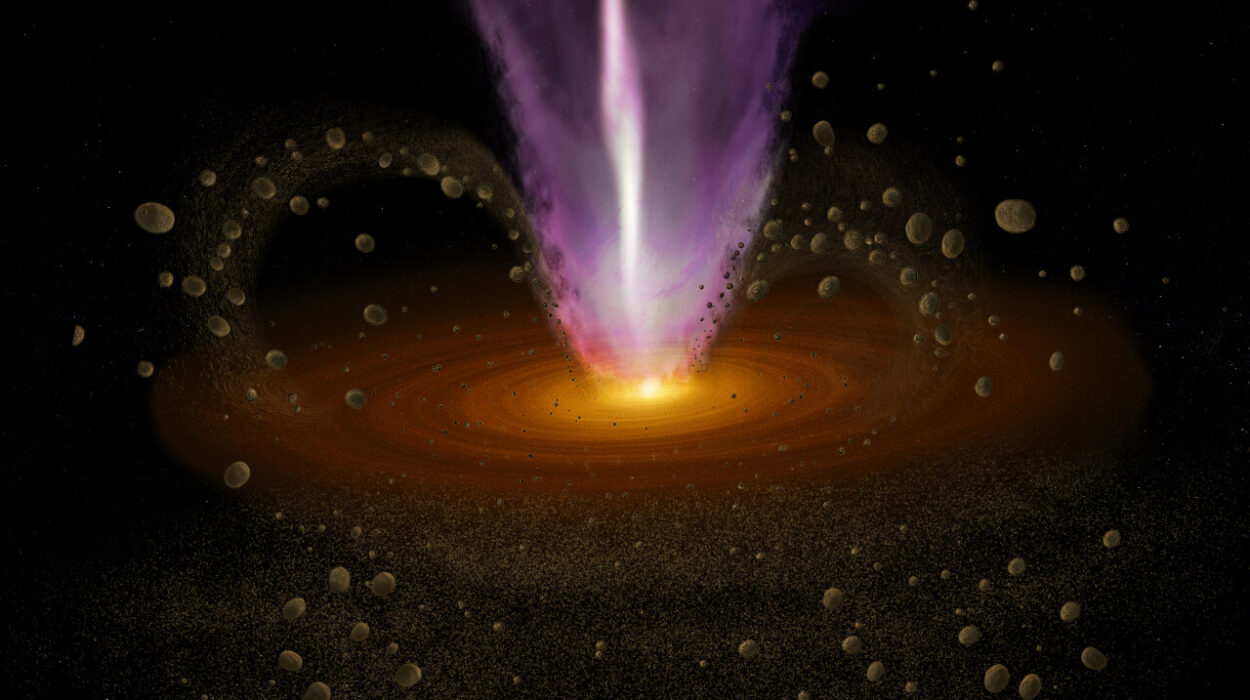
However, Comerford and Simon suspected that these smaller black holes were being underestimated. They realized that a galaxy merger is not a clean or polite event; it is a chaotic influx of matter. As two galaxies smash together, immense clouds of gas are funneled toward the center, forming a massive, doughnut-shaped ring of material around the pair of orbiting black holes. This is where the physics of growth begins to change the math of the universe.
In their simulations, the researchers noticed a phenomenon they call preferential accretion. Within the gas doughnut, the more massive black hole tends to sit closer to the center, a region that is surprisingly sparse in material. Meanwhile, the smaller black hole orbits further out, right in the thick of the gas cloud. It is perfectly positioned for a feast. While the big black hole waits at a nearly empty table, the smaller one is essentially swimming through an all-you-can-eat buffet.
The Power of a Ten Percent Tweak
To test if this lopsided feeding frenzy could explain the NANOGrav findings, Comerford designed a series of detailed equations to simulate the physics of merging galaxies. The team introduced a specific variable: they adjusted the math so that the smaller black holes grew just 10% more than their larger partners. It seemed like a modest change, a minor growth spurt in the grand scale of the cosmos.
The results were transformative. That single 10% increase in mass for the smaller black holes was the “magic number” that bridged the gap. With that extra weight, the smaller black holes produced waves powerful enough to make the simulated gravitational wave background match the real-world measurements captured by NANOGrav. It turned out the “small” black holes weren’t stayng small; they were bulked up by the gas of their merging galaxies, turning their tiny ripples into significant waves.
This discovery flips the script on how we view galactic evolution. It suggests that the “scrappy” black holes are the secret drivers of the cosmic hum. They may start out small, but because they grow at a much faster rate during the merger process, they end up contributing a massive amount of energy to the vibrations of the universe. By accounting for this preferential accretion, scientists have moved from a state of confusion to a much clearer understanding of why space-time is jiggling with such intensity.
Why Mapping the Cosmic Hum Matters
This research is about more than just solving a mathematical discrepancy; it is a window into the very origins of our universe. We live in a cosmos built from the “bottom up,” where tiny, primordial galaxies from the dawn of time merged over billions of years to create the massive structures we see today. Yet, a fundamental mystery remains: scientists still do not know exactly how supermassive black holes formed in the first place.
By understanding how these objects gain mass through gas consumption during mergers, researchers can begin to trace the lineage of the universe. It allows us to look back at those first gas-rich galaxies and understand how they built the gargantuan engines of gravity that anchor galaxies like our own. The study of the gravitational wave background is, in essence, a way of listening to the history of galactic growth.
The team at CU Boulder is now moving from computer screens to telescopes, launching new efforts to observe real galaxies caught in the act of merging. They want to see if the “physics of the buffet” they discovered in their simulations holds true in the deep reaches of space. Every ripple they measure brings us closer to answering the most fundamental questions about our existence: where we came from, how our galaxy was built, and what other secrets are hidden in the invisible waves that constantly move through us.
Study Details
Julia M. Comerford et al, Preferential Accretion onto the Secondary Black Hole Strengthens Gravitational-wave Signals, The Astrophysical Journal (2025). DOI: 10.3847/1538-4357/ae1133