Mars is often painted as a silent, rusted graveyard, a world where the clock stopped eons ago. Yet, if you were to stand upon its frigid plains, you would witness a landscape that is anything but still. The red horizon is frequently obscured by massive dust storms and towering dust devils that whirl across the surface, driven by a thin but restless atmosphere. These are not merely clouds of dirt; they are the engines of a massive, invisible power plant. As dust grains collide in the dry Martian air, they undergo frictional electrification, building up massive amounts of static energy.
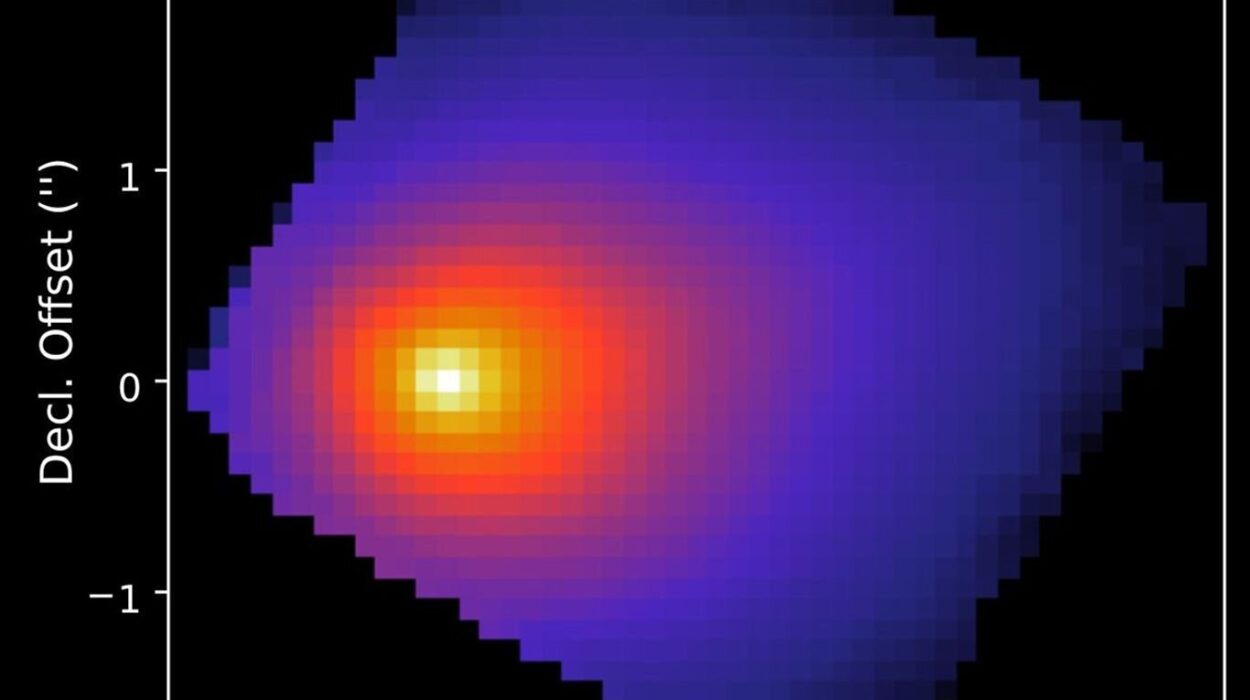
This buildup eventually reaches a breaking point, triggering electrostatic discharges or ESDs. Because the Martian atmosphere is so thin—far less dense than Earth’s—these electrical bursts happen more easily and frequently. They don’t look like the jagged, blinding lightning bolts we see during a summer storm on Earth. Instead, they manifest as eerie, subtle glows, reminiscent of the auroras that haunt our own North and South poles. These ghostly lights are the visual signature of a planet-wide laboratory, where electricity is busy tearing apart molecules and reassembling them into something new.
Recreating a Haunted World in a Laboratory
To understand how these faint sparks change the face of a planet, planetary scientist Alian Wang and her team turned to a pair of specialized chambers: PEACh (the Planetary Environment and Analysis Chamber) and SCHILGAR (the Simulation Chamber with InLine Gas AnalyzeR). Inside these metallic hulls, researchers meticulously recreated the harsh conditions of the Amazonian period, the current geological era of Mars characterized by extreme cold and dryness. By simulating the low atmospheric pressure and the specific gas mixtures of the Red Planet, they were able to witness the “geochemical dance” triggered by dust-induced electrochemistry.
The results were transformative. When the simulated Martian air was zapped with electrical discharges, a variety of complex chemicals began to emerge from the chaos. The team identified volatile chlorine species, activated oxides, and airborne carbonates. Most significantly, they found (per)chlorates, a type of salt that has been a major point of interest for every mission to the Martian surface. These reactions suggest that the Martian soil isn’t just sitting there; it is being actively processed by the electricity crackling through the dust. The ancient chloride deposits—the salty remains of Mars’s long-lost oceans—serve as the raw material for this ongoing electrical factory.
Finding the Fingerprints in the Dust
While identifying the chemicals was a breakthrough, the team needed a “smoking gun” to prove that these reactions were responsible for the planet’s current state. They found it in the isotopic signatures of the reaction products. Isotopes are versions of elements like chlorine, oxygen, and carbon that have different masses. Because they are minor constituents of matter, their ratios only change when a major, dominant process is at work. It is like a chemical fingerprint that records the history of how a substance was formed.
The team’s analysis revealed a substantial and coherent depletion of heavy isotopes across all three elements. This means the electrostatic discharges were systematically favoring lighter versions of atoms, leaving behind a specific mathematical trail. On Mars, the Curiosity rover had previously measured an unusually light chlorine isotopic signature—specifically a very negative δ37Cl value of -51‰. Wang’s experiments showed that ESDs drive isotopic fractionation in exactly that direction. While the lab results didn’t perfectly match the extreme lightness found by the rover, they moved the needle significantly, proving that electricity is the primary architect of the modern Martian chlorine cycle.
A Global Cycle of Falling Salts and Rising Gases
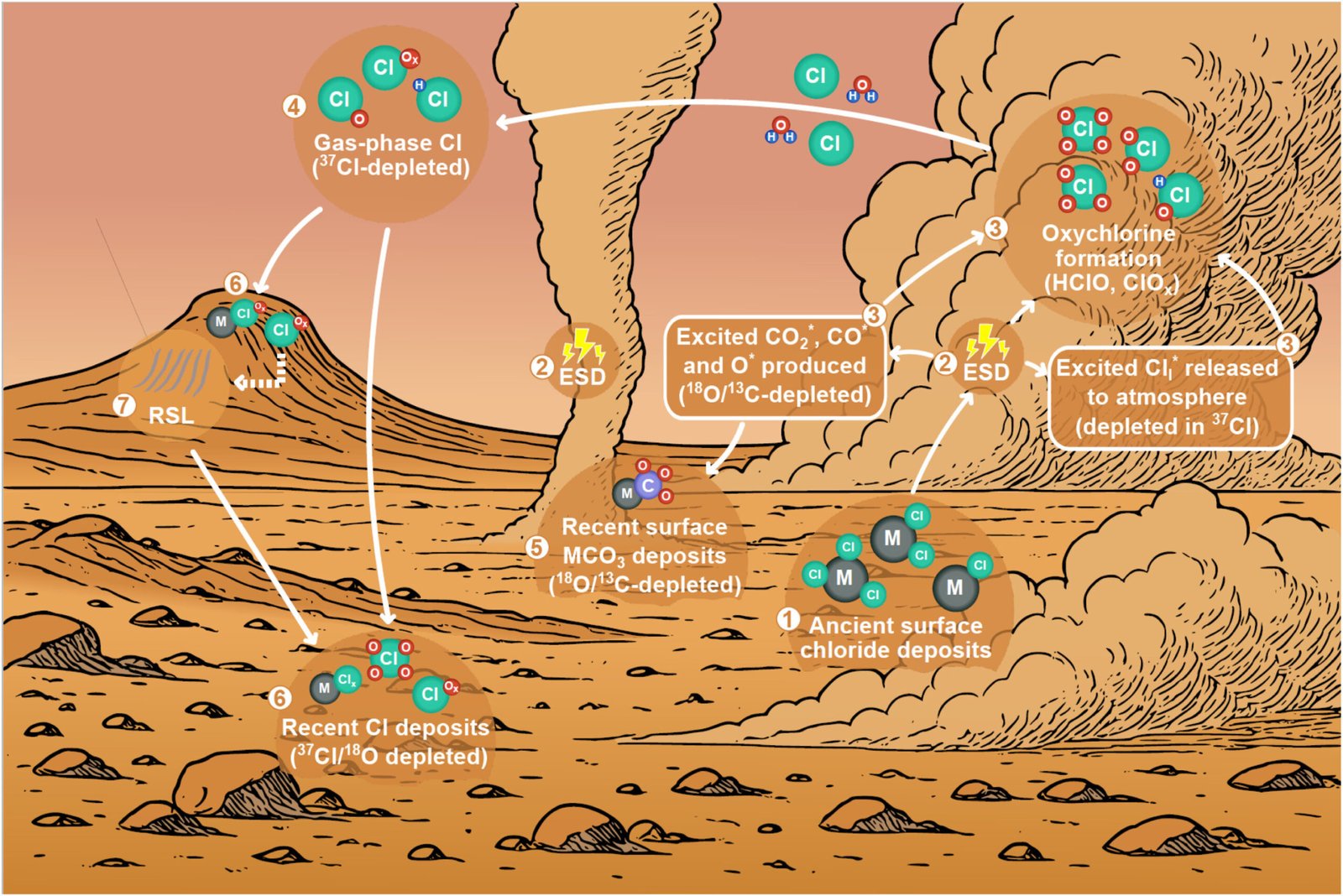
This research has allowed scientists to sketch a new conceptual model of how Mars “breathes” chemically. It begins with the dust. As storms lift particles into the sky, electricity breaks down the air and surface minerals, creating ESD products depleted of heavy isotopes. These new chemicals, including airborne carbonate minerals, eventually settle back onto the ground. Over time, these products don’t just sit on the surface; they can percolate into the subsurface, where they become part of the next generation of Martian minerals.
This cycle suggests a constant interplay between the ground and the sky, mediated by the energy of the wind. The Amazonian period, once thought to be a time of geological stagnation, is revealed to be a period of intense, slow-motion chemical evolution. The ongoing dust-driven electrochemistry has been scrubbing the atmosphere and the soil for millions of years, leading to the unique chemical makeup that modern rovers like Perseverance are now finding. In fact, Perseverance recently backed up this theory by recording 55 electric discharges during actual Martian dust events, providing real-world validation for the chamber experiments conducted back on Earth.
Why the Spark of Life and Light Matters
This research fundamentally changes how we view the “dead” planets of our solar system. By proving that triboelectric charging—the same force that gives you a shock when you touch a doorknob—can reshape the chemistry of an entire world, scientists have opened a door to understanding other celestial bodies. The same processes are likely occurring on Venus, where lightning may be altering the atmosphere, or on the Moon and the icy moons of the outer solar system, where energetic electrons bombard the surface.
Understanding the chlorine cycle and the formation of (per)chlorates is also vital for our search for life. These chemicals are highly reactive and influence whether an environment is hospitable or toxic. By decoding the “fingerprints” left by electrical discharges, we aren’t just learning about rocks and gas; we are learning how the environment of a planet is maintained over billions of years. This work provides the foundation for future missions, giving explorers the tools to distinguish between biological signatures and the natural, “electrified” chemistry of a restless, dusty world.
Study Details
Neil C. Sturchio et al, Isotope effects (Cl, O, C) of heterogeneous electrochemistry induced by Martian dust activities, Earth and Planetary Science Letters (2026). DOI: 10.1016/j.epsl.2025.119784