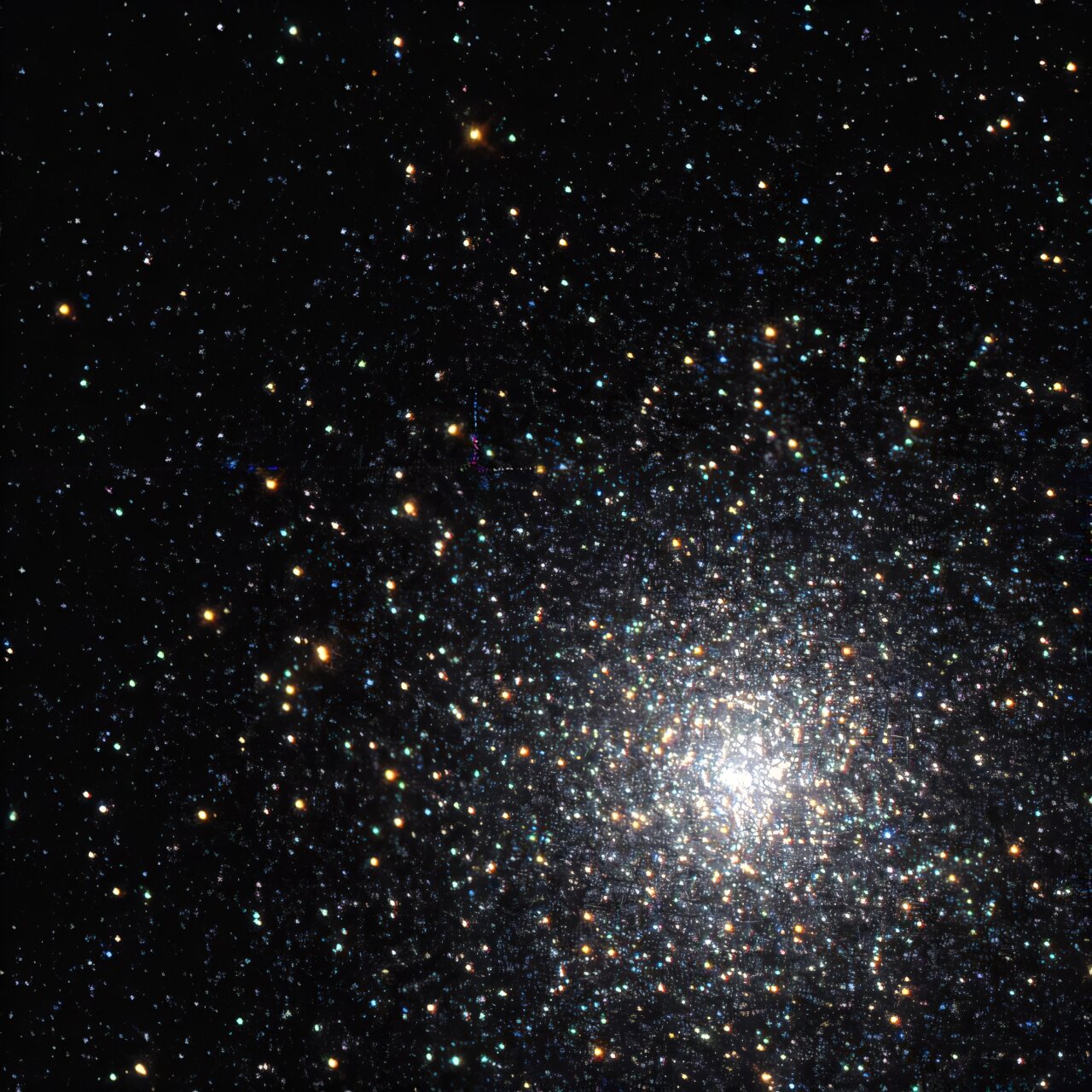
Deep in the outer reaches of our galaxy, a luminous relic from the dawn of time is whispering secrets that could change how we understand the architecture of the universe. This ancient traveler, known to astronomers as NGC 5824, is not just another collection of stars. Located approximately 104,000 light years away in the Milky Way’s outer halo, it stands as a brilliant, dense powerhouse of light. For decades, it has sat quietly on the edge of our galactic neighborhood, but a team of astronomers led by Paula B. Díaz from the University of Chile recently turned a suite of powerful telescopes toward it, uncovering a structure so vast and mysterious that it challenges the very definition of what a globular cluster should be.
A Ghostly Glow in the Outer Darkness
To understand why NGC 5824 is currently captivating the scientific community, one must first appreciate its sheer scale and age. At 12.8 billion years old, it is nearly as old as the universe itself. It boasts a staggering mass of roughly 1 million solar masses, making it the second brightest globular cluster in the outer reaches of the Milky Way. While most globular clusters are thought of as tightly packed, spherical “snowballs” of stars held together by their own gravity, NGC 5824 is different. It is surrounded by a diffuse stellar envelope, a ghostly shroud of stars that extends far beyond what scientists call the tidal radius—the point where the cluster’s gravity should theoretically lose its grip.
For a long time, the origin of these far-flung stars remained a cosmic puzzle. Were they being stripped away by the Milky Way’s gravity, or were they still bound to the cluster center by an invisible force? To find out, the research team utilized data from the Magellan Clay telescope and the Canada-France-Hawaii Telescope (CFHT), blending these observations with high-precision measurements from the ESA’s Gaia satellite. By combining deep and homogeneous imaging with high-precision astrometry, they were able to map the cluster’s neighborhood with unprecedented clarity, looking for the telltale signs of how these stars move and where they truly belong.
Mapping the invisible architecture
The investigation relied on more than just taking pictures; it required a deep dive into the photometric and proper motion data of the cluster. By analyzing color-magnitude diagrams, the researchers could pick out which stars were true members of NGC 5824 and which were merely background actors in the celestial play. They further assessed the luminosity function—a way of measuring the brightness distribution of the stars—to see how the cluster was shaped in three-dimensional space.
What they found was a structure of remarkable consistency. The cluster does not just end abruptly; instead, it is symmetrically extended to a distance of at least 20 arcminutes from its center. Even more intriguing was the outer surface density profile. The researchers discovered that the density of stars thins out following a specific power-law index of -2.6. Crucially, the cumulative luminosity functions confirmed that this extension isn’t a lopsided trail of debris being dragged behind the cluster like a tail. Instead, it is a balanced, symmetrical envelope that surrounds the cluster in every direction. This symmetry is a vital clue, suggesting that whatever is holding these stars in place is part of the cluster itself, rather than an external tidal force pulling it apart.
The Secret Weight of a Hidden Giant
The most provocative finding of the study, published recently on the arXiv pre-print server, concerns what the astronomers couldn’t see. In a typical globular cluster, the density of stars should eventually drop off or “truncate” as the cluster’s gravity gives way to the influence of the host galaxy. However, in NGC 5824, the team observed an absence of truncation in the density profile. This lack of a clear boundary is highly unusual. It suggests that the cluster is much “heavier” than the light of its stars would suggest.
The researchers compared their observations with the Peñarrubia et al. (2017) model, a mathematical framework used to predict how clusters behave under different conditions. The data aligned with a startling possibility: NGC 5824 may be embedded within a dark matter halo. If true, this would be a groundbreaking discovery. While entire galaxies are known to sit inside massive clouds of dark matter, globular clusters are generally thought to be devoid of it. If this ancient cluster has retained its own private reservoir of dark matter for billions of years, it would mean that NGC 5824 didn’t form like a normal cluster. Instead, it might be the stripped-down remains of a dwarf galaxy that was swallowed by the Milky Way long ago, leaving only its dense heart and a lingering halo of invisible matter.
Hunting for the Final Proof
While the evidence for a dark matter component is compelling, the team is cautious. To move from a suggestion to a scientific certainty, they need more than just maps of where the stars are; they need to know how fast they are moving. The study concludes that the next vital step is to obtain kinematic data through further spectroscopic observations. By measuring the radial velocities of the stars in the cluster’s outermost fringes, scientists can calculate exactly how much gravity is pulling on them.
If those outer stars are moving faster than the visible stars can account for, it will provide the “smoking gun” for dark matter. These measurements will allow the team to definitively distinguish whether the extended structure is a result of hidden mass or other dynamical effects related to the cluster’s journey through the Milky Way. For now, NGC 5824 remains a tantalizing enigma—a 12-billion-year-old relic that may be holding onto the very substance that helped build the universe.
Why This Research Matters
The study of NGC 5824 is significant because it challenges our fundamental understanding of how sub-galactic structures form and survive. If a globular cluster can host a dark matter halo, it suggests a much more complex “family tree” for our galaxy. It implies that many of the objects we see as simple clusters might actually be the “skeletons” of ancient, small galaxies that donated their mass to help the Milky Way grow.
Furthermore, because NGC 5824 is located in the outer halo, it serves as a pristine laboratory. In this quiet, distant region, the cluster is less affected by the chaotic center of the galaxy, allowing astronomers to see the “fossil” records of the early universe. Identifying dark matter in such a small-scale object would provide crucial data points for physicists trying to map out exactly what dark matter is and how it interacts with normal matter over billions of years. By looking at this bright, distant speck of light, we are actually looking at the invisible glue that holds the cosmos together.
Study Details
Paula B. Díaz et al, The case of NGC 5824, a cluster possibly embedded in a dark matter halo, arXiv (2026). DOI: 10.48550/arxiv.2603.05605