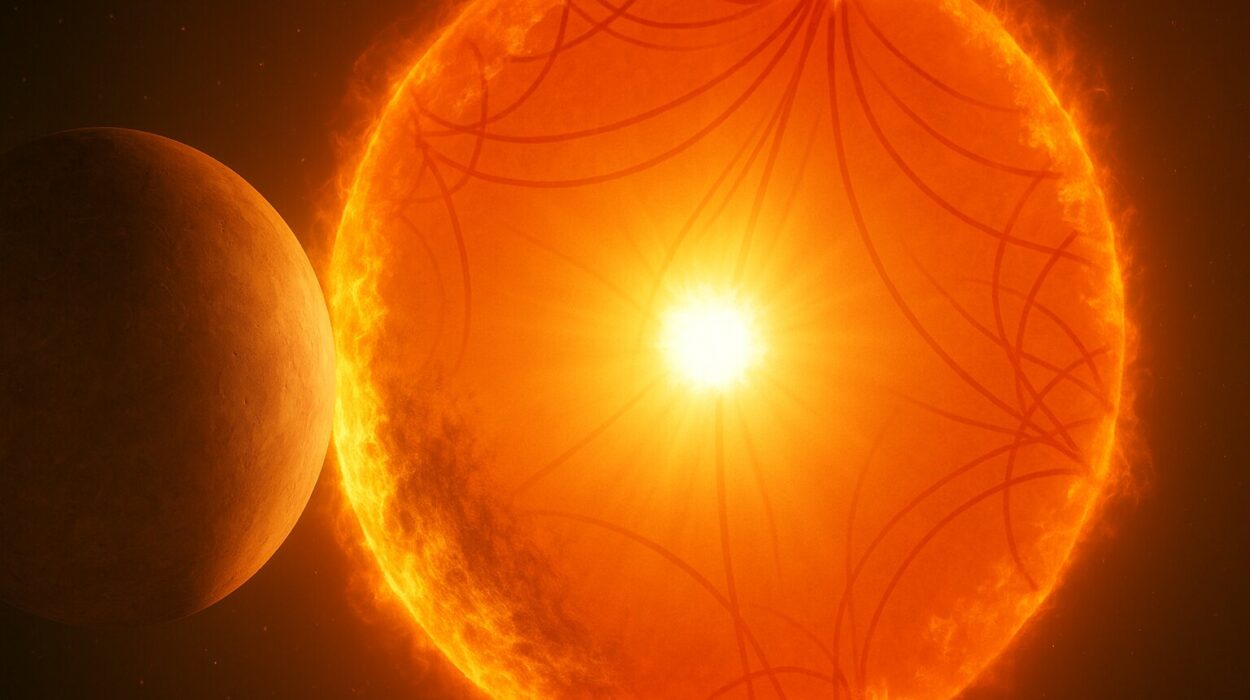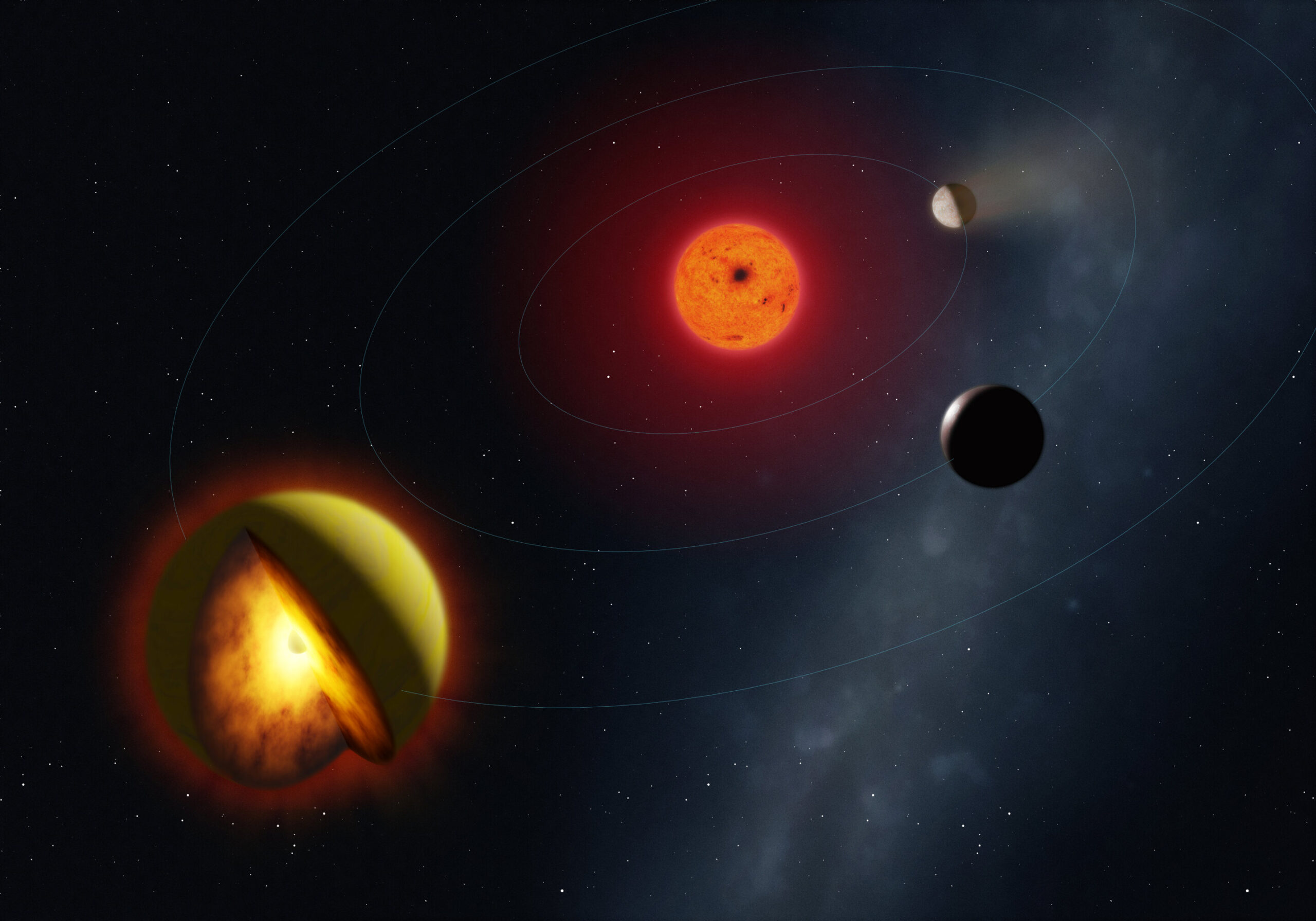
Around a small, glowing red star some 35 light-years away from our own familiar neighborhood, a world exists that defies every category we once thought we understood. This is the story of L 98-59 d, an exoplanet roughly 1.6 times the size of Earth, which has recently been unmasked by the James Webb Space Telescope (JWST). For years, astronomers viewed the cosmos through a binary lens: a small planet was either a rocky “gas-dwarf” wrapped in hydrogen, or it was a “water-world” composed of deep, freezing oceans and thick layers of ice. But as the light from this distant star passed through the atmosphere of L 98-59 d, it carried a chemical signature that didn’t fit the script. It was a scent of something far more pungent and primordial.
A Secret Hidden Beneath the Clouds
The first clue that something was amiss came from the planet’s low density. Despite its significant size, it wasn’t heavy enough to be a simple hunk of rock like Earth or Mars. When the JWST and ground-based observatories peered closer in 2024, they detected an atmosphere rich in hydrogen sulfide—the gas famously responsible for the smell of rotten eggs. This discovery sent a shockwave through the scientific community. To understand why a planet would be shrouded in such a sulfurous veil, a team of researchers from the University of Oxford, the University of Groningen, the University of Leeds, and ETH Zurich began a digital journey into the planet’s deep past.
They didn’t just look at the planet as it is today; they used advanced computer simulations to reconstruct nearly five billion years of history. By linking the telescope’s observations to physical models of planetary interiors, they effectively turned back the clock to the moment of the planet’s birth. What they found was not a world of water or a typical gas giant, but a landscape dominated by fire and chemistry. Deep beneath its gaseous exterior, L 98-59 d harbors a permanent, global ocean of magma.
The Great Molten Reservoir
This is not a temporary sea of lava like those found on a young, cooling Earth. Instead, the mantle of L 98-59 d is a vast, molten silicate reservoir extending thousands of kilometers into the dark. This liquid interior acts as a massive storage locker for sulfur. In the crushing heat and pressure of the deep mantle, sulfur molecules are trapped and held over geological timescales. This molten heart is the engine that drives everything we see from our telescopes millions of miles away.
The existence of this magma ocean explains a long-standing mystery: how a planet so close to its star could keep its atmosphere. Usually, the intense X-ray radiation from a red dwarf star would strip a planet of its hydrogen-rich atmosphere, blowing it away into the vacuum of space. However, on L 98-59 d, a constant chemical exchange occurs between the molten interior and the sky. The magma ocean buffers the volatile gases, slowly releasing them to replenish what is lost. It is a world in a state of eternal, pungent exhaling, maintaining a thick shroud of hydrogen sulfide and sulfur dioxide.
A Transformation Across Aeons
The simulations suggest that L 98-59 d was not always the “pungent planet” we see today. In its infancy, it likely formed with a massive hoard of volatile material, looking more like a sub-Neptune—a larger, fluffier world. Over billions of years, the planet began to shrink and cool, shedding layers of its outer atmosphere while its interior remained stubbornly molten. The ultraviolet light from its host star, L 98-59, continues to trigger chemical reactions in the upper reaches of the sky, creating the sulfur dioxide that the JWST detected.
This discovery introduces an entirely new class of celestial body: the gas-rich sulfurous planet. It suggests that the diversity of the galaxy is far more colorful—and perhaps more aromatic—than we ever dared to imagine. While L 98-59 d is an unlikely candidate for life as we know it, its existence teaches us about the universal initial states of all rocky worlds. Even our own Earth and Mars began their lives as glowing balls of magma. By studying this distant, molten outlier, we are essentially looking into a mirror of our own primordial history, albeit one where the chemistry took a very different, sulfur-heavy turn.
Why This Alien World Matters
The revelation of L 98-59 d is a reminder that our current categories for planets are perhaps too simple. As we stand on the precipice of a new era of discovery—with data pouring in from the JWST and upcoming missions like Ariel and PLATO—we are learning that the universe does not always follow our established rules. By using machine learning and complex modeling to “visit” interiors we can never physically touch, researchers are beginning to map the true diversity of the cosmos.
Understanding these long-lived magma oceans and the way they store gases like sulfur is crucial for the future of astronomy. It helps scientists set expectations for which worlds might be habitable and which are destined to remain beautiful, toxic furnaces. Most importantly, it proves that by looking 35 light-years away, we can uncover the hidden mechanisms that govern the birth and evolution of every planet in the galaxy, including our own. The “rotten egg” clouds of L 98-59 d are more than just a chemical curiosity; they are a beacon, signaling that there are still many strange and wonderful types of worlds waiting to be uncovered.
Study Details
Volatile-rich evolution of molten super-Earth L 98-59 d, Nature Astronomy (2026). DOI: 10.1038/s41550-026-02815-8