Deep in the silent expanse of our galactic neighborhood, a small, unassuming star has been harboring a secret for billions of years. Located just 83 light years away, a distance that is practically a stone’s throw in cosmic terms, this star remained a quiet observer of the universe until a sophisticated piece of human technology turned its gaze toward it. This is the story of TOI-1080, an ancient, dim star, and the hidden world that has finally been revealed by a team of dedicated astronomers.
A Sentinel in the Sea of Stars
The hunt for new worlds is a monumental task that requires patience and precision. Leading the charge is NASA’s Transiting Exoplanet Survey Satellite, better known as TESS. This orbital scout is currently on a mission to survey approximately 200,000 of the brightest stars near our sun, watching for the tiniest flicker in their light. These flickers, or transits, occur when a planet crosses in front of its host star from our perspective, momentarily blocking a fraction of its glow.
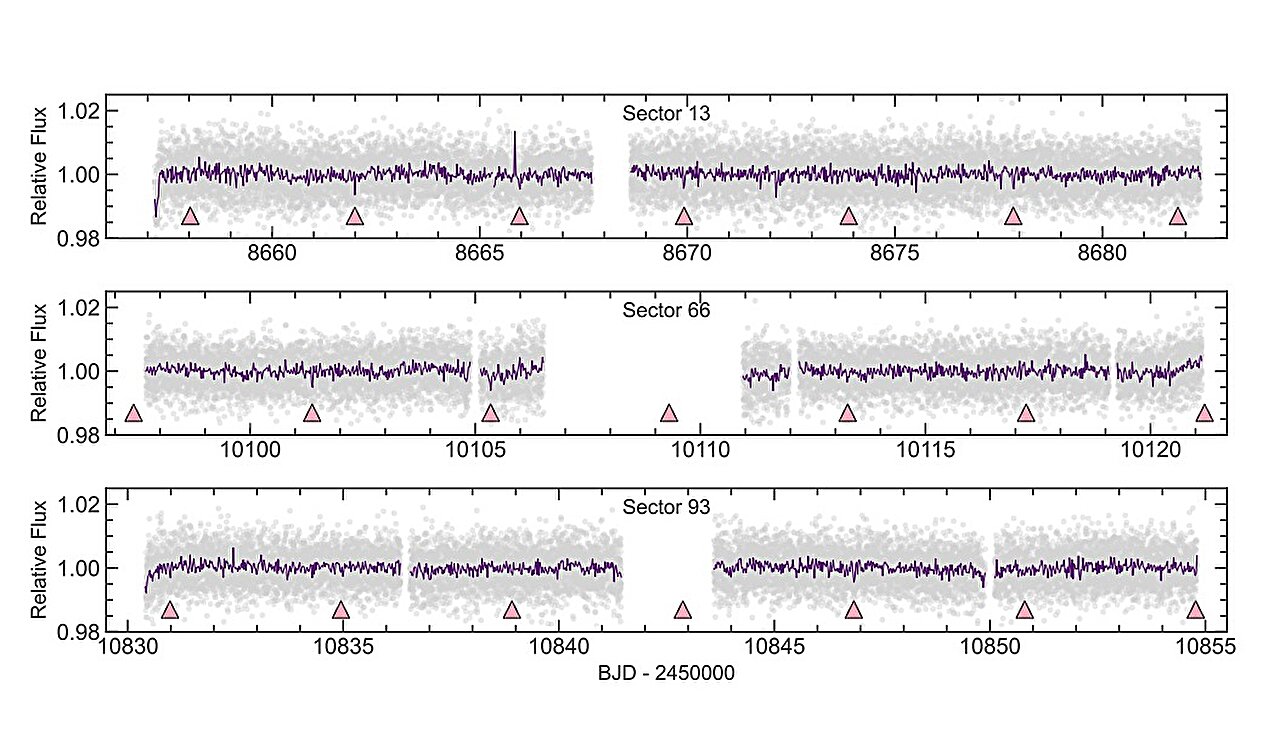
To date, the mission has been incredibly prolific, cataloging nearly 7,900 potential candidates. However, a signal is just a whisper until it is proven. Out of those thousands of candidates, only 759 have been officially confirmed as true extrasolar worlds. The latest addition to this elite group is TOI-1080 b, a discovery led by astronomer Yilen Gómez Maqueo Chew and a team from the National Autonomous University of Mexico. By analyzing the light curve of the host star, the team caught the rhythmic shadow of a planet that had been dancing in the dark for eons.
The Ancient Host and its Shadow
To understand the planet, one must first understand the sun it calls home. The star, TOI-1080, is a far cry from our own yellow sun. It is a spectral type M4V star, a category often called a red dwarf. These stars are the long-lived marathon runners of the universe. This particular star is estimated to be at least 5 to 7 billion years old, making it potentially older than our entire solar system.
Despite its age, TOI-1080 is quite small and cool. It possesses only about 0.16 solar masses and is roughly five times smaller than our sun. Its surface temperature hovers around 3,065 K, and the researchers describe it as an inactive star, meaning it lacks the violent solar flares and magnetic storms often seen in younger, more temperamental red dwarfs. It was in the steady, quiet light of this ancient anchor that astronomers found the signature of a new super-Earth.
A Rocky World in the Fast Lane
The planet itself, TOI-1080 b, is a fascinating study in extremes and similarities. It is slightly larger than our home, with a radius of approximately 1.2 Earth radii. While its exact weight is still being refined, scientists estimate its mass is likely around 1.75 Earth masses, though it could be as high as 10.7 Earth masses. Because of these dimensions, it has been officially classified as a super-Earth, a type of planet that doesn’t exist in our own solar system but appears to be common throughout the galaxy.
Life on TOI-1080 b would be defined by its breakneck pace. The planet sits incredibly close to its host star, at a distance of only 0.027 AU. For comparison, this is a tiny fraction of the distance between Earth and the sun. Because it is so close, it completes a full trip around its star in just 3.97 days. On this world, a “year” passes in less than a standard human work week.
Despite this proximity, the world is categorized as a temperate planet because its host star is so much cooler than our sun. The equilibrium temperature of the planet is roughly 368 K. While this is too hot for liquid water to sit comfortably on the surface like it does on Earth, it is relatively mild compared to the scorched, molten surfaces of other short-period exoplanets. This temperature suggests a world that is likely rocky in composition, providing a solid foundation rather than a bloated ball of gas.
Searching for an Invisible Veil
One of the most intriguing aspects of the discovery is what might be wrapping around this rocky orb. Because TOI-1080 b is positioned just inside the habitable zone of its star, researchers have begun to speculate about its potential for an atmosphere. Without the heavy radiation of an active star to strip it away, it is possible that this super-Earth has held onto a carbon dioxide or even a massive oxygen atmosphere.
However, seeing an atmosphere across 83 light years of void is no easy feat. The team noted that while the presence of these gases is a compelling possibility, we won’t know for sure until atmospheric characterization studies are conducted. These future observations will act like a chemical fingerprint, identifying the specific molecules that linger in the planet’s sky as it passes in front of the red dwarf star.
A Lonely Orbit in a Quiet Neighborhood
In many systems involving M dwarfs, it is common to find a whole family of planets huddled close together. With this in mind, the astronomers used the TESS photometry to hunt for siblings of TOI-1080 b. They looked for any other shadows crossing the star, but for now, the planet seems to be a solitary traveler.
The researchers were able to rule out any other transiting planets larger than 0.9 Earth radii that might have orbits between half a day and roughly a week. Even looking further out, they could find no evidence of planets larger than 1.4 Earth radii with orbital periods up to 19 days. While it is possible that smaller worlds or planets with tilted orbits are hiding there, TOI-1080 b currently stands alone in the data.
Why This Ancient World Matters
The discovery and validation of TOI-1080 b is more than just adding another name to a celestial ledger; it is a vital piece of the puzzle in our quest to understand the diversity of worlds in the Milky Way. By finding a rocky, temperate super-Earth orbiting an inactive M4V star, astronomers have identified a perfect laboratory for future study.
Because the host star is “quiet” and relatively close to Earth, it provides an ideal backdrop for telescopes to peer into the planet’s potential atmosphere. Every planet like this helps scientists refine their models of how planetary systems form around the most common stars in the universe. In the quiet glow of an ancient red dwarf, we have found a stable, rocky neighbor that may soon teach us exactly what a super-Earth’s sky is made of, bringing us one step closer to understanding the true nature of the cosmos.
Study Details
Y. Gómez Maqueo Chew et al, TOI-1080 b: a temperate, rocky planet orbiting a quiet M4V host, arXiv (2026). DOI: 10.48550/arxiv.2603.00385