Imagine a landscape over three million years ago in what is now the Afar region of Ethiopia. The air is thick with the scent of shrublands and wetlands, and the ground is a mosaic of gallery forests and wet grasslands. In this prehistoric world, our famous ancestor Lucy, a member of the species Australopithecus afarensis, moved through the trees and across the open ground. While Lucy is celebrated by modern science for proving that bipedalism—walking on two legs—evolved before our large brains, she was not the undisputed master of her domain. In the shadows of the riverbanks, a silent, armored titan was watching.
Researchers led by the University of Iowa have recently pulled back the curtain on this ancient predator. For decades, the fossils of this creature sat in the collections of a museum in Addis Ababa, waiting for someone to decode their story. When Professor Christopher Brochu, a veteran of crocodile research for thirty-five years, finally examined the specimens in 2016, he found himself face-to-face with a “weird” combination of physical traits that defied existing classifications. This was not just another reptile; it was a new species entirely, one that the team has formally named Crocodylus lucivenator.
An Ambush in the Shallows
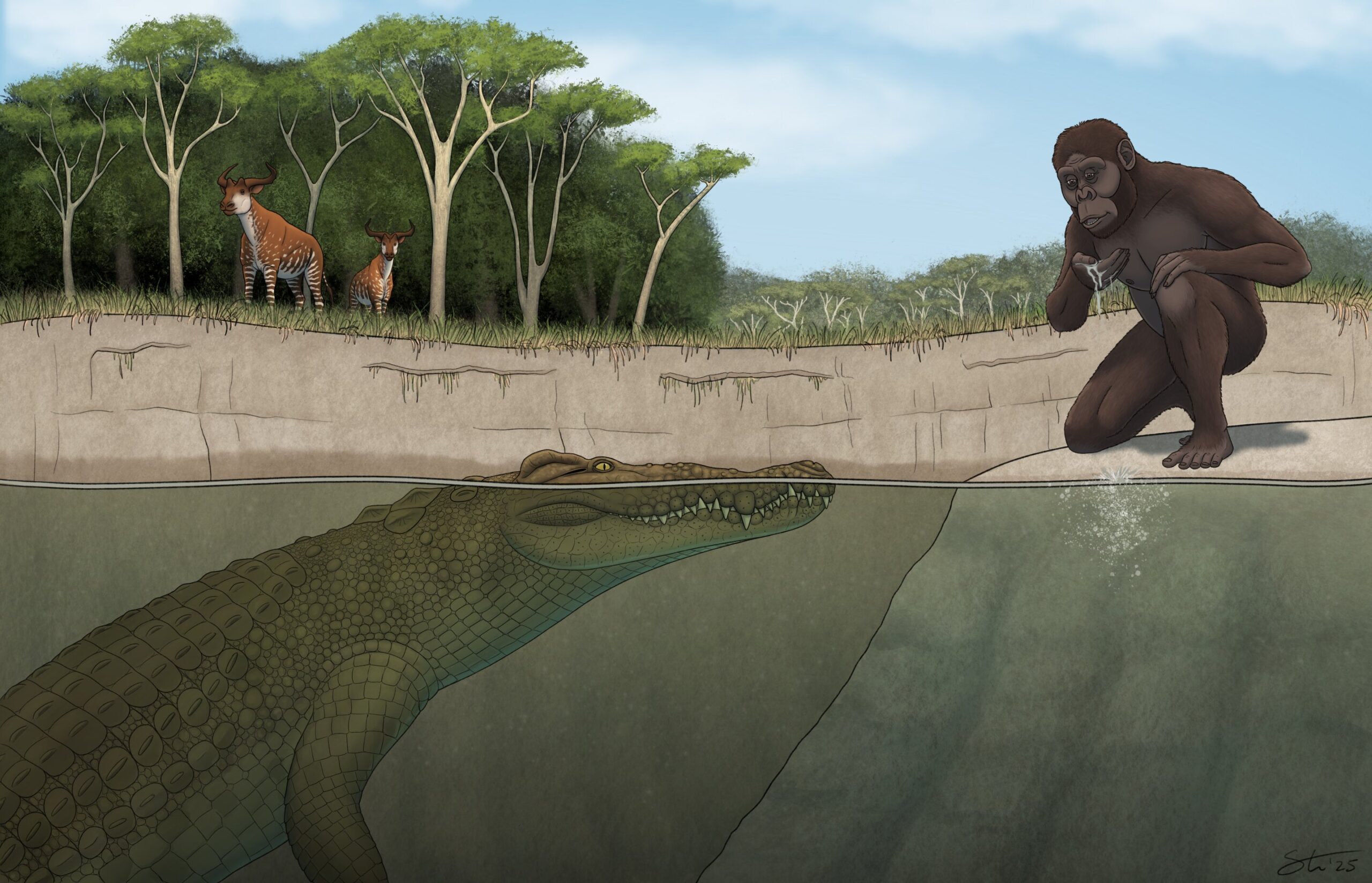
The name Crocodylus lucivenator translates translates to “Lucy’s hunter,” a title that captures the terrifying reality of life in the Pliocene epoch. This reptile was a massive ambush predator, perfectly designed to dominate the lake and river systems of the Hadar site. Growing to lengths of 12 to 15 feet and weighing anywhere from 600 to 1,300 pounds, it was a heavyweight of the ecosystem.
While the savanna held dangers like lions and hyenas, they paled in comparison to the threat lurking beneath the water’s surface. As the largest predator in that environment, the Lucy’s hunter crocodile was a near-certain predator of our hominin ancestors. It would have remained silently submerged, with only its eyes and nostrils breaking the surface, waiting for a thirsty Australopithecus afarensis to approach the water’s edge. To this crocodile, the creatures that would eventually become us were simply “dinner.”
The Mystery of the Hump
What makes Crocodylus lucivenator stand out to paleontologists isn’t just its size, but its strange appearance. When Brochu first analyzed the 121 cataloged remains, which included skulls, teeth, and jaw fragments, he noticed a feature that seemed out of place for an African crocodile. In the middle of its snout, the creature sported a prominent lump or hump.
This physical “weirdness” is a trait seen in modern American crocodiles, but it is notably absent in the Nile crocodiles that inhabit Africa today. Scientists believe this hump wasn’t a weapon, but rather a tool for social communication. In the world of the Crocodylus lucivenator, a male might have lowered its head toward a female, displaying the large growth as a way to attract a mate.
Beyond the hump, the animal possessed a snout that extended significantly further from its nostrils than other crocodiles of that era. This elongated profile actually makes it look more like the modern crocodiles we see today than its own contemporary relatives. These distinct features—the long snout and the ornamental hump—mark it as a unique evolutionary branch in the crocodile family tree.
Scars of a Prehistoric Life
The fossils gathered from Hadar, a UNESCO World Heritage site since 1980, tell stories of individual lives, not just a species profile. Among the dozens of individuals represented in the find, one particular specimen caught the eye of researcher Stephanie Drumheller. This individual possessed a jaw marked by several partially healed injuries.
These scars are the smoking gun of a face-biting encounter. Such aggressive behavior is common among modern crocodiles, who frequently tussle with their peers over territory or mates. Because the bone showed clear signs of healing, the researchers know that this specific crocodile survived the brutal fight. Whether it won or lost the battle is lost to time, but the presence of the injury proves that these predators were as dangerous to each other as they were to the creatures drinking at the shore.
The Sole Ruler of the Hadar Waters
One of the most surprising revelations of the study is the exclusive nature of this crocodile’s territory. In the Eastern Rift Valley to the south, the fossil record shows at least three different species of crocodiles living in relatively close proximity. However, in the Hadar region, Crocodylus lucivenator appears to have been the lone crocodile on the landscape.
Despite the fact that the environment was constantly shifting between open and closed woodlands, shrublands, and various water systems, this species was one of the few that managed to persist throughout the changes of the Pliocene. It was a specialist in survival, maintaining a monopoly on the waterways of Hadar for hundreds of thousands of years.
Why This Discovery Matters
Understanding Crocodylus lucivenator is about more than just identifying a new prehistoric reptile; it provides a vital missing piece of the puzzle regarding human evolution. By identifying the dominant predator of the Hadar ecosystem, researchers can better reconstruct the intense evolutionary pressures that shaped our ancestors.
The presence of a 15-foot ambush predator helps explain the environment in which Lucy and her kin lived, moved, and survived. It reminds us that our ancestors were not just wandering explorers; they were prey. Knowing that Lucy’s hunter was a “near certainty” in her life adds a layer of survivalist drama to the story of bipedalism and early human development. This research highlights the interconnectedness of ancient life, showing that to truly understand the history of humanity, we must also understand the giants that waited for us in the water.
Study Details
Lucy’s Peril: A Pliocene Crocodile from the Hadar Formation, Northeastern Ethiopia, Journal of Systematic Palaeontology (2026). tandfonline.com/doi/full/10.10 … 4772019.2026.2614954