The world was dying, but Lystrosaurus was just getting started. Some 252 million years ago, Earth endured the End-Permian Mass Extinction, a cataclysm so absolute it earned the nickname “The Great Dying.” As the oceans turned acidic and the land baked under a relentless, suffocating heat, the majority of life simply flickered out. Yet, amidst the scorched landscapes and prolonged droughts, a sturdy, pig-sized mammal ancestor didn’t just survive—it became the most successful animal on the planet. For decades, scientists wondered how this hardy pioneer managed to rebuild a world from the ashes, and more specifically, how it brought the next generation into such a hostile environment.
A Secret Hidden in Stone
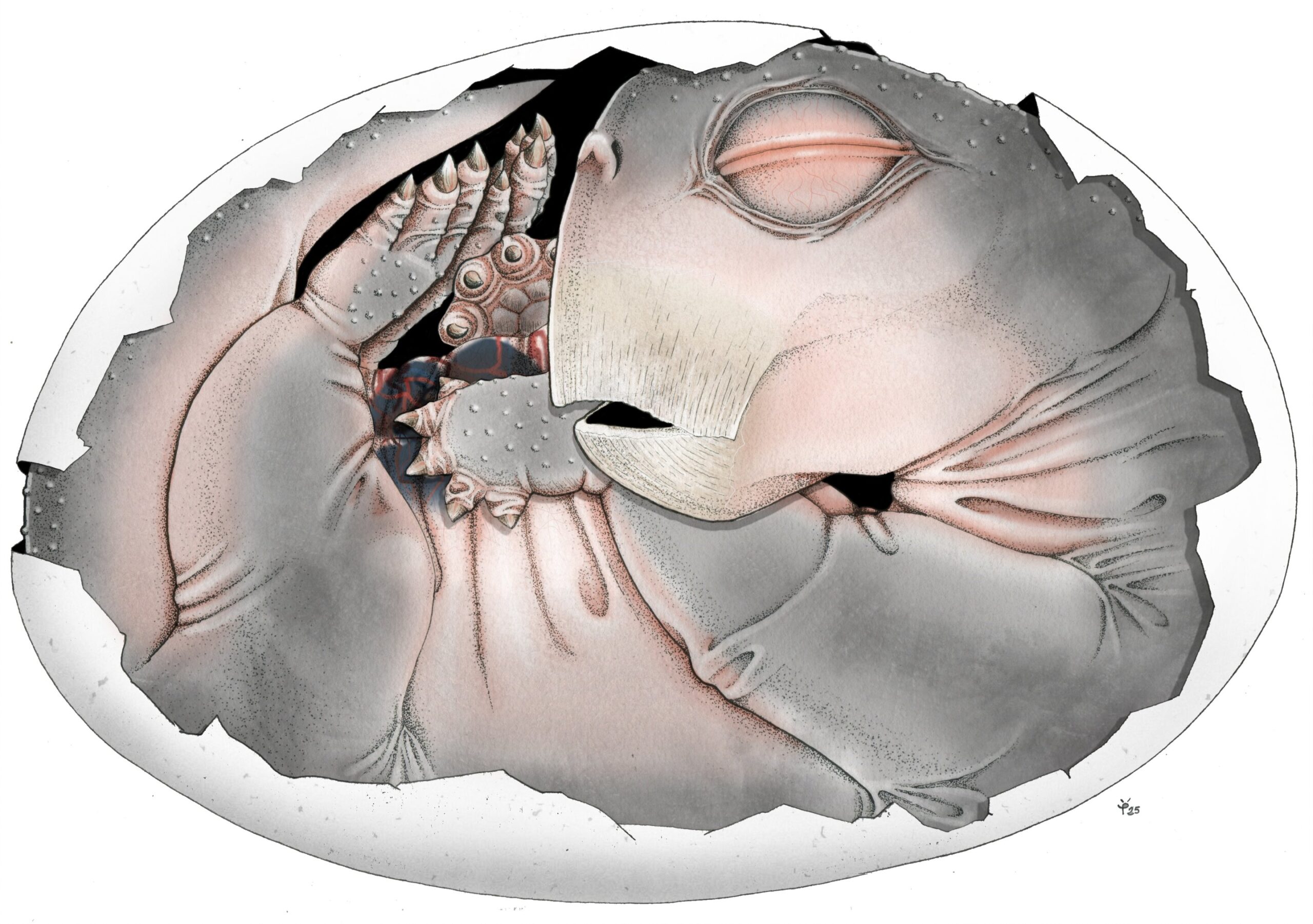
The journey to solving this mystery began not in a high-tech lab, but in the rugged terrain of South Africa in 2008. Professor Jennifer Botha was leading a field excursion when a fossil finder named John Nyaphuli spotted a modest, unremarkable nodule of stone. To the untrained eye, it was just another rock, but Nyaphuli saw a few tiny flecks of bone peeking through the surface. As the specimen was meticulously cleaned and prepared, a breathtaking scene emerged: a perfectly curled-up Lystrosaurus, frozen in time for 250 million years.
Professor Botha suspected she was looking at an embryo—a creature that had perished before it ever took its first breath in the open air. However, the evidence was frustratingly incomplete. There was no visible, hardened eggshell surrounding the tiny skeleton, leaving the team with a haunting question they couldn’t answer with the tools of the time. For seventeen years, the little fossil held its breath, waiting for technology to catch up with the secrets locked inside its stony tomb.
Peering Through the Veil of Time
That breakthrough finally arrived through the power of the European Synchrotron Radiation Facility (ESRF) in France. By using advanced synchrotron X-ray CT scans, an international team led by Professor Julien Benoit and Dr. Vincent Fernandez was able to “see” through the rock with unprecedented clarity. These bright X-rays acted like a digital scalpel, revealing the internal anatomy of the hatchling at a level of detail that was previously impossible.
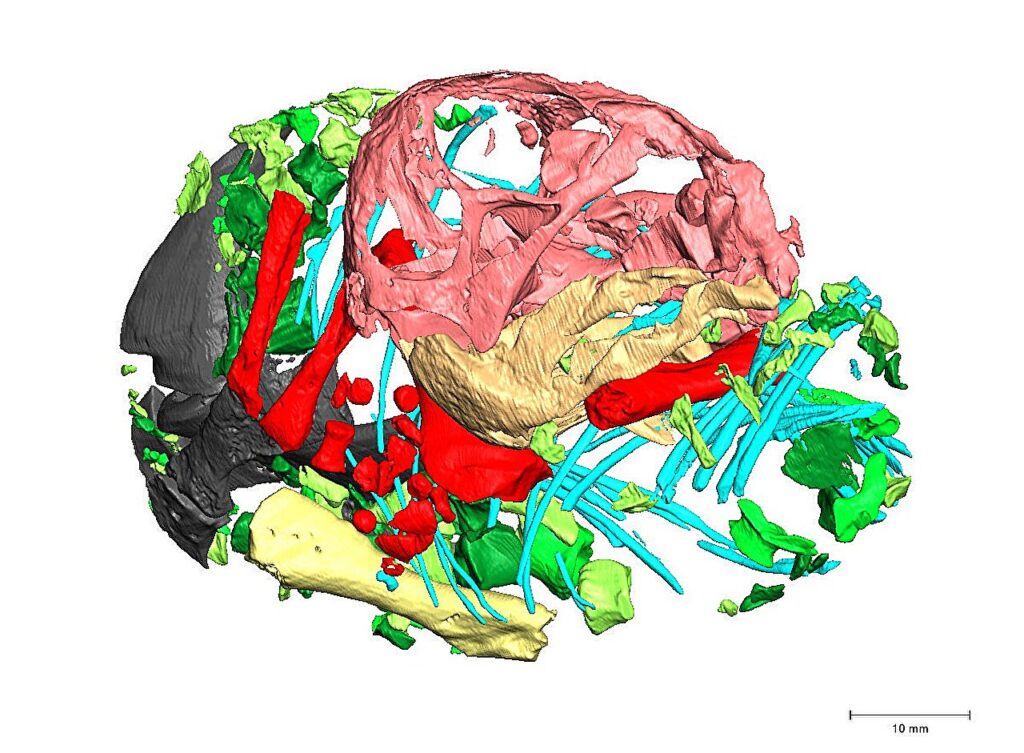
The “smoking gun” was found in the creature’s jaw. When the researchers examined the mandible, or lower jaw, they noticed something critical: the mandibular symphysis—the point where the two halves of the jaw meet—was incomplete. In a living, breathing animal, these two halves must fuse together before it can effectively feed itself. The fact that this fusion hadn’t happened yet proved that this individual was a pre-hatching embryo, physically incapable of survival outside the protective confines of an egg.
The Mystery of the Missing Shell
This discovery provided the first-ever direct evidence that the ancestors of mammals were egg-layers. For over 150 years, paleontologists had searched for a therapsid egg, but they had always come up empty-handed. The reason, it turns out, was a matter of chemistry. Unlike the hard, mineral-rich shells of dinosaurs that turn to stone easily, Lystrosaurus likely laid soft-shelled eggs. These leathery containers were delicate and prone to decay, rarely surviving the brutal process of fossilization.
Finding one was a biological miracle, but the size of the egg told an even more important story about survival. The scans indicated that these eggs were relatively large compared to the animal’s body size. In the natural world, a large egg is a heavy investment; it is packed with a massive amount of yolk. This nutrient-rich fuel meant the embryo could develop fully and hatch as a precocial youngster—an animal born at an advanced stage, ready to hit the ground running.
A Strategy for a Broken World
This “live fast, die young” reproductive strategy was the engine behind the Lystrosaurus success story. Because the eggs were large and full of yolk, the young didn’t need their parents to feed them; they were born capable of finding their own food and dodging predators. This also confirms that Lystrosaurus did not produce milk, a trait that would evolve much later in the mammalian line.
Furthermore, these large, leathery eggs offered a physical defense against the environment. Their size made them more resistant to drying out, a vital adaptation in a post-extinction world plagued by extreme environmental instability and recurring droughts. By reproducing early and ensuring their young were independent from day one, Lystrosaurus effectively hacked the system of survival, outcompeting everything else in the wasteland.
Why Ancient Resilience Matters Today
This milestone in paleontology is more than just a look back at a distant relative; it is a masterclass in resilience and adaptability. By uncovering how Lystrosaurus mastered its reproductive strategy to endure Earth’s darkest chapter, scientists are gaining a “deep-time” perspective on how life responds to ecological crisis and rapid climate change.
As our modern world faces its own set of environmental stresses and biodiversity challenges, the story of the Lystrosaurus egg serves as a reminder that survival often comes down to how a species protects its future. This tiny, curled-up embryo, once lost in a nondescript nodule, has finally spoken, offering a blueprint for endurance that has lasted a quarter of a billion years.
Study Details
PLOS One (2026). DOI: 10.1371/journal.pone.0345016