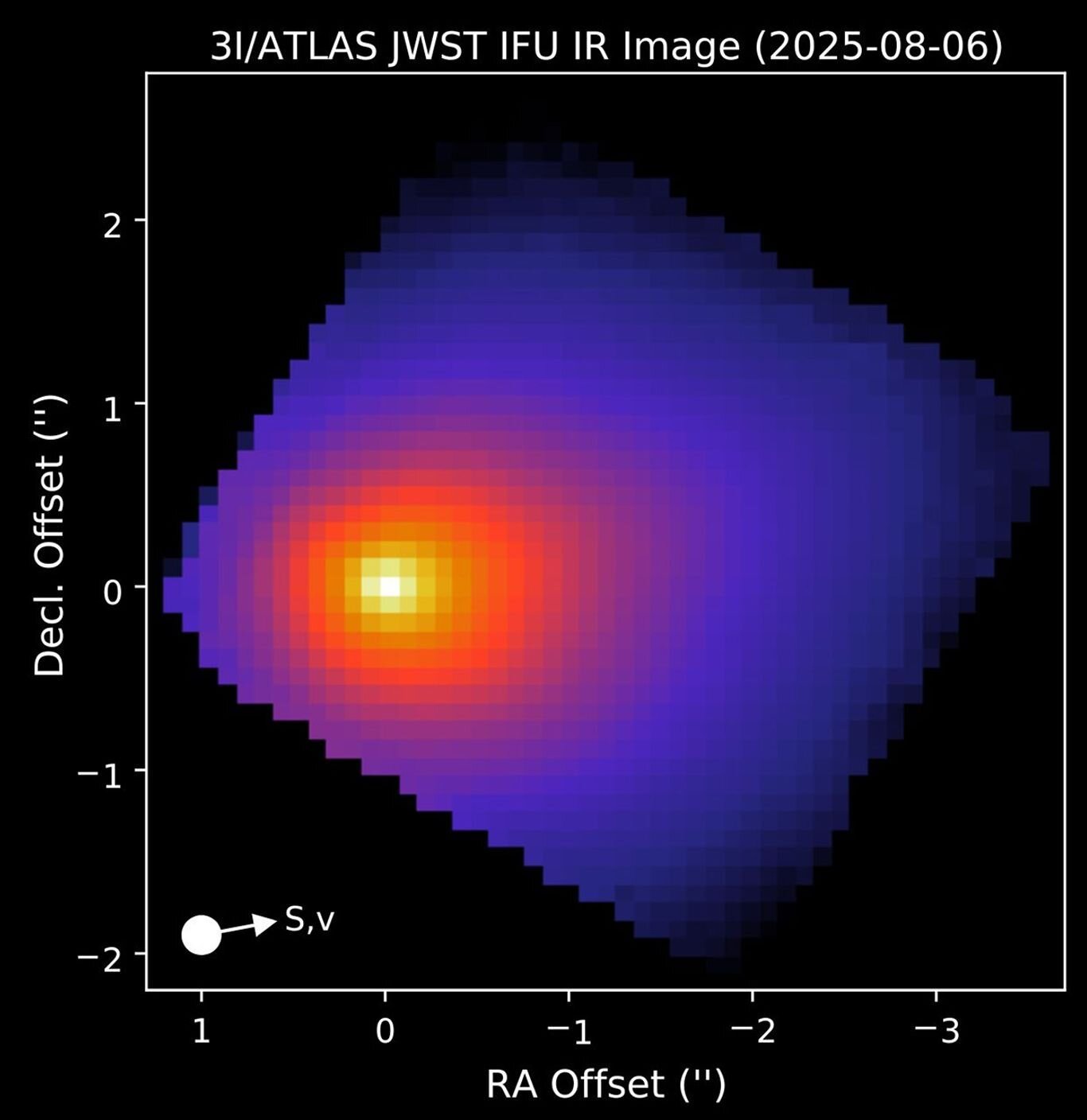
When astronomers first noticed a faint, fast-moving object slipping into our solar system on July 1, 2025, it felt like a moment suspended between science and imagination. The object was named 3I/ATLAS, only the third interstellar object ever confirmed to pass through our cosmic neighborhood. It had come from elsewhere, from the vast darkness between stars, carrying with it a sense of mystery that few astronomical discoveries can match.
Almost immediately, 3I/ATLAS became more than a scientific curiosity. Online discussions erupted with speculation, hope, and fear. Could this visitor be more than rock and ice? Could it, perhaps, be a messenger from another civilization? The idea was not new—previous interstellar visitors had sparked similar debates—but the rarity of such objects gave the question an emotional weight. When something arrives from beyond our solar system, it feels personal, as if the universe itself has knocked on our door.
Between Wonder and Skepticism
Only two interstellar objects had been seen before. The first, 1I/”Oumuamua, baffled scientists with its unusual behavior and shifting classification. It was first thought to be an asteroid, then later a comet. The second, 2I/Borisov, fit more comfortably into expectations as a comet. These earlier visitors taught astronomers an important lesson: interstellar objects can look strange simply because they formed in environments unlike our own.
3I/ATLAS, however, seemed more familiar. Observations showed it displaying typical cometary characteristics, including a coma and an unelongated nucleus. In other words, it looked like what scientists would expect a comet to look like. Yet that did little to quiet speculation. The rarity of such visitors, combined with the human tendency to imagine meaning in the unknown, kept rumors alive. Some online claims suggested odd features or hidden technology, even as scientists urged caution.
The authors of a new study acknowledged this tension directly. “There is currently no evidence to suggest that ISOs are anything other than natural astrophysical objects. However, given the small number of such objects known (only three to date), and the plausibility of interstellar probes as a technosignature, thorough study is warranted,” they said. It was a statement that balanced curiosity with discipline, acknowledging both the excitement and the responsibility that comes with studying something so rare.
Listening Instead of Looking
As months passed, the excitement surrounding 3I/ATLAS evolved into a coordinated scientific effort. Telescopes around the world and in space turned their attention toward the object. Observations were made across many wavelengths, including radio, infrared, X-ray, and optical light. Each band offered a different way of seeing, or hearing, the visitor.
Among the most intriguing efforts came from the Breakthrough Listen program, an initiative designed specifically to search for signs of alien life. Instead of looking for shapes or structures, Breakthrough Listen focuses on signals. The reasoning is simple and grounded in physics: if an advanced civilization wanted to communicate across interstellar distances, narrowband radio signals would be an efficient choice. These signals travel well through space and stand out clearly against natural cosmic noise.
On December 18, 2025, the day before 3I/ATLAS made its closest approach to Earth, scientists aimed the 100-meter Green Bank Telescope toward the object. It was a moment charged with anticipation. If there were ever a time to listen closely, this was it.
The Avalanche of Signals
The telescope did not hear silence. In fact, it detected an overwhelming number of signals—more than 471,000 candidate signals at first glance. For a brief moment, that number alone might have fueled dreams. But in radio astronomy, detection is only the beginning. The real work lies in separating meaningful signals from the constant chatter of the universe and, more importantly, from the noise created by human technology.
The researchers applied a sky localization filter, a method that helps identify where signals are truly coming from. After this careful process, the number of candidates dropped dramatically, from hundreds of thousands to just nine events. These few signals received intense scrutiny. Were they coming from 3I/ATLAS? Were they something artificial, something deliberate?
The answer, after further analysis, was no. Each of the nine events could be traced to radio frequency interference. Some appeared in off-target scans, meaning they were detected even when the telescope was pointed away from the object. Others matched known contaminants. They were echoes of our own technological world, not whispers from another one.
Even with the high sensitivity of the Green Bank Telescope, the search found nothing that could be identified as a technosignature. This result aligned with what other studies had already suggested: 3I/ATLAS was behaving like a natural object.
How Quiet the Object Really Was
The study went further, translating its findings into terms that are surprisingly easy to grasp. The authors wrote, “Our survey concludes that there are no isotropic continuous-wave transmitters above 0.1W at the location of 3I/ATLAS. For comparison, a cell phone is an approximately isotropic continuous-wave transmitter at a level of ∼1W.”
In other words, if 3I/ATLAS were broadcasting a signal evenly in all directions with even a fraction of the power of a typical cell phone, the telescope should have detected it. It did not. The object, at least in radio waves, was profoundly quiet.
This kind of clarity matters. It does not just say that no alien signal was found; it defines the limits of what was searched and what can reasonably be ruled out. The universe is vast, and silence does not mean emptiness, but it does mean that certain possibilities become less likely.
The Weight of a Negative Result
For those hoping for evidence of advanced alien civilizations, the findings may feel disappointing. There is something undeniably compelling about the idea that an object from another star system could carry a message, or even be a probe. But science does not exist to satisfy hopes; it exists to test them.
Negative results are not failures. They are answers. In this case, the answer is that 3I/ATLAS shows no signs of being anything other than a natural astrophysical object, at least within the sensitivity and scope of current observations. That conclusion is not dramatic, but it is powerful.
It also reinforces a broader picture. According to SETI, none of the observations across different wavelengths have resulted in evidence of technosignatures. When many independent methods point to the same conclusion, confidence grows.
Keeping the Door Open
Even so, the story does not end here. The data from this study, like other data from the Breakthrough Listen program, are publicly available. That openness invites reanalysis, new ideas, and future discoveries. Data collection will also continue on certain telescopes, including Hubble, ensuring that 3I/ATLAS remains under watch as long as it is observable.
Scientists involved in the research are careful not to frame their conclusions as absolute. The universe has a way of surprising us, and each new interstellar object offers a fresh opportunity to learn. While it is unlikely at this point that technosignatures will be found associated with 3I/ATLAS, the methods developed and refined during this search will be ready for the next visitor.
Why This Search Matters
The importance of this research goes beyond a single object. Interstellar objects are rare messengers, carrying information about other star systems and the processes that shape them. Studying them helps scientists understand how planetary systems form and evolve across the galaxy.
At the same time, the careful search for technosignatures reflects something deeply human. It is the desire to know whether we are alone, tempered by the discipline to demand evidence. By listening carefully and reporting honestly, even when the answer is silence, scientists strengthen the foundation of that search.
3I/ATLAS may not be an alien spacecraft, but it has still given us something valuable. It has shown how curiosity, skepticism, and advanced technology come together in modern science. It has reminded us that the universe is vast, quiet, and full of natural wonders that do not need to be artificial to be extraordinary.
And perhaps most importantly, it has shown that when the next interstellar visitor arrives—and it will—we will be ready to listen again, with patience, rigor, and a sense of awe that no negative result can erase.
More information: Ben Jacobson-Bell et al, Breakthrough Listen Observations of 3I/ATLAS with the Green Bank Telescope at 1-12 GHz, arXiv (2025). DOI: 10.48550/arxiv.2512.19763