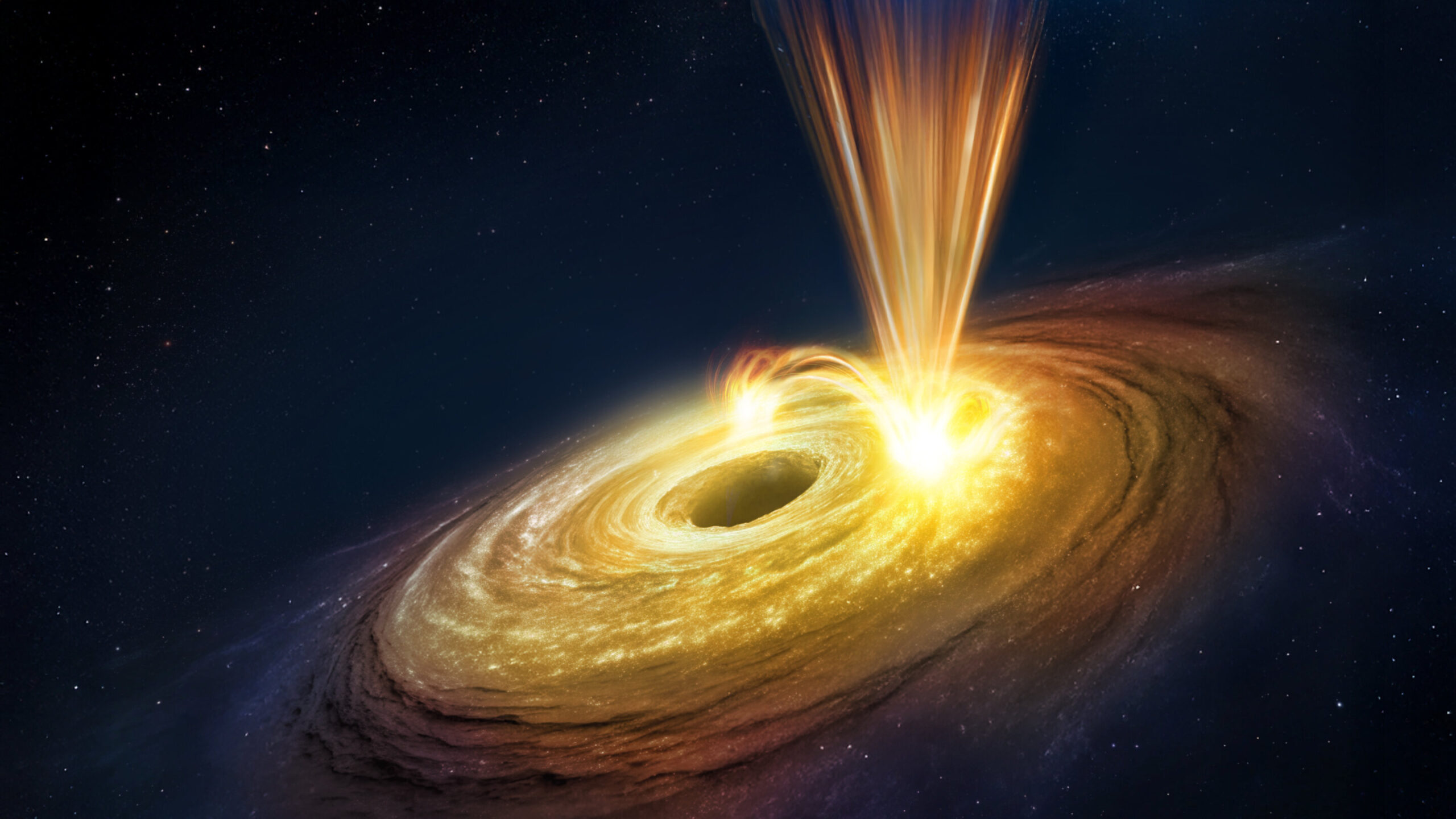
Somewhere deep within a graceful spiral galaxy called NGC 3783, a quiet balance was broken. For countless years, a supermassive black hole had been feeding, glowing, and shaping its surroundings in ways astronomers know well. Then, in the span of mere hours, it did something no one had ever seen before.
X-ray space telescopes watching the galaxy caught a sudden, brilliant flare erupting from the black hole’s heart. The light blazed fiercely and then faded almost as quickly as it appeared. But what followed was even more startling. As the flare dimmed, powerful winds surged outward, blasting material into space at 60,000 kilometers per second, roughly one-fifth the speed of light. The universe had offered scientists a fleeting glimpse of an event both violent and exquisitely timed.
Watching a Giant Wake Up
The black hole at the center of NGC 3783 is a gravitational titan, weighing as much as 30 million suns. It sits inside an Active Galactic Nucleus, a region so energetic that it floods its galaxy with radiation and launches jets and winds across interstellar distances. Astronomers have studied such regions for decades, but this time something different unfolded.
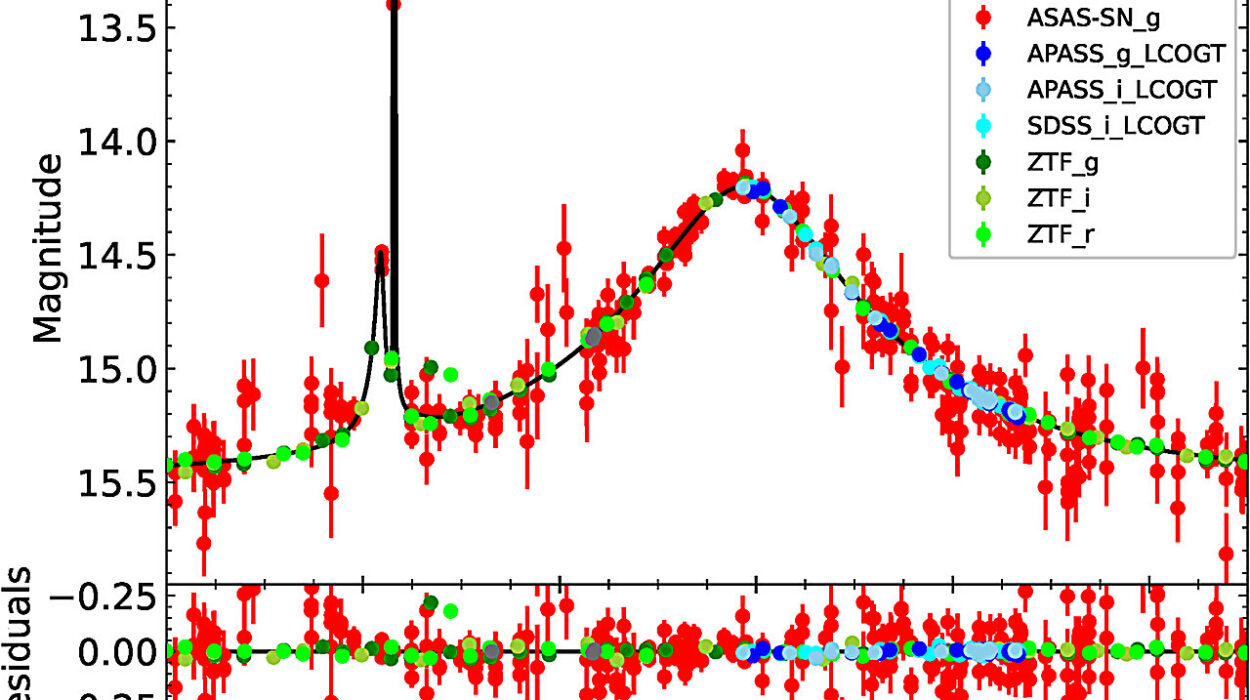
XMM-Newton and XRISM, two of the world’s leading X-ray observatories, were both pointed at the galaxy when the flare ignited. They did not just see light brighten and fade. They saw cause and effect playing out in real time. As the X-ray flare erupted, then diminished, ultra-fast winds appeared almost immediately, forming in just a single day.
“We’ve not watched a black hole create winds this speedily before,” says lead researcher Liyi Gu at Space Research Organization Netherlands (SRON). “For the first time, we’ve seen how a rapid burst of X-ray light from a black hole immediately triggers ultra-fast winds, with these winds forming in just a single day.”
For astronomers accustomed to piecing together cosmic events from scattered clues, this was like watching a storm form directly overhead.
Feeding the Fire at a Galactic Core
The flare came from the black hole’s relentless appetite. As matter spirals inward, it heats up and releases enormous amounts of energy. This process powers the Active Galactic Nucleus, turning the galaxy’s core into a beacon visible across the universe. It is an environment defined by extremes, where gravity, radiation, and magnetism wrestle constantly for control.
“AGNs are really fascinating and intense regions, and key targets for both XMM-Newton and XRISM,” adds Matteo Guainazzi, ESA XRISM Project Scientist and co-author of the discovery.
In this case, the struggle appears to have reached a breaking point. The researchers believe the winds were unleashed when the black hole’s tangled magnetic field suddenly untwisted. The result was an explosive release of energy, driving matter outward at astonishing speed.
“The winds around this black hole seem to have been created as the AGN’s tangled magnetic field suddenly ‘untwisted’ – similar to the flares that erupt from the sun, but on a scale almost too big to imagine.”
A Familiar Pattern in an Unfamiliar Place
For all its alien scale, the event carried an echo of something closer to home. On the sun, intense flares are sometimes followed by coronal mass ejections, massive eruptions that hurl superheated material into space. These solar storms can race outward at thousands of kilometers per second, reshaping space weather throughout the solar system.
The black hole’s winds look strikingly similar, only far more powerful. In fact, the study draws a direct comparison to a solar coronal mass ejection observed as recently as 11 November, where material was launched at initial speeds of 1,500 kilometers per second. The numbers differ dramatically, but the underlying process appears familiar.
By revealing this resemblance, the observation does something quietly profound. It makes supermassive black holes feel a little less alien. Despite their size and mystery, they may follow the same fundamental physical rules as stars like our own.
Two Telescopes, One Moment
Catching such a short-lived event required perfect timing and cooperation. XMM-Newton, a veteran explorer of the hot and extreme universe for more than 25 years, and XRISM, a newer mission launched in September 2023, worked together seamlessly.
XMM-Newton traced the flare’s rise and fall using its Optical Monitor and mapped the winds with its European Photon Imaging Camera. XRISM, equipped with its Resolve instrument, measured the winds’ speed and structure, revealing how they were launched into space.
“Their discovery stems from successful collaboration, something that’s a core part of all ESA missions,” says ESA XMM-Newton Project Scientist Erik Kuulkers.
“By zeroing in on an active supermassive black hole, the two telescopes have found something we’ve not seen before: rapid, ultra-fast, flare-triggered winds reminiscent of those that form at the sun. Excitingly, this suggests that solar and high-energy physics may work in surprisingly familiar ways throughout the universe.”
Together, the telescopes transformed a brief cosmic flash into a detailed story of motion, energy, and cause.
The Winds That Shape Galaxies
These winds are not just dramatic fireworks. They are agents of change on a galactic scale. When a black hole launches powerful outflows, it can sweep gas away from star-forming regions or compress it elsewhere, altering how and where new stars are born.
“Windy AGNs also play a big role in how their host galaxies evolve over time, and how they form new stars,” adds Camille Diez, a team member and ESA Research Fellow.
“Because they’re so influential, knowing more about the magnetism of AGNs, and how they whip up winds such as these, is key to understanding the history of galaxies throughout the universe.”
In other words, this brief flare and its sudden winds are part of a much larger narrative. They help explain how galaxies grow, age, and change over billions of years.
Why This Moment Matters
This discovery matters because it captures a black hole in the act of transformation. For the first time, astronomers have watched a rapid X-ray flare directly trigger ultra-fast winds, linking cause and effect with unprecedented clarity. It bridges the physics of stars and black holes, showing that the same processes shaping our sun may also sculpt entire galaxies.
It also reminds us that the universe is not static. Even the most massive and seemingly eternal objects can change dramatically in a single day. By catching that change as it happened, scientists gained not just data, but insight into how energy, magnetism, and matter interact on the grandest scales.
In the end, this fleeting flash from NGC 3783 is a reminder of why we look up at all. Somewhere far beyond our reach, a black hole twisted its magnetic fields, flared, and breathed out a storm. And for a moment, we were watching.
More information: Delving into the depths of NGC 3783 with XRISM III. Birth of an ultrafast outflow during a soft flare, Astronomy and Astrophysics (2025). DOI: 10.1051/0004-6361/202557189