As calendars turned and celebrations marked the arrival of a new year, astronomers found themselves raising a different kind of glass. On Dec. 31, 2020, a distant structure of galaxies revealed itself in a way that felt almost festive, as if the universe itself were joining the celebration. The object was a galaxy cluster, newly discovered and glowing with a peculiar beauty. Its appearance, paired with the timing of its discovery, inspired scientists to give it a name that felt joyful and human: the “Champagne Cluster”.
Seen through the eyes of NASA’s Chandra X-ray Observatory and combined with optical telescopes on Earth, the cluster looked as though bubbles had been frozen mid-rise, suspended in cosmic space. The imagery was striking, but the story behind it was even more compelling. What appeared at first glance to be a single cluster was, in fact, something far more dynamic and dramatic.
When One Cluster Became Two
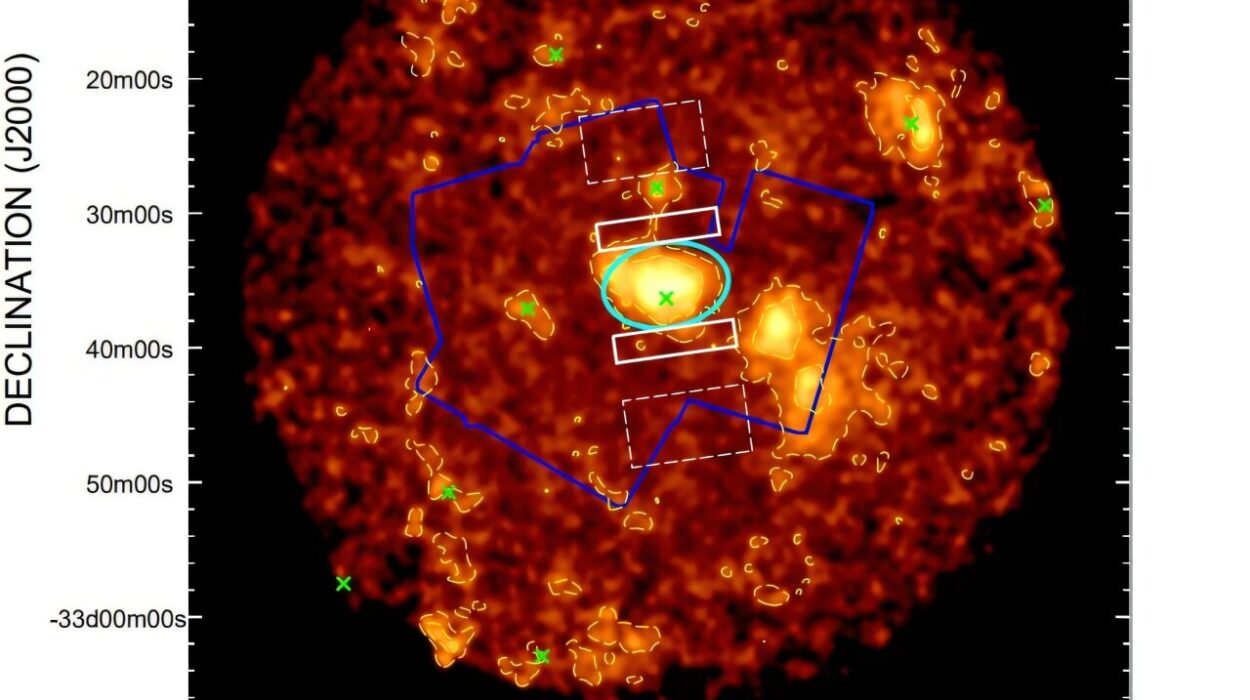
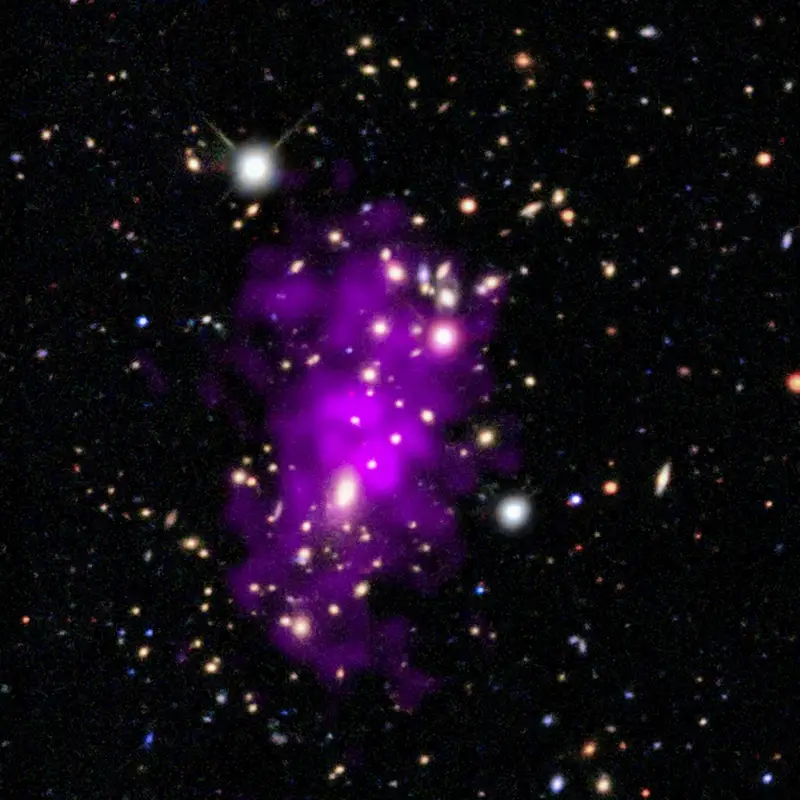
The Champagne Cluster carries an official designation that only a catalog could love: RM J130558.9+263048.4. Yet behind that technical name lies a scene of colossal motion. The new composite image revealed that this cluster is actually two galaxy clusters caught in the act of merging, slowly shaping themselves into an even larger structure.
This realization came from the way the hot gas inside the cluster behaved. In most galaxy clusters, multimillion-degree gas tends to form shapes that are roughly circular or gently oval when viewed in images. The Champagne Cluster refused to follow that pattern. Instead, the hot gas spread more dramatically from top to bottom, stretching itself across space in a way that hinted at upheaval and collision.
Within this elongated glow, two clumps of individual galaxies became visible, positioned toward the top and bottom of the center. These clumps are the galactic hearts of the two colliding clusters. To help viewers interpret the scene, astronomers rotated the image clockwise by 90 degrees, aligning north to the right and clarifying the unusual structure.
The result is a portrait not of stillness, but of motion. It is a snapshot of cosmic construction in progress.
The Heat That Outweighs Galaxies
The purple glow seen in the Chandra X-ray data represents superheated gas, heated to millions of degrees. This gas does more than shine; it dominates. In the newly forming Champagne Cluster, the mass of this hot gas outweighs the combined mass of all the hundred-plus individual galaxies within it.
That fact alone reshapes how one thinks about galaxy clusters. The galaxies, luminous and visually striking, are not the primary players by mass. They are passengers moving through a much heavier environment of gas and gravity.
Beyond even this enormous quantity of hot gas lies something still more massive and more elusive. The clusters contain even larger amounts of unseen dark matter, described as the mysterious substance that pervades the universe. It does not glow or emit X-rays, yet its gravitational presence shapes the motion and structure of everything around it.
The Champagne Cluster, then, is not just a gathering of galaxies. It is a layered system where visible matter, hot gas, and dark matter all interact in a slow-motion cosmic collision.
Seeing the Universe in Combined Light
The image that brought this cluster into focus is not the work of a single telescope. Alongside Chandra’s X-ray data, astronomers incorporated optical data from the Legacy Surveys, shown in red, green, and blue. These surveys are themselves a collaboration, combining observations from various telescopes in Arizona and Chile.
Together, these different forms of light tell a richer story than any single wavelength could offer. The optical data reveals the galaxies themselves, points of light scattered across space. The X-ray data exposes the hot gas that fills the space between them, invisible to human eyes but dominant in mass.
This blending of perspectives transforms the image into a kind of cosmic map, one that shows not just where galaxies are, but how they interact with their environment. It allows astronomers to read the history of motion, collision, and gravity written into the cluster’s shape.
A Rare Cosmic Class
The Champagne Cluster belongs to a rare and scientifically valuable class of merging clusters. Among this group is the well-known Bullet Cluster, a system famous for the way its hot gas has collided and slowed down, creating a clear separation between the hot gas and the most massive galaxy in each cluster.
Clusters like these act as natural laboratories. Their violent interactions strip away simplicity and reveal the underlying components of cosmic structures. The Champagne Cluster shows similar signs of disruption, with hot gas that has been displaced and reshaped by collision.
These rare systems are not just visually striking. They are essential for understanding how the largest structures in the universe grow and evolve.
Reconstructing a Collision Across Time
To understand how the Champagne Cluster reached its current state, astronomers turned to computer simulations. By comparing observations with simulated collisions, they identified two possible histories for the cluster.
In the first scenario, the two clusters collided with each other over two billion years ago. After that initial impact, they continued moving outward, separating across space. Gravity, however, refused to let them drift apart forever. Over time, it pulled them back toward each other, and they are now heading into a second collision.
In the second scenario, the story is shorter and more recent. A single collision occurred about 400 million years ago, and the two clusters are now traveling away from each other in the aftermath of that encounter.
Both possibilities fit the observed data, and distinguishing between them will require further study. Yet even this uncertainty is meaningful. It shows how astronomers read the universe not just as it is, but as it has been, using structure and motion as clues to events that unfolded hundreds of millions or even billions of years ago.
The Scientists Behind the Discovery
The findings about the Champagne Cluster are detailed in a paper published in The Astrophysical Journal. The authors, Faik Bouhrik, Rodrigo Stancioli, and David Wittman, are all from the University of California, Davis.
Their work transforms a visually appealing image into a scientific narrative, connecting shapes and colors to mass, motion, and time. Through careful analysis, they reveal that what looks like a cosmic celebration is also a cosmic collision.
Why the Champagne Cluster Matters
Beyond its festive nickname and striking appearance, the Champagne Cluster carries deep scientific importance. Researchers believe that further studies of this system can potentially teach them how dark matter reacts to a high-speed collision.
Dark matter remains one of the most profound mysteries in modern astronomy. It outweighs visible matter in galaxy clusters, yet it does not emit light or radiation that telescopes can directly detect. Its presence is inferred through gravity, through how it shapes the movement of galaxies and gas.
In merging clusters like the Champagne Cluster, dark matter is subjected to extreme conditions. The collisions separate hot gas from galaxies and, potentially, from dark matter itself. By observing how these components behave relative to one another, astronomers gain rare insight into the properties of this unseen substance.
The Champagne Cluster reminds us that the universe is not static. It is dynamic, colliding, reshaping itself over unimaginable timescales. Each discovery adds a chapter to our understanding of how cosmic structures form and evolve.
What began as a New Year’s discovery, marked by bubbles of glowing gas and a celebratory name, now stands as a powerful tool for probing the deepest questions about matter, gravity, and the unseen architecture of the universe. In studying this cluster, astronomers are not just observing a collision. They are listening to a story written across billions of years, one that may help reveal what the universe is truly made of.
More information: Faik Bouhrik et al, Discovery and Multiwavelength Analysis of a New Dissociative Galaxy Cluster Merger: The Champagne Cluster, The Astrophysical Journal (2025). DOI: 10.3847/1538-4357/ade67c