In 2017, the Cassini spacecraft began its final act. After years of orbiting Saturn, sending back breathtaking images and reshaping humanity’s understanding of the ringed giant, the probe embarked on what scientists called the Grand Finale Orbits. These were daring, close passes that took Cassini between Saturn and its rings, skimming regions no spacecraft had ever explored before. At the end of that journey, Cassini plunged into Saturn’s atmosphere and fell silent.
Or so it seemed.
Years later, scientists are still listening to what Cassini gathered during those final moments. Hidden in streams of data collected just before its destruction is a new story about Saturn’s rings—one that challenges how thin, tidy, and well-behaved we once thought they were. According to a new study published in The Planetary Science Journal, Saturn’s rings are not confined to a narrow, flat plane. Instead, they are surrounded by a vast, ghostly halo of dust that stretches far above and below what telescopes can see.
This discovery did not come from images. It came from dust.
A Halo Where No One Expected One
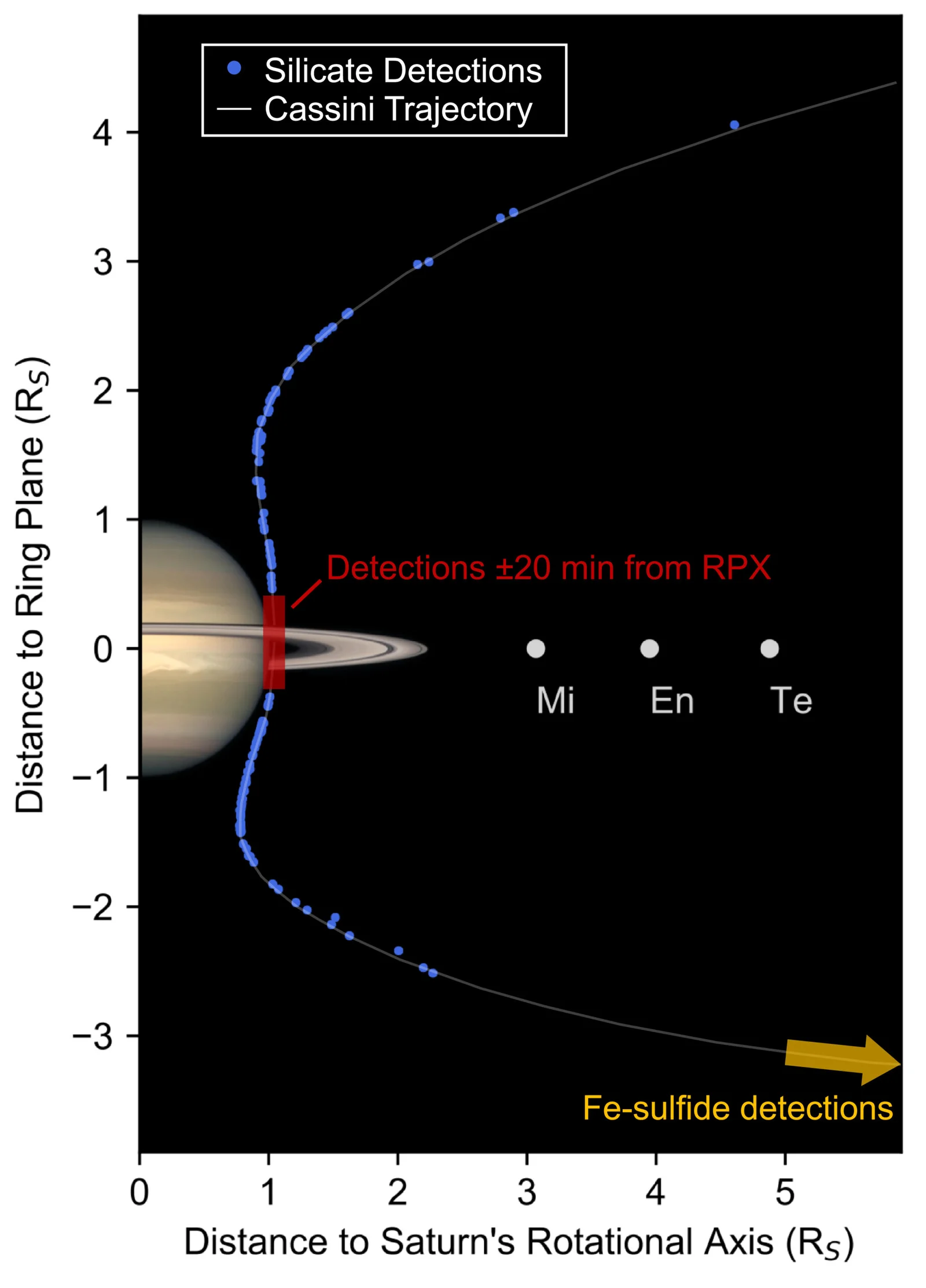
As Cassini traced its 20 Grand Finale Orbits, it passed through regions both above and below Saturn’s ring plane. During these passes, the spacecraft’s Cosmic Dust Analyzer quietly collected tiny particles drifting through space. Each impact left behind a spectral fingerprint, a clue to what the particle was made of and where it might have come from.
In total, Cassini recorded 1,690 dust spectra during those final orbits. When researchers later examined them, 155 stood out clearly as mineral, or silicate, particles. What surprised the scientists was not just what these particles were, but where they were found.
These silicate grains appeared at distances reaching up to three Saturnian radii above and below the ring plane. They were present in roughly equal amounts on both sides, forming what researchers describe as a halo surrounding the rings. This was far beyond the thin, shimmering bands visible through telescopes, extending Saturn’s ring system into a three-dimensional structure that had gone unnoticed until now.
When Dust Reveals Its Family History
Finding dust so far from the rings raised an immediate question: where did it come from?
To answer that, researchers turned to the composition of the particles themselves. By analyzing the dust spectra, they could determine which elements were present and in what proportions. The results were unexpectedly clear.
The high-latitude silicate particles were nearly identical in composition to dust found much closer to the rings. They were mostly made of magnesium and calcium in amounts consistent with cosmic levels. Iron, however, was significantly depleted. This iron shortage matched what had already been observed in dust near the rings.
The similarities were so precise that the researchers described them as “striking compositional similarities.”
The implication was hard to ignore. These particles, drifting far above and below the rings, appeared to share the same origin as the ring material itself. As the study authors put it, “We conclude that within the accuracy of the method these mineral dust grains are of identical composition, suggesting that silicates of this study likewise originate from the main rings, reaching latitudes >3RS with respect to Saturn’s ring plane.”
Saturn’s rings, it seemed, were shedding material into space, creating a diffuse cloud that extended much farther than anyone had imagined.
Violence in a Beautiful Place
But how does material escape the rings and travel such enormous distances?
To explore this mystery, the research team ran a series of dynamical simulations. These simulations tested different scenarios to see which could realistically lift tiny particles out of the ring plane and send them soaring to high latitudes.
The simulations pointed to a dramatic but common process: micrometeoroid impacts.
Saturn’s rings are constantly bombarded by micrometeoroids, tiny grains of material moving at immense speeds. When these micrometeoroids slam into ring particles, they release bursts of energy capable of ejecting fragments outward. According to the simulations, if particles are smaller than 20 nanometers and launched at speeds greater than 25 kilometers per second, they can reach the distant regions where Cassini detected them.
This mechanism also explains why the dust forms a halo that becomes denser closer to the ring plane. As the study authors explain, “The observed increase in particle number density with decreasing distance to the ring plane is in agreement with ejection after micrometeoroid impact as the dominant particle production mechanism. Most ejected particles are expected to either recollide with the main rings or fall into Saturn, and only a small fraction are assumed to escape successfully from the rings.”
In other words, Saturn’s rings are constantly losing material, but most of it does not get far. Only a rare few particles achieve the right conditions to escape and linger in the halo.
Vapor, Condensation, and Missing Iron
The researchers didn’t stop at ejection alone. They also examined what happens in the immediate aftermath of a micrometeoroid strike. When a high-speed impact occurs, it can generate a fast-moving vapor plume. As that vapor cools, it condenses into tiny solid grains.
This process, the team suggests, is the most likely source of the nanoscale silicate particles detected by Cassini. It also provides a natural explanation for the observed iron depletion. Iron may behave differently during vaporization and condensation, leading to dust grains that are poor in iron compared to their original material.
The story that emerges is one of constant renewal and loss. Saturn’s rings are not static structures frozen in time. They are active, dynamic environments where impacts continually break, vaporize, and reassemble material, sending some of it drifting into space.
A Tempting Alternative, Quietly Rejected
The researchers also considered another possibility. Perhaps the dust did not originate from Saturn’s rings at all. Perhaps it was drawn in from outside the Saturnian system, guided inward by gravitational focusing.
But this idea ran into a problem. The composition of the dust detected during the Grand Finale Orbits did not match the composition of exogenous dust grains that Cassini’s Cosmic Dust Analyzer had observed elsewhere in the Saturnian system. The chemical fingerprints simply didn’t align.
Given the strong compositional match with ring material and the success of the micrometeoroid simulations, the team concluded that an external origin was far less likely. The halo, it seems, belongs to Saturn.
Rings That Reach Beyond Sight
This discovery reshapes the way scientists think about planetary rings. Saturn’s iconic rings are no longer just thin bands circling the planet. They are the dense core of a much larger structure, surrounded by a diffuse cloud of dust that extends far into space.
The finding also raises new questions. If micrometeoroid impacts can create such halos around Saturn’s rings, could the same thing be happening elsewhere? Could other planets with rings also be surrounded by invisible clouds of dust, extending their ring systems far beyond what we can see?
The study hints that dust dynamics may play a larger role in shaping ring systems than previously understood. These processes are subtle, difficult to observe, and easy to miss without a spacecraft willing to venture into dangerous territory.
Why This Discovery Matters
This research matters because it reveals that Saturn’s rings are not just beautiful—they are alive with motion, interaction, and change. By showing that ring material can be lifted far above and below the ring plane, it forces scientists to rethink how rings evolve over time and how they interact with their planetary environments.
It also highlights the enduring power of data. Cassini is gone, but its final measurements continue to rewrite textbooks, reminding us that exploration does not end when a mission does. Sometimes, the most profound discoveries are waiting patiently in the data, ready to emerge years later.
Above all, this finding reminds us that the universe often hides its complexity just beyond the limits of our vision. Saturn’s rings looked thin and simple from afar. Up close, they reveal a sprawling, dynamic system shaped by constant impacts and invisible dust storms. Thanks to Cassini’s last brave orbits, we now know that Saturn’s rings reach much farther than anyone ever dreamed.
More information: Simon Linti et al, A Dust Halo from Saturn’s Main Rings Extending Several Saturnian Radii above the Ring Plane, The Planetary Science Journal (2025). DOI: 10.3847/psj/ae18c1