In the cold, vast reaches of our outer solar system, two titans reign supreme. Jupiter and Saturn are not just massive worlds of swirling gas; they are the centers of their own miniature “solar systems.” At the last count, Jupiter hosted more than 100 moons, while Saturn, draped in its iconic rings, boasted a staggering collection of over 280 reported moons. Yet, despite their shared status as gas giants, these two neighborhoods look nothing alike. Jupiter is anchored by a quartet of massive worlds known as the Galilean moons, including Ganymede, the largest moon in our entire solar system. Saturn, meanwhile, has a family dominated by a single, lonely giant named Titan. For decades, astronomers have stared at these two distinct blueprints and wondered why the same basic ingredients—gas, dust, and gravity—produced such wildly different results.
The Mystery of the Missing Cavity
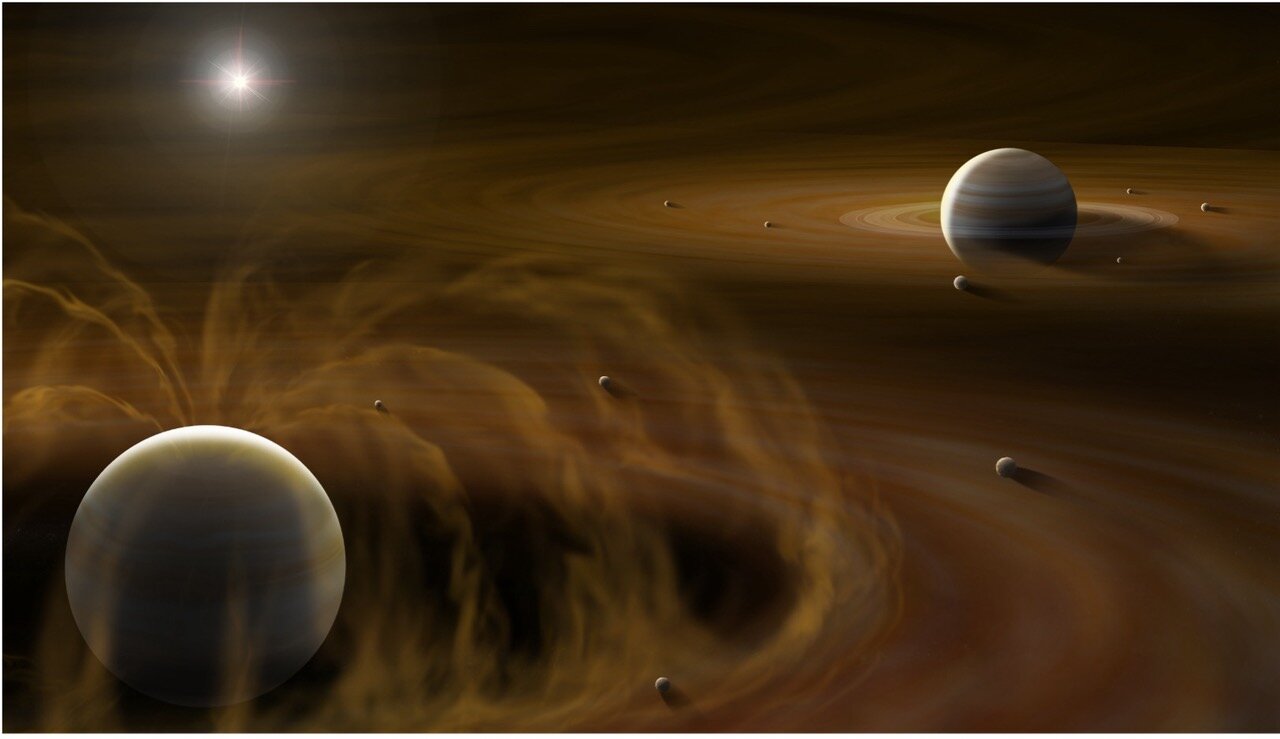
To solve this celestial puzzle, a collaborative team of researchers from Kyoto University and other institutions in Japan and China decided to look back billions of years. They knew that these moons didn’t just appear; they were born from a circumplanetary disk, a thick halo of material that once swirled around the young planets like a cosmic nursery. The traditional theories of satellite formation had long struggled to explain why Jupiter could keep several large moons in stable orbits while Saturn seemingly could not.
The researchers suspected the answer lay in an invisible force: the magnetic field. There has been a long-running debate in the scientific community regarding magnetic accretion and whether a planet’s magnetic pull could carve out an inner cavity within that disk of dust and gas. If such a hole existed, it would act like a safety zone, stopping moons from falling into the planet’s crushing interior. The team realized that if they could build a unified satellite model that explained both our neighbors, they might finally unlock the secrets of how moons form around planets across the entire galaxy.
Simulations of a Violent Youth
Testing these ideas is no small feat because, as lead author Yuri I. Fujii notes, we only have our own solar system as a reference point. To peer into the past, the team turned to the PC cluster at the Center for Computational Astrophysics in the National Astronomical Observatory of Japan. They launched complex numerical simulations designed to recreate the interior structures and thermal evolution of young gas giants. They weren’t just looking at the gas on the surface; they were modeling how the magnetic fields of these giants ebbed and flowed as the planets cooled and matured.
By combining these interior models with N-body simulations, the researchers could track the life stories of individual moons. They watched as digital dust clumped into satellites and then began a process called orbital migration, where the friction of the surrounding disk causes moons to spiral inward toward the planet. The simulation became a high-stakes race: could the moons find a place to stop, or were they destined to be swallowed by the giant they orbited?
A Tale of Two Magnetic Fortunes
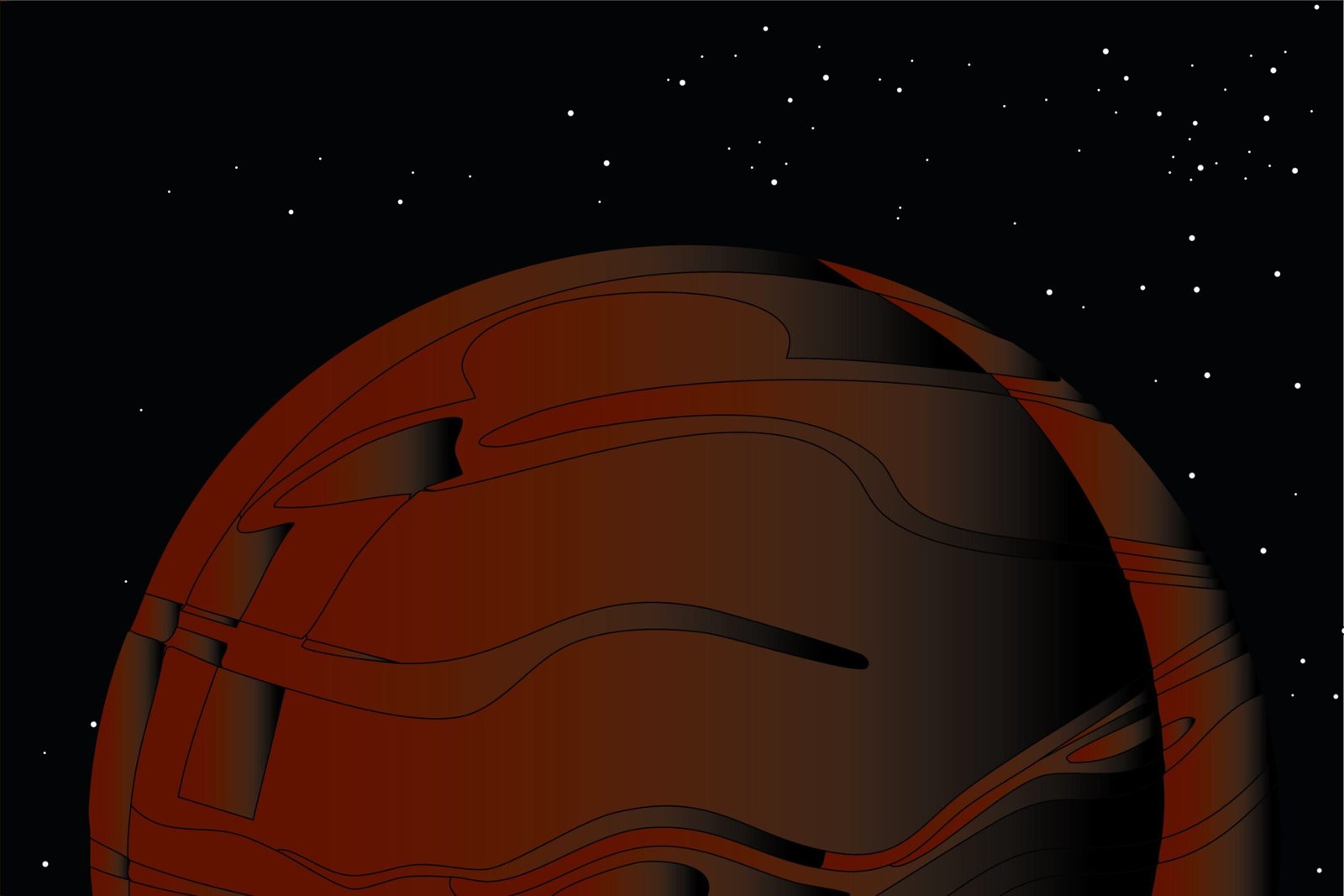
The results of the study, published in Nature Astronomy, revealed a startling contrast between the two giants. The researchers discovered that the strength of a planet’s magnetic field is the ultimate architect of its moon system. In the early days of our solar system, Jupiter possessed a formidable magnetic field. This field was strong enough to push back against the encroaching disk of gas, carving out a magnetospheric cavity—a hollow space close to the planet where the disk material could not enter.
As Io, Europa, and Ganymede migrated inward, they hit the edge of this magnetospheric cavity and stopped. The cavity acted as a protective barrier, capturing them in stable, compact orbits and preventing them from spiraling to their doom. Saturn, however, told a different story. The simulations showed that the young Saturn’s magnetic field was significantly weaker. Because it lacked the strength to push the disk away, no inner cavity formed. Without a “parking spot” to halt their migration, most of Saturn’s early large moons likely plunged into the planet. Titan survived as the lone survivor of a much more treacherous environment, leading to the lopsided family tree we see today.
Beyond the Borders of Our Sun
This research does more than just settle a local dispute between Jupiter and Saturn; it provides a roadmap for the future of astronomy. The team’s model suggests that this isn’t just a quirk of our solar system but a fundamental law of the cosmos. They predict that across the universe, gas giants the size of Jupiter or larger will likely host compact multi-moon systems, while planets closer to Saturn’s size will typically be orbited by only one or two moons.
As we prepare for a new era of space exploration, these findings provide a foundation for the eventual discovery of exomoons—satellites orbiting planets in other star systems. By understanding the link between a planet’s magnetic field and its circumplanetary disk, scientists can now predict what kind of moons might be hiding around distant stars before we even see them. The team is now looking to expand their theory to include even more diverse satellite systems, proving that the invisible forces of magnetism are just as important as gravity in shaping the architecture of the heavens.
Why This Research Matters
This study is a breakthrough because it moves us closer to a “Grand Unified Theory” of how worlds are built. By proving that magnetic fields dictate the survival of moons, scientists have identified a key variable that determines the habitability and complexity of planetary systems. Understanding why Jupiter kept its diverse family while Saturn lost most of its own helps us understand the history of our own cosmic backyard. Furthermore, as we hunt for life on icy moons like Europa or Titan, knowing the conditions that allowed them to form and stay in stable orbits is essential. This research transforms our view of gas giants from simple balls of hydrogen into active magnetic engines that decide the fate of the worlds spinning around them.
Study Details
Yuri I. Fujii et al, Different architecture of Jupiter and Saturn satellite systems from magnetospheric cavity formation, Nature Astronomy (2026). DOI: 10.1038/s41550-026-02820-x