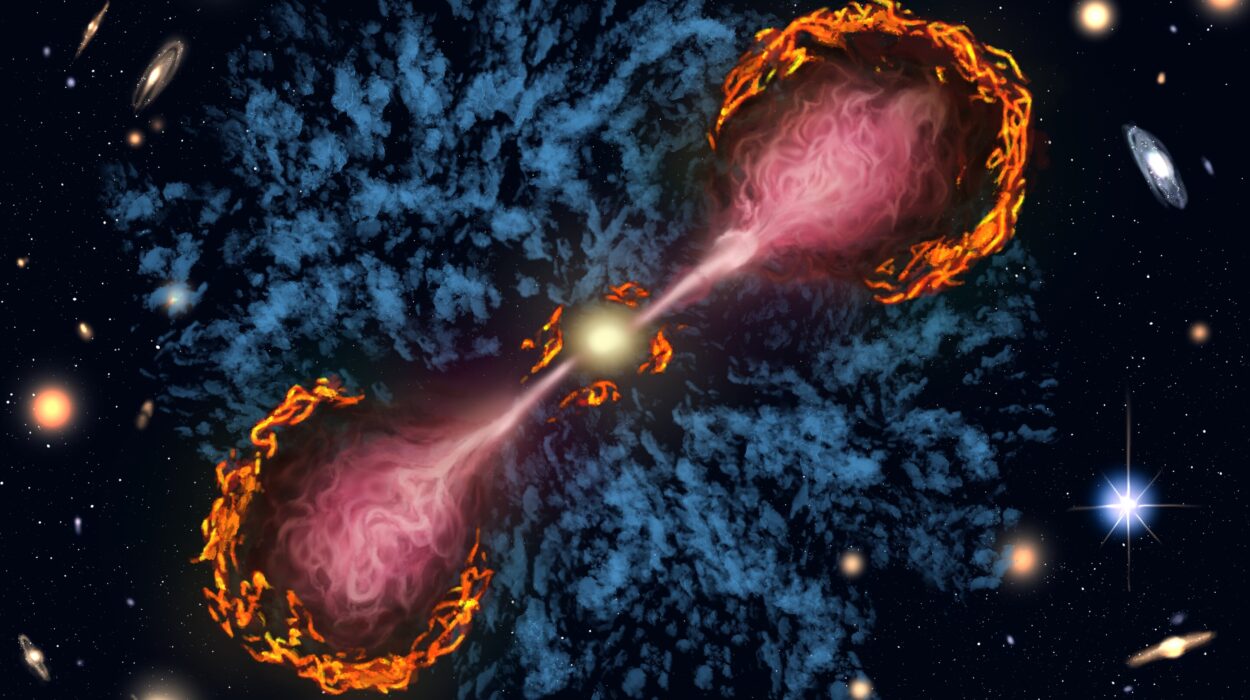
Deep in the constellation Hercules, within the heart of a galaxy known as Markarian 501, a cosmic drama is unfolding that has remained hidden from human eyes for eons. For decades, astronomers have stared into the centers of galaxies, knowing that they harbor giants—supermassive black holes with the mass of millions or even billions of suns. Yet, a fundamental mystery has haunted the halls of physics: how did these monsters get so big? While they are known to feast on surrounding gas, the math simply doesn’t add up. Accreting gas is a slow process, far too slow to explain the sheer scale of the titans we see today. Logic dictates that these giants must grow by eating one another, crashing together during galaxy collisions to forge even larger shadows in the fabric of spacetime. But while we have seen galaxies collide, the final, intimate dance of two black holes about to become one has remained a theoretical ghost—until now.
A Hidden Passenger in the Dark
The breakthrough came not from a single moment of observation, but from a painstaking reconstruction of twenty-three years of history. A research team led by Silke Britzen from the Max Planck Institute for Radio Astronomy went back through decades of high-resolution radio frequency data, looking for patterns in the chaos. For a long time, scientists knew that Mrk 501 possessed a jet, a narrow, powerful beam of particles screaming into space at nearly the speed of light. This primary jet points directly toward Earth, appearing brilliantly bright and acting as a lighthouse for radio telescopes. But as the team combed through the data, they realized the lighthouse wasn’t standing still. The entire system appeared to be in motion, swaying like a ship on a heavy sea. Then came the surprise that changed everything: a second jet.
This discovery was the “smoking gun” the team had been searching for. It wasn’t just a stray signal; it was the first direct image of such a dual-jet system at the center of a galaxy. While the first jet was easy to see, the second was oriented differently, lurking in the shadows of its more famous partner. By tracking this second beam over time, the researchers watched as it moved counterclockwise, circling behind the larger black hole in a predictable, repeating rhythm. This wasn’t the behavior of a solitary giant. It was the unmistakable signature of a supermassive black hole binary, two colossal weights locked in a gravitational embrace so tight that they are dragging their particle beams along with them as they spin.
The Ring and the Rhythm of the Dance
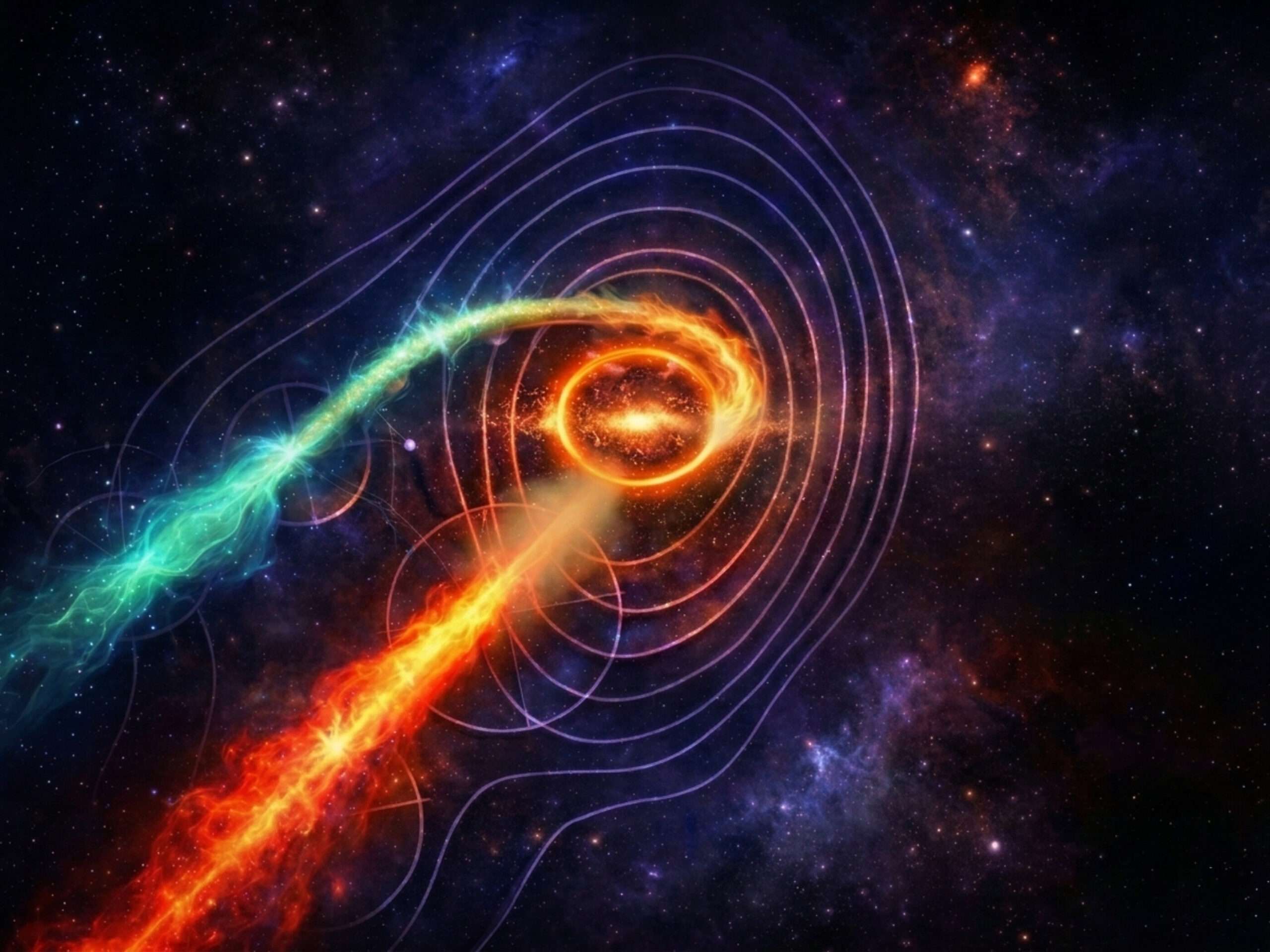
The evidence reached a crescendo during one specific observation in June 2022. On that day, the alignment of the cosmos was perfect. The radiation from the system reached Earth on such a distorted, crooked path that it manifested as a glowing circle of light—an Einstein ring. This phenomenon, known as gravitational lensing, occurs when a massive object in the foreground acts like a cosmic magnifying glass, bending the light of an object directly behind it. In this case, the known black hole in the front was perfectly positioned to warp the light from the second jet as it passed behind. It was a moment of geometric perfection that confirmed the two objects were stacked almost directly in our line of sight, providing a rare, clear look at their orientation.
By analyzing these recurring patterns of brightness and the swaying of the jets, the team was able to calculate the tempo of this cosmic waltz. The two black holes are orbiting one another every 121 days. To put that in perspective, they are separated by a distance only 250 to 540 times the gap between the Earth and the sun. In the vast, empty reaches of intergalactic space, that is a microscopic distance, especially for objects that weigh between 100 million and a billion solar masses. They are so close, and moving so fast, that the orbital plane itself is wobbling. The researchers realized they weren’t just looking at a pair of black holes; they were looking at a countdown.
The Final Hundred Years
Because Mrk 501 is so far away, even our most powerful tools reach their limits here. Even the Event Horizon Telescope, the famous global array that gave us the first direct images of black hole shadows, cannot resolve these two giants as separate dots of light. They are simply too close together for any current camera to pull them apart. We cannot watch the gap between them close with our eyes, but we can hear it with the ears of physics. As the orbit shrinks, the laws of gravity dictate that the system must be screaming into the void, emitting gravitational waves at incredibly low frequencies.
These waves are ripples in the very fabric of reality, and they offer the only way to track the final moments of the merger. Scientists believe that this pair is spiraling toward a collision at a staggering pace. Depending on their exact mass, they could merge into a single entity in as little as 100 years. This is a blink of an eye in cosmic time, suggesting we have caught these two giants in the absolute final stage of their multi-million-year journey toward one another. The hope now lies with pulsar timing arrays, specialized networks of telescopes that can detect the subtle stretching of space caused by these low-frequency waves.
Why the Hercules Giants Matter
This discovery is more than just a record-breaking observation; it is the missing piece of the puzzle for galaxy evolution. For the first time, we have a prime candidate for a specific source of the gravitational wave background—the low-frequency hum of the universe that was first detected in 2023. If we can successfully detect the waves coming specifically from Mrk 501, we will see the frequency of those ripples steadily rise as the two giants spiral closer. It offers humanity a front-row seat to the most violent and transformative event in the life of a galaxy. By watching this merger unfold, we finally move from theoretical models to direct evidence, seeing exactly how the universe builds its largest inhabitants and how the centers of galaxies are forged in the heat of a billion-sun collision.
Study Details
S Britzen et al, Detection of a second jet within the nuclear core of Mrk 501, Monthly Notices of the Royal Astronomical Society (2026). DOI: 10.1093/mnras/stag291