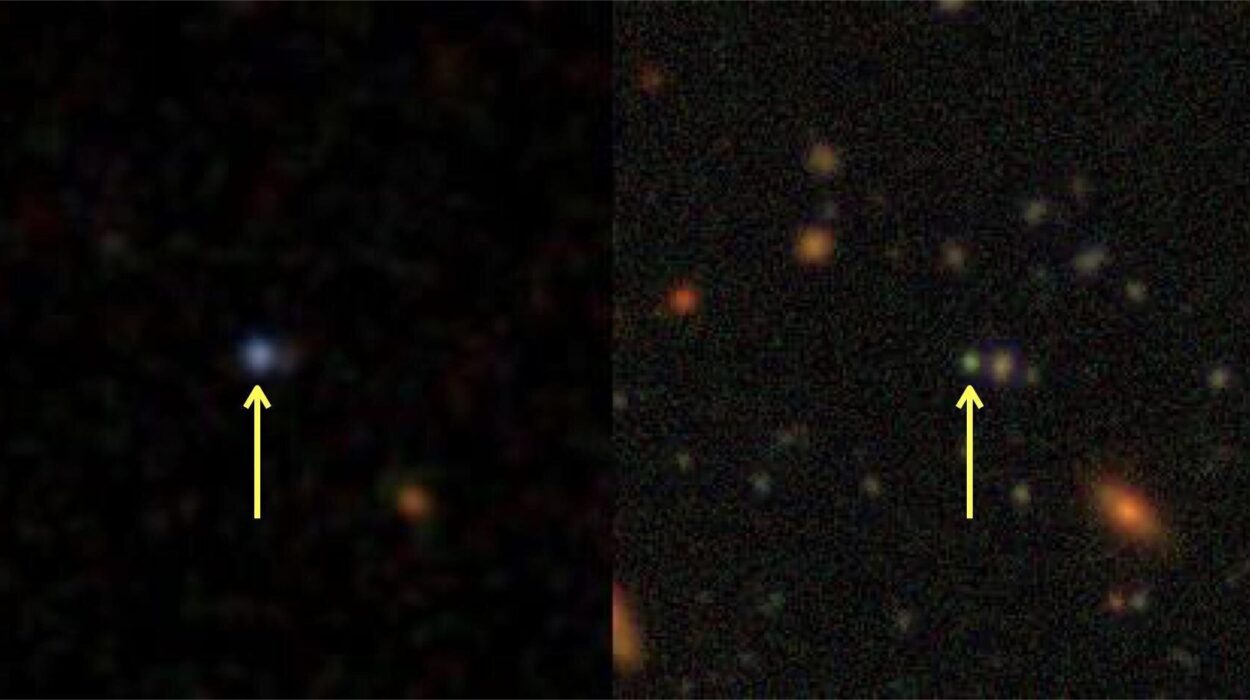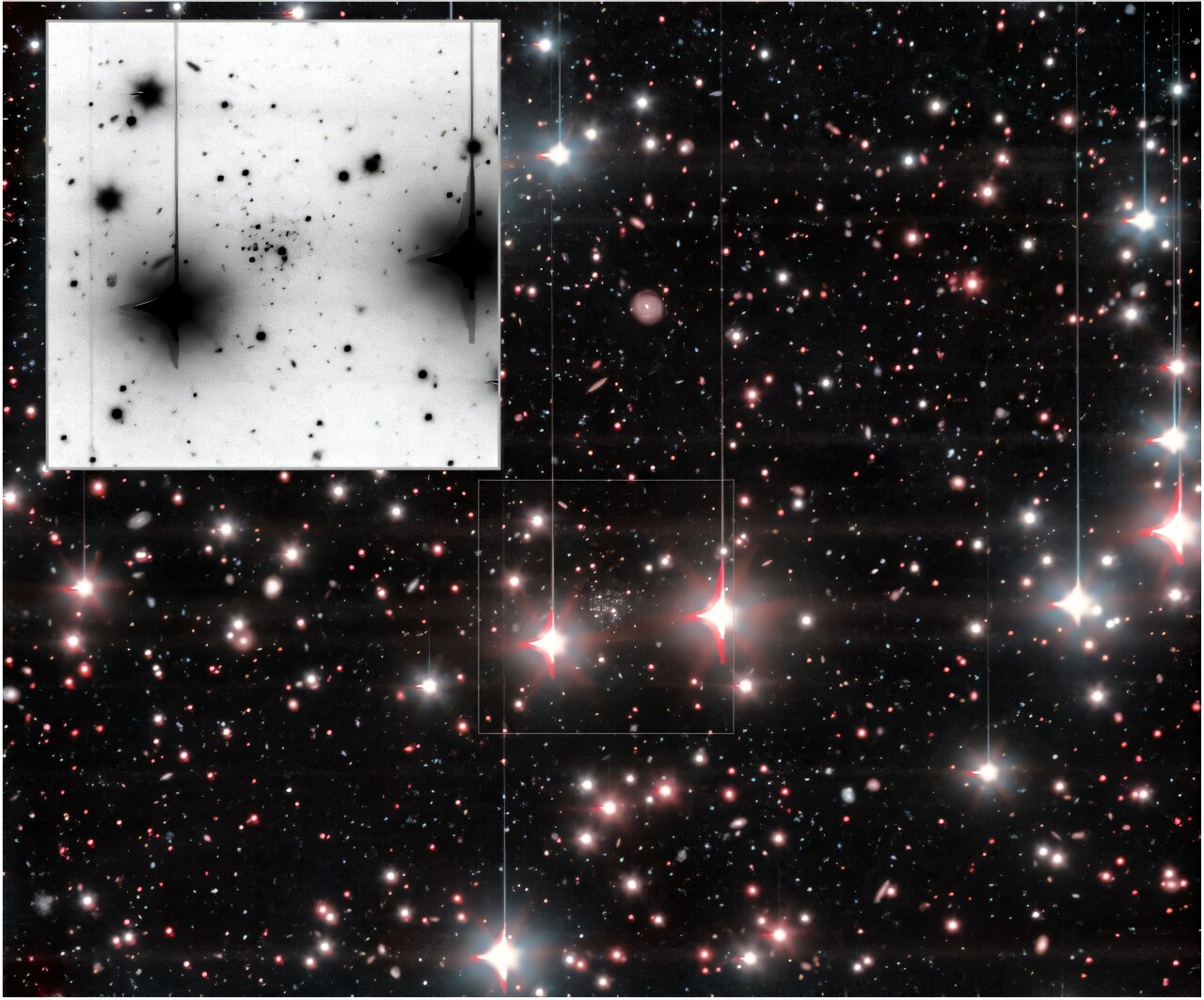
For millions of years, a ghostly inhabitant has been drifting through the dark suburbs of our neighboring galaxy, successfully evading every lens and sensor humanity pointed toward the sky. It is a tiny, ancient collection of stars so dim that it barely registers against the blackness of space. Yet, this spectral presence, now named Andromeda XXXVI, has finally been pulled from the shadows. Its discovery is not just a win for the record books; it is a breakthrough in our understanding of the ultra-faint dwarf galaxies (UFDs) that represent the oldest, most primitive building blocks of the universe.
The Amateur Eye and the Digital Treasure Map
The story of this cosmic find began not with a supercomputer, but with a pair of human eyes. Amateur astronomer Giuseppe Donatiello was scanning the public data from the Pan-Andromeda Archaeological Survey, a massive digital footprint known as PAndAS. While machine-learning algorithms and automated software often handle the heavy lifting of modern astronomy, they can sometimes overlook the subtle, smudgy signatures of the universe’s most elusive objects. Through a systematic, visual inspection of these deep-space images, Donatiello spotted a faint candidate that seemed to be more than just background noise.
Recognizing the potential importance of this smudge, a team of professional astronomers led by Joanna D. Sakowska at the Institute of Astrophysics of Andalusia stepped in to investigate further. They turned the powerful gaze of the Roque de los Muchachos Observatory toward the coordinates Donatiello had identified. This follow-up, deep imaging confirmed what the amateur’s intuition had suggested: they were looking at a brand-new satellite of the Andromeda galaxy, a fossil from the earliest dawn of time that had remained hidden just outside our celestial doorstep.
Resolving the Ghostly Architecture of a Fossil Galaxy
To prove that Andromeda XXXVI was indeed a galaxy and not just a random cluster of stars, the researchers had to peer deep into its structure. They managed to resolve enough individual stars to construct a color-magnitude diagram, a scientific tool that acts as a fingerprint for stellar populations. This allowed them to measure the object’s specific properties and confirm its identity as an ultra-faint dwarf. These objects are the least luminous and most dark matter-dominated structures in existence. Because they have undergone so little chemical evolution, they are essentially the “fossils” of the early universe, preserved in the cold vacuum of space.
The data revealed a galaxy that is staggering in its subtlety. Andromeda XXXVI sits approximately 2.53 million light years away from Earth. More importantly, it is located only 388,000 light years from the center of Andromeda, also known as Messier 31. Since this distance falls well within Andromeda’s viral radius of 850,000 light years, the team concluded that this tiny neighbor is officially a permanent satellite, bound forever by the gravitational grip of the larger galaxy.
A Tiny Titan in the Shadows of a Giant
Despite its grand title, Andromeda XXXVI is a minimalist in every sense. The study found it has a visual magnitude of only -6.0, placing it among the faintest galaxies ever recorded. It is also incredibly dense for its size, with a half-light radius of just 208 light years. This measurement suggests it is potentially the second-most compact ultra-faint dwarf orbiting Andromeda. With an ellipticity of roughly 0.015, it maintains a nearly perfect, subtle circularity as it drifts through the halo of its host.
The most striking aspect of this newfound neighbor, however, is its age. By analyzing its metallicity—the concentration of elements heavier than hydrogen and helium—astronomers found a level of -2.5. This extremely low metal content is a hallmark of the universe’s first generations of stars. The researchers estimate the age of Andromeda XXXVI to be a staggering 12.5 billion years. It has been quietly orbiting the Andromeda galaxy since the universe was in its infancy, witnessing the slow assembly of the cosmos while remaining virtually unchanged itself.
Why the Hunt for These Invisible Neighbors Matters
The discovery of Andromeda XXXVI is a stark reminder of how much we still don’t know about our own cosmic neighborhood. Astronomers estimate that Andromeda should host nearly 100 dwarf satellites, yet only about half of them have been found. Each time we locate a new one, we move a step closer to completing the map of our local universe. This research underscores a vital truth in modern science: while machine learning and automatic approaches are powerful, they are most effective when paired with the human element. The visual inspection of data remains a crucial, complementary tool for finding the “needles in the haystack” that algorithms might discard.
By finding and studying these faint satellites, we gain a clearer picture of how galaxies grow and how dark matter shapes the visible world. These ultra-faint dwarfs are the pure, unevolved remnants of the high-redshift universe, and they hold the keys to understanding the first stars and the mysterious dark scaffolding that holds everything together. Andromeda XXXVI may be small and dim, but as a window into the history of the cosmos, its light shines far brighter than its visual magnitude suggests.
Study Details
Joanna D. Sakowska et al, Andromeda XXXVI: discovery of a new ultra-faint dwarf galaxy towards M31, arXiv (2026). DOI: 10.48550/arxiv.2603.28492