Imagine standing in the middle of a vast, pitch-black ocean at midnight. You know the water is there, but you can only see the occasional whitecap where a wave breaks or a distant ship’s lantern flickers. For twenty years, this was the frustrating reality for astronomers trying to map the early universe. They knew that deep in the cosmic past, there must have been massive reservoirs of fuel to build the first great cities of stars, but the fuel itself—hydrogen gas—was effectively invisible, a ghost in the machine of the cosmos.
A Ghostly Glow in the Dark
The story of our universe has a middle chapter known as Cosmic Noon, a frantic, high-energy era occurring between 10 billion and 12 billion years ago. This was the universe’s teenage growth spurt, a time when galaxies were maturing at their fastest possible rate. To sustain such a frantic pace of construction, these young galaxies required staggering amounts of raw material. Scientists suspected that galaxies were nestled inside gargantuan clouds of gas, yet these structures, known as Lyman-alpha nebulae, remained frustratingly elusive.
The problem is that hydrogen gas is a shy inhabitant of the deep sky; it does not generate its own light. It sits in the freezing void, silent and dark. The only way to see it is if something nearby—like a cluster of hot, UV-emitting stars—pumps enough energy into the gas to make it glow. Detecting this faint, borrowed light requires an incredible amount of patience and the kind of specialized equipment that is usually booked years in advance. For decades, astronomers were forced to study the same small handful of about 3,000 known halos, like researchers trying to understand an entire continent by looking at a single neighborhood.
The Telescope That Saw Too Much
Everything changed with a project of unprecedented scale: the Eberly Telescope Dark Energy Experiment, or HETDEX. Utilizing the Hobby-Eberly Telescope at the McDonald Observatory, which ranks among the largest optical telescopes on Earth, researchers stopped squinting through keyholes and instead threw open the double doors. While the primary mission of HETDEX is to solve the mystery of dark energy, its “side effect” has been the collection of a staggering half-petabyte of data.
The sheer ambition of the survey is difficult to wrap the mind around. It surveyed a patch of sky equivalent to the area of 2,000 full moons. Every time the telescope looked up, it produced 100,000 spectra, capturing the chemical signatures of over a million galaxies and the lonely, empty regions of space that sit between them. By casting such a wide net, the team moved beyond the “extreme” examples—the biggest, brightest halos that were easy to spot—and began to see the “average” residents of the early universe that had been hidden in the shadows for eons.
Monsters and Amoebas in the Deep
When the team, led by data manager Erin Mentuch Cooper, began sifting through this mountain of information with the help of supercomputers at the Texas Advanced Computing Center, the numbers didn’t just grow; they exploded. They narrowed their search to the 70,000 brightest galaxies within their catalog, looking for the telltale signature of a halo: a dense core of hydrogen surrounded by a thinner, ghostly veil extending far into the void.
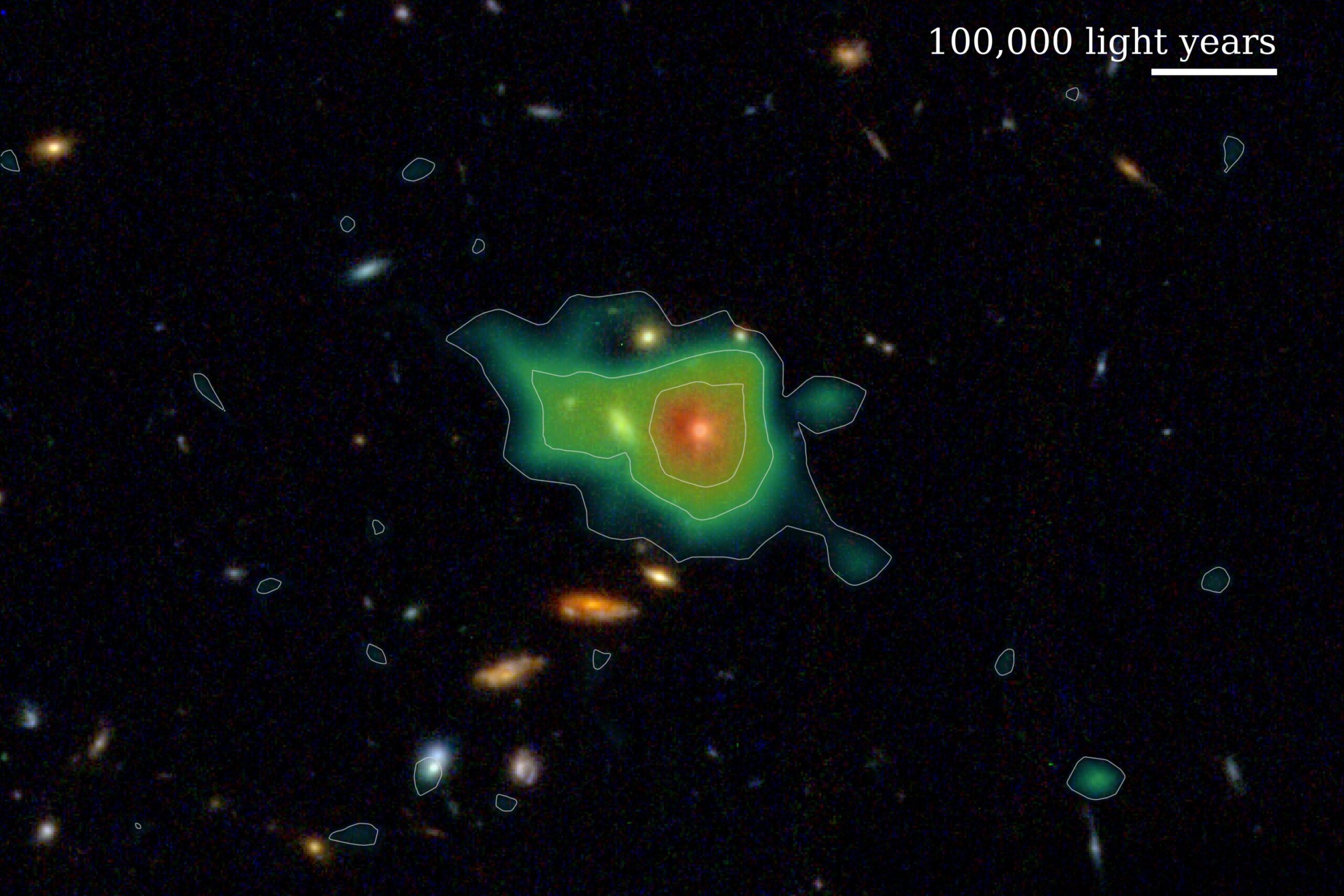
What they found was a census that rewrote the maps of the early universe. The number of known hydrogen gas halos jumped tenfold, skyrocketing from 3,000 to more than 33,000. These weren’t just dots on a map; they were diverse, structural titans. Some were relatively “simple,” appearing as football-shaped clouds cradling a single galaxy. Others were much more chaotic. The researchers described the most complex versions as giant amoebas, irregular blobs with long, misty tendrils of gas reaching out into the darkness, sometimes encompassing multiple galaxies at once.
These halos are massive, spanning from tens of thousands to hundreds of thousands of light years across. Incredibly, the team believes even this massive new catalog is an underestimate. Nearly half of the galaxies they studied showed clear evidence of these halos, and it is highly likely that many more exist, just waiting for even more sensitive instruments to pick up their incredibly faint shimmer.
Why This Cosmic Census Matters
For the first time, astronomers have moved from studying curiosities to building a statistical catalog. This matters because, until now, our models of how the universe grew were full of “gaps and holes.” We had theories about how matter was distributed and how the first structures evolved, but we lacked the data to prove which theories were right and which belonged in the trash.
With 33,000 halos now identified, the scientific community has moved from a famine of information to a feast. This massive library of Lyman-alpha nebulae allows researchers to zoom in on individual “amoebas” to study the specific physics and mechanics of how gas becomes stars. By observing the shapes and sizes of these halos, scientists can finally track the movement of matter in the early universe with precision. This discovery doesn’t just add more objects to our star charts; it provides the raw data needed to fix, refine, or completely reinvent our understanding of how the cosmos built itself from the ground up during its most productive era.
Study Details
Erin Mentuch Cooper et al, Lyα Nebulae in HETDEX: The Largest Statistical Census Bridging Lyα Halos and Blobs across Cosmic Noon, The Astrophysical Journal (2026). DOI: 10.3847/1538-4357/ae44f3