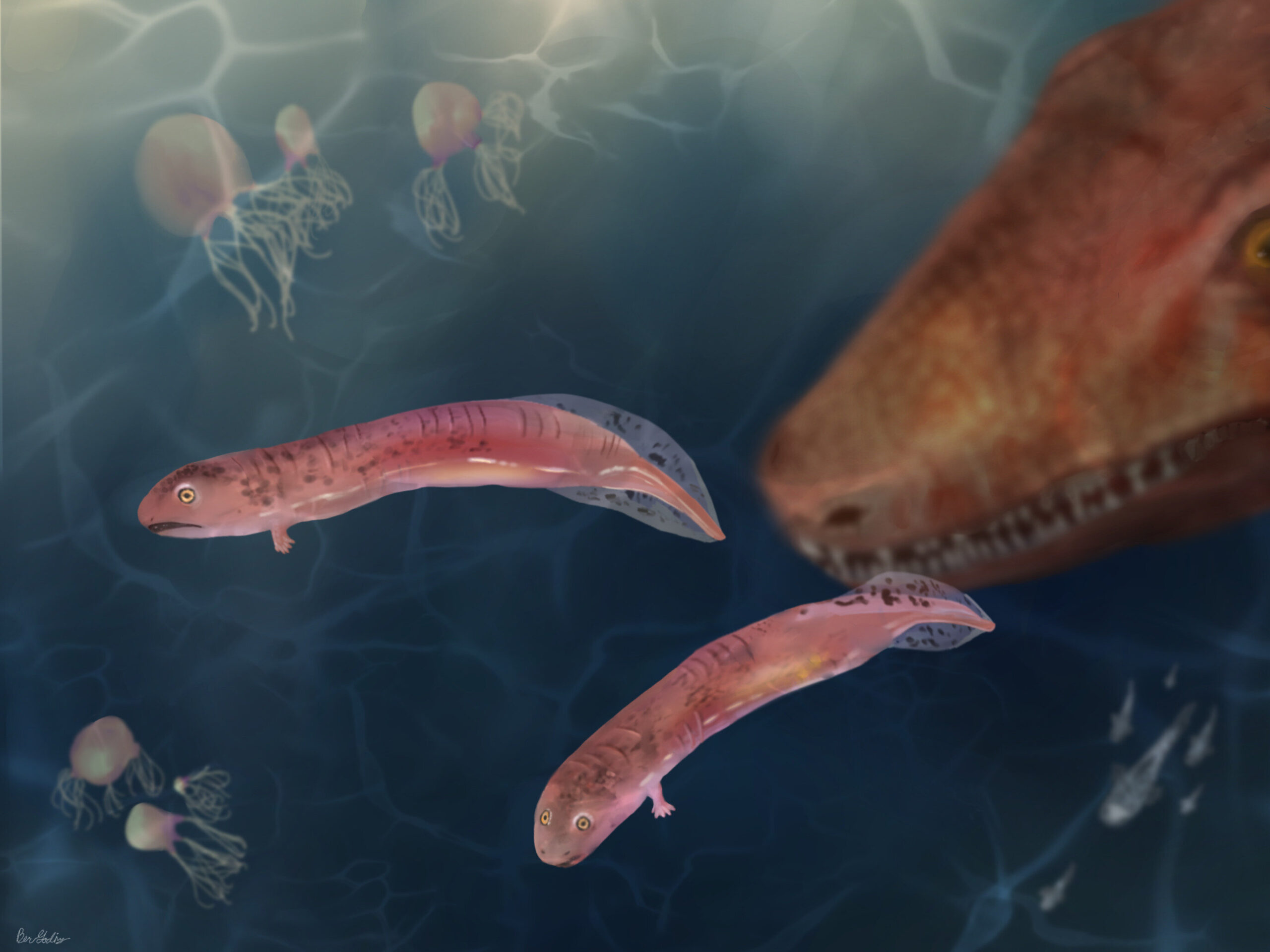
Tiny fossilized hatchlings from Illinois have overturned one of evolution’s longest-standing assumptions, revealing that some of the earliest four-legged vertebrates developed without an amphibian-like tadpole stage. The discovery suggests the first land-dwelling vertebrates followed a very different developmental path than scientists have believed for decades, reshaping ideas about one of the most important transitions in Earth’s history.
Life on Earth began in the water, but at some point, a branch of ancient fish evolved limbs and began venturing onto land. These pioneering animals, known as tetrapods, eventually gave rise to every living mammal, bird, reptile, and amphibian. For decades, scientists assumed these early vertebrates grew up much like today’s amphibians—hatching into tadpole-like larvae before undergoing a dramatic metamorphosis into adults.
That long-accepted picture has now been challenged by a remarkable collection of fossilized baby tetrapods described in the journal Science.
Ancient Hatchlings Reveal an Unexpected Developmental Pattern
The breakthrough comes from exceptionally preserved fossils discovered at Mazon Creek, a world-famous fossil site located about an hour southwest of Chicago. The site is renowned for preserving delicate fossils and even soft tissues that rarely survive over millions of years.
Among dozens of fossils representing the evolutionary transition from fish to four-legged animals, two tiny specimens stood out. They belonged to an ancient predator known as an embolomere, a crocodile-like early tetrapod that lived in rivers, lakes, and swamps between 350 million and 280 million years ago.
Adult embolomeres could grow to more than 10 feet long. The newly studied fossils, however, were only a few centimeters in length, representing hatchlings that offered an unprecedented glimpse into early tetrapod development.
According to co-lead author Jason Pardo, these fossils challenge a simplified evolutionary story that has been taught for generations.
He explained that many people learned that fish evolved into amphibians, amphibians into reptiles, and reptiles into mammals. The new findings, however, show that the basic assumption—that the first four-legged vertebrates developed like modern amphibians—was incorrect.
A Decade-Long Scientific Mystery
The discovery did not happen overnight.
Co-lead author Arjan Mann first encountered one of the tiny fossils about 10 years ago while working on his Ph.D. The specimen had been sitting in the collections of the Field Museum, but it had not yet been recognized as an embolomere.
Mann borrowed the fossil for study, and over the following decade he and Pardo repeatedly debated its unusual anatomy. Night after night, they examined its features, trying to determine exactly what kind of animal it represented.
Eventually, researchers used scanning electron microscopy at the Canadian Museum of Nature to confirm the fossil’s identity. Rather than solving the mystery, however, the identification created an even bigger puzzle.
Where Were the Tadpoles?
Scientists expected that baby embolomeres would resemble amphibian tadpoles if early tetrapods truly shared the same developmental strategy as modern frogs and salamanders.
Instead, the fossils showed something entirely different.
Although the young animals developed limbs as they matured, they lacked defining characteristics of amphibian larvae, including the external feathery gills that are hallmarks of tadpoles.
The pattern was not limited to a single fossil.
Researchers examined another even smaller embolomere along with fossilized young from several related species representing different branches of the evolutionary transition between fish and tetrapods. Across every lineage they studied, the same surprising trend emerged.
None displayed anything resembling a true tadpole stage.
Even species that experienced substantial changes during growth showed no evidence of the kind of complete amphibian metamorphosis scientists had expected.
Pardo summarized the finding plainly: if there is no tadpole stage, then there is no amphibian-style metamorphosis.
Instead, he said, the life cycles of these early tetrapods appear to have been more similar to those of fish—or even humans—than to modern amphibians.
Rethinking How Vertebrates Moved Onto Land
The implications extend far beyond one extinct group of animals.
For years, many researchers believed that metamorphosis played a central role in helping vertebrates transition from aquatic environments onto land. Under that view, early tetrapods were thought to pass through aquatic larval stages before transforming into more terrestrial adults.
The new fossil evidence no longer supports that scenario.
If embolomeres and other early tetrapods never possessed amphibian-like tadpoles, then the widely accepted idea that mammals and reptiles descended from amphibian-like ancestors with similar life cycles must be reconsidered.
Pardo said the long-standing explanation that metamorphosis served as the critical tool for moving from water to land simply “doesn’t work anymore.”
Rather than confirming decades of assumptions, these fossils reveal that the earliest four-legged vertebrates followed developmental pathways unlike those seen in living amphibians today.
A Fossil Site That Captured the Impossible
The study also highlights the extraordinary scientific value of Mazon Creek.
According to Mann, the fossil deposit is among the finest in the world for preserving delicate organisms that would normally disappear from the fossil record.
The tiny hatchlings serve as rare “time capsules,” preserving stages of life that are almost never fossilized. Without these exceptionally preserved specimens, researchers would have had little chance of testing long-held assumptions about early vertebrate development.
Their discovery provides the first direct evidence of what some of the earliest tetrapod hatchlings actually looked like instead of relying solely on comparisons with living animals.
Citizen Scientists Played a Crucial Role
The research also depended on a broad network of collaboration.
Mann emphasized that every specimen analyzed in the study resulted from joint efforts involving the Earth Science Club of Northern Illinois, the Lauer Foundation for Paleontology, Science and Education, the Field Museum, professional researchers, volunteers, and citizen scientists.
Several fossil collectors generously allowed researchers to study specimens they had discovered. Those contributions ultimately became central to a study that has reshaped scientific thinking about one of evolution’s defining transitions.
According to Mann, the discovery demonstrates how citizen science can directly contribute to major advances in understanding Earth’s ancient history.
Why This Matters
The transition from water to land remains one of the defining moments in the history of life. Every living mammal, bird, reptile, and amphibian traces its ancestry back to those first four-legged vertebrates.
By uncovering fossilized hatchlings that developed without amphibian-like tadpoles or true metamorphosis, researchers have challenged a foundational assumption about that evolutionary journey. Instead of confirming that the earliest tetrapods grew like modern amphibians, the fossils reveal that their life histories were fundamentally different.
More importantly, the discovery reminds scientists that even long-accepted evolutionary narratives can change when rare fossils preserve previously unseen stages of life. Sometimes, the smallest fossils can force the biggest revisions to our understanding of Earth’s past.