Buried beneath volcanic ash 74.6 million years ago, an exceptionally preserved fossil forest in New Mexico reveals that flowering plants were already dominating lush forests nearly 10 million years before the asteroid impact that ended the age of dinosaurs. The discovery challenges a long-standing view that flowering plants only became Earth’s dominant trees after dinosaur extinction.
The rise of flowering plants may have started much earlier than scientists once believed.
An extraordinary fossil site in New Mexico has captured an entire ancient forest frozen in time beneath volcanic ash, offering an unprecedented glimpse into life during the Late Cretaceous. Instead of revealing forests ruled by ancient conifers, the site shows thriving ecosystems where flowering plants had already become major players long before the dinosaurs vanished.
The findings suggest that the transformation of Earth’s forests was already well underway 74.6 million years ago, forcing scientists to rethink one of the most widely accepted narratives in plant evolution.
A Forest Preserved in a Single Moment
Unlike most fossil plant sites, where remains accumulate gradually in rivers, lakes, or coastal sediments, this forest was buried rapidly by volcanic ash following a nearby eruption.
According to the researchers, the ash settled within days, preserving the forest almost exactly as it stood. Ground-cover plants remained at the base of the ash layer, while leaves, flowers, and seeds from the canopy fell into place as the ash blanketed the landscape.
Lead author Jaemin Lee, a doctoral student at UC Berkeley, described the site as a “botanical Pompeii,” explaining that the remarkable preservation allowed researchers to reconstruct the forest’s structure in exceptional detail.
The fossil deposit, known as Dori’s tuff, stretches about three-quarters of a mile (1.2 kilometers) and is part of the Jose Creek Formation in New Mexico, near Truth or Consequences.
Flowering Plants Were Already Thriving
For decades, paleobotanists believed flowering plants, known as angiosperms, remained relatively small and scattered during the Late Cretaceous. Under that view, they only rose to global dominance after the mass extinction 66 million years ago, when mammals capable of dispersing large fruits became more widespread.
The newly reconstructed forest tells a different story.
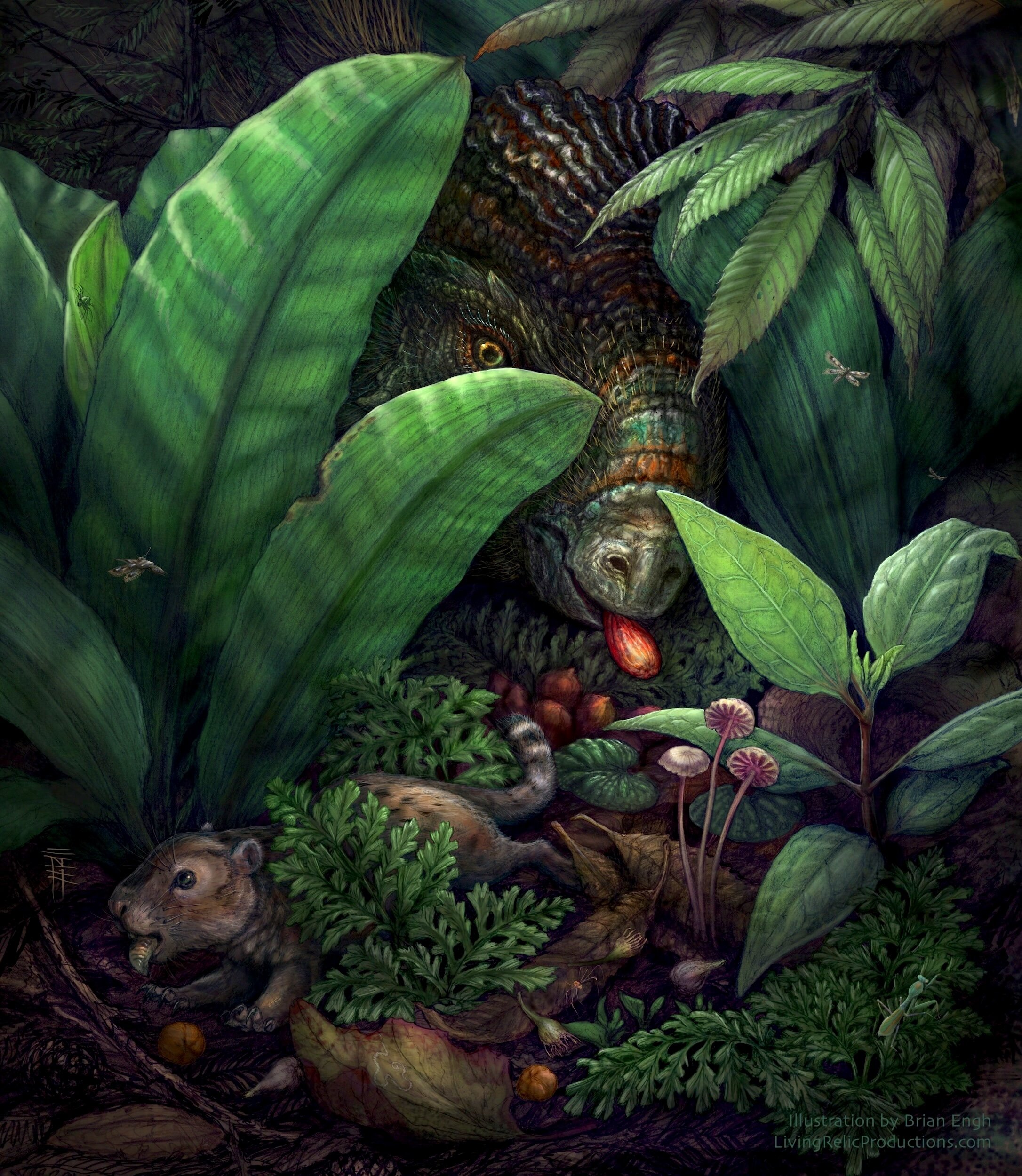
Researchers found towering flowering trees, including relatives of laurels and palms, growing alongside older plant groups such as ferns and redwoods. Rather than forming sparse vegetation beneath dinosaur-dominated ecosystems, these flowering plants created mature, dense forests.
“Our results show that, at least in some hot and humid environments during the Late Cretaceous, well before the extinction boundary by 10 million years, angiosperms were already investing more resources into individual diaspores and forming dense forests,” Lee said.
Fossil Seeds Reveal an Unexpected Strategy
One of the study’s most striking discoveries came from analyzing fossilized diaspores—the seeds and associated structures that help plants spread to new locations.
The size of these reproductive structures provides important clues about how plants reproduce and interact with animals.
In most previously studied Late Cretaceous fossil sites, angiosperm diaspores were roughly the size of poppy seeds. At the New Mexico site, however, the average diaspore was comparable to a large blueberry, representing more than a hundredfold increase in volume.
While that may seem modest compared with many modern fruits, Lee noted that today’s large fruits have been shaped by centuries of selective breeding. Wild versions were often much smaller.
The fossil forest contained nearly 80 distinct types of fruits and seeds, with several reaching about 1 inch in length. Researchers say this is the first fossil assemblage from the Cretaceous to preserve such a wide diversity of relatively large fruits and seeds together.
Rethinking Plant and Animal Relationships
Scientists have long proposed that flowering plants only began producing larger fruits after dinosaur extinction, when mammals such as rodents, bats, and primates became abundant seed dispersers.
The new evidence suggests that shift had already begun millions of years earlier.
Lee said the discovery indicates that the evolution of large fruits and dense flowering forests likely occurred before the end-Cretaceous extinction and before the ecological restructuring that followed.
Co-author Cindy Looy, a professor of integrative biology at UC Berkeley and curator at the UC Museum of Paleontology, noted that animals consuming large fleshy reproductive structures were already known from other ancient seed plants such as ginkgos.
What surprised researchers was that flowering plants had apparently already adopted similar strategies by about 75 million years ago.
The findings suggest animals were likely dispersing larger angiosperm seeds much earlier than previously recognized.
A Tropical-Like Forest in a Warmer World
When volcanic ash buried the forest, the site lay about 200 kilometers (124 miles) west of the shoreline of the Western Interior Seaway, which once divided eastern and western North America.
Although located in the midlatitudes, Earth’s climate was much warmer during the Late Cretaceous. Researchers say the forest likely resembled a modern tropical ecosystem.
The area is also known for dinosaur fossils, including remains of a large Tyrannosaurus species. Yet the plant fossils have proven equally remarkable.
Extensive excavations uncovered thousands of fossilized leaves, flowers, fruits, and wood. Some of the preserved flowering tree trunks rank among the largest known from the Cretaceous.
A New Perspective on Flowering Plant Evolution
Flowering plants first appeared roughly 135 million years ago during the Early Cretaceous. Early species were generally small, inconspicuous plants that produced tiny seeds dispersed by wind or without assistance.
The New Mexico fossils suggest that, in at least some environments, flowering plants had already evolved far more sophisticated reproductive strategies long before the dinosaurs disappeared.
Lee emphasized that researchers still do not know exactly what drove the initial increase in angiosperm diaspore size. Multiple ecological factors likely contributed, and different groups of flowering plants may have evolved larger reproductive structures for different reasons.
What now appears unlikely is the long-held idea that the end-Cretaceous extinction alone triggered the diversification of flowering plant reproductive strategies.
The study instead places those evolutionary changes within the broader ecological expansion of flowering plants during the Late Cretaceous.
The research has been published in the journal Science.
Why This Matters
Flowering plants now make up roughly 90% of today’s land plants and include virtually all of humanity’s staple crops, fruits, grains, nuts, and vegetables. Understanding when and how they became ecologically dominant is central to understanding the evolution of modern terrestrial ecosystems.
This fossil forest provides one of the clearest snapshots ever recovered from the Cretaceous, revealing that dense angiosperm forests and complex interactions between plants and animals were already flourishing millions of years before the dinosaurs disappeared. Rather than marking the beginning of flowering plants’ success, the mass extinction may have accelerated a transformation that was already well underway.