Galaxy observations spanning 47 million galaxies across 11 billion light-years have revealed evidence that the universe may retain large-scale directional structure instead of appearing uniform in every direction. If confirmed, the findings challenge one of modern cosmology’s most fundamental assumptions and could force scientists to rethink how the universe is modeled.
For decades, cosmologists have relied on a simple but powerful assumption: when viewed across the largest possible scales, the universe should look essentially the same no matter which direction you observe. Now, an analysis of one of the largest maps of the cosmos ever assembled suggests that assumption may not hold true.
Using observations from the Dark Energy Spectroscopic Instrument (DESI), astronomers Francesco Sylos Labini and Marco Galoppo report evidence that the distribution of galaxies remains uneven even across enormous cosmic distances. Their findings, published in Nature, challenge the standard picture of the universe’s large-scale structure and raise important questions about one of cosmology’s foundational principles.
One of Cosmology’s Core Assumptions Faces a New Test
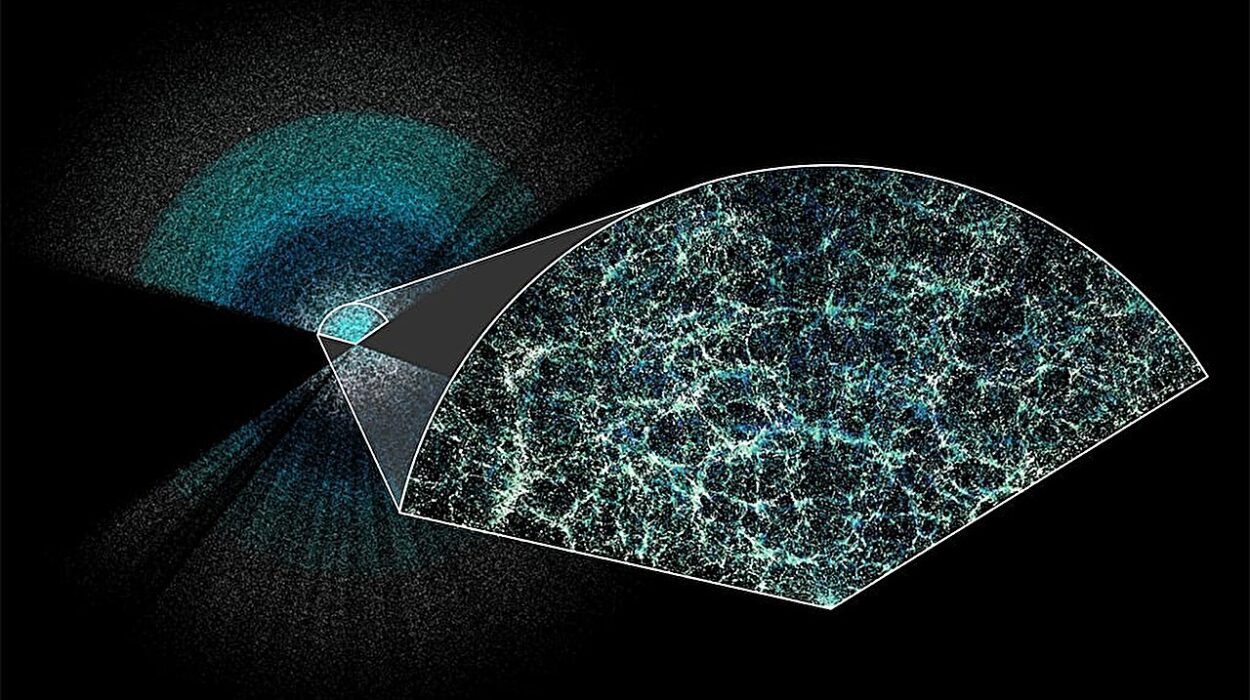
At relatively small cosmic scales, astronomers have long known that the universe is anything but uniform. Galaxies gather into clusters connected by filaments, while enormous voids stretch between them. Looking in different directions naturally reveals different structures.
Modern cosmology, however, assumes this patchiness eventually disappears when viewed over sufficiently large distances.
This idea, known as the cosmological principle, holds that matter becomes statistically evenly distributed on the largest scales, making the universe appear the same in every direction. The principle is rooted in the Copernican principle, which states that no observer occupies a special location in the universe. If that is true, then the universe should appear statistically similar regardless of where an observer is located.
An often-used comparison is a woven cloth. Up close, individual fibers and empty spaces are obvious. From much farther away, however, the fabric appears smooth and uniform.
Exactly how large the universe must be before this uniformity emerges has remained an active area of debate.
DESI Created One of the Largest Maps of the Universe Ever Examined
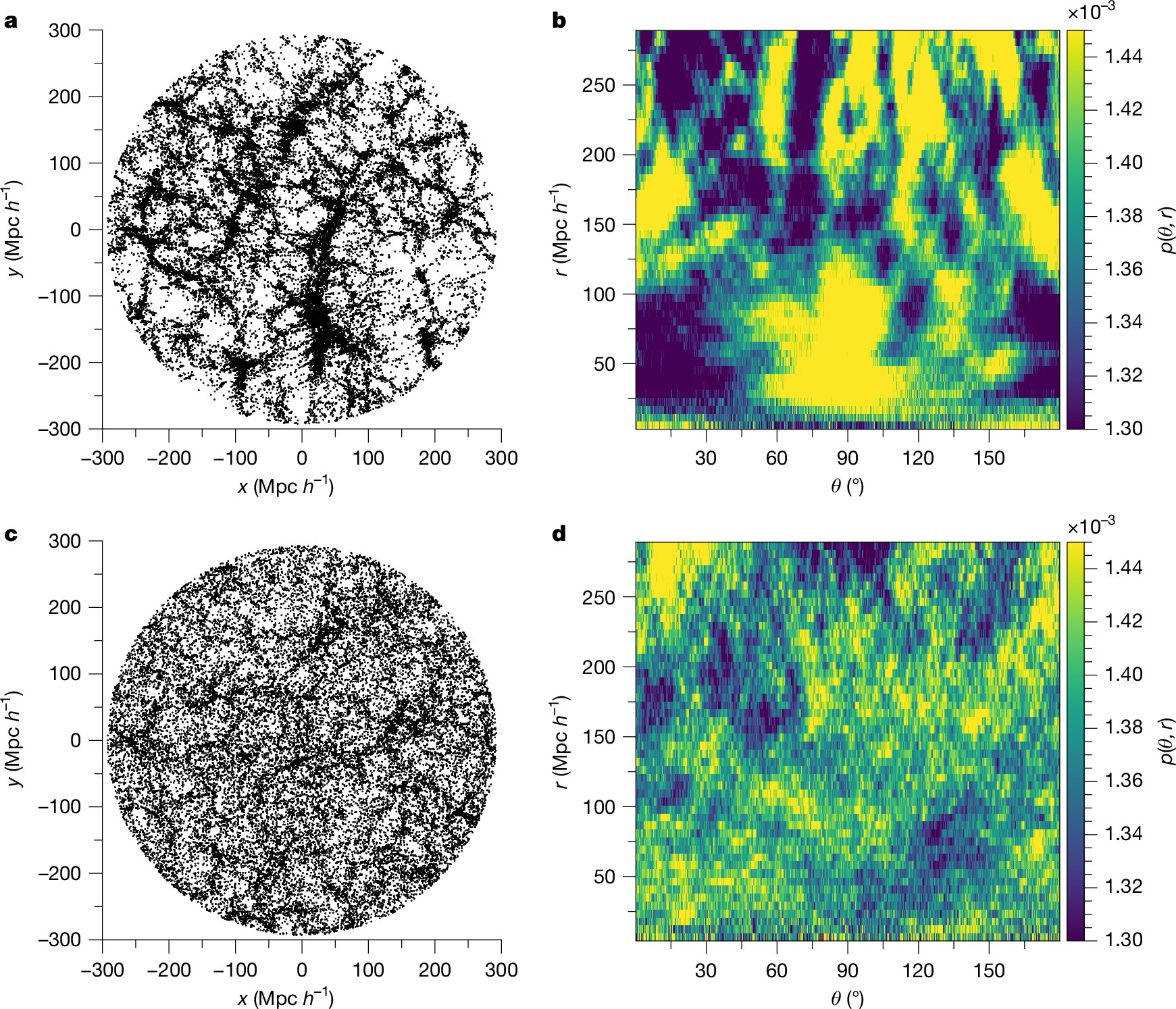
Earlier this year, DESI completed an unprecedented survey, mapping 47 million galaxies spread across 11 billion light-years. The enormous dataset allowed researchers to investigate cosmic structure over scales far beyond many previous studies.
Rather than searching only for preferred directions in space, the researchers used a different statistical approach designed to capture more general directional patterns.
Their method, called the Angular Distribution of Pairwise Distances (ADPD), measures how galaxy distributions vary simultaneously with both distance and direction. The technique is parameter-free, allowing the observed galaxy distribution to be compared directly with models based on the expectation of large-scale isotropy.
Unexpected Patterns Persist Across Gigaparsec Scales
The analysis revealed that galaxies remain directionally structured over remarkably large distances.
According to the researchers, the DESI observations show persistent anisotropic structure extending to approximately gigaparsec scales. In other words, galaxies continue clustering in ways that differ depending on direction, even across distances much larger than many previous investigations had explored.
Earlier studies had suggested possible anisotropy on scales ranging from tens to hundreds of megaparsecs, although their statistical significance remained uncertain. The new results extend that possibility dramatically.
The researchers note that the newly observed anisotropic structure reaches scales roughly 1,000 times larger than those highlighted in earlier megaparsec-scale studies.
As the authors write, “These results provide direct evidence that directional coherence persists to larger scales than predicted in the standard framework, challenging the assumption of large-scale isotropy.”
What the Results Do—and Do Not—Mean
Despite the striking findings, the researchers emphasize that their study does not identify the physical cause of the observed anisotropy.
The results also do not prove that the universe can never become isotropic. It remains possible that uniformity emerges only at even larger scales than those examined in the current analysis.
Because of these uncertainties, the study stops short of overturning the cosmological principle outright. Instead, it presents evidence that the commonly assumed transition to large-scale isotropy may occur differently than expected—or perhaps not within the scales currently observed.
Could Cosmological Models Need Revision?
If future observations confirm these large-scale anisotropies, the implications could extend throughout theoretical cosmology.
The researchers argue that their findings contrast with the standard formulation of the cosmological principle, which assumes both statistical homogeneity and isotropy around every point in the universe. At the same time, they note that the results remain compatible with the Copernican principle, since the absence of preferred observing locations does not necessarily require perfect isotropy.
The authors suggest that confirming these observations could motivate exploration of more general solutions to Einstein’s field equations that explicitly allow large-scale inhomogeneities.
They also point to the possibility of investigating alternative explanations for accelerated structure formation, including models involving self-interacting dark matter or backreaction effects produced by cosmic inhomogeneities.
Why This Matters
The cosmological principle serves as one of the foundations of modern cosmology, shaping how scientists interpret the evolution and large-scale structure of the universe. Evidence that galaxies remain directionally organized across gigaparsec scales challenges that long-standing assumption without contradicting the idea that no observer occupies a privileged position in the cosmos.
Whether these findings withstand future scrutiny remains to be seen. But with DESI providing one of the most detailed maps of the visible universe ever assembled, the study offers a compelling new test of one of cosmology’s deepest assumptions—and suggests that the universe may be more structurally complex than standard models have predicted.