Researchers have demonstrated that tiny, physically separated lasers can spontaneously synchronize into a single coherent light source using a simple liquid crystal system at room temperature. The discovery overturns the long-standing belief that this type of collective light behavior requires complex quantum materials, strong light-matter coupling, and cryogenic conditions, potentially opening the door to more practical and reconfigurable photonic technologies.
For decades, one of photonics’ biggest assumptions seemed firmly established: if you wanted multiple lasers to act as one, you needed highly specialized materials operating under extreme conditions. Now, researchers have shown that this remarkable level of coordination can emerge in a far simpler system—one that works at ordinary room temperature.
The international research team developed a new class of tunable photonic devices in which multiple microscopic laser beams, despite being physically separated, spontaneously synchronize and function as a single, coherent light source. Their findings, published in Nature Communications, suggest that sophisticated quantum materials may not be essential for creating collective states of light after all.
Tiny Laser Spots That Synchronize on Their Own
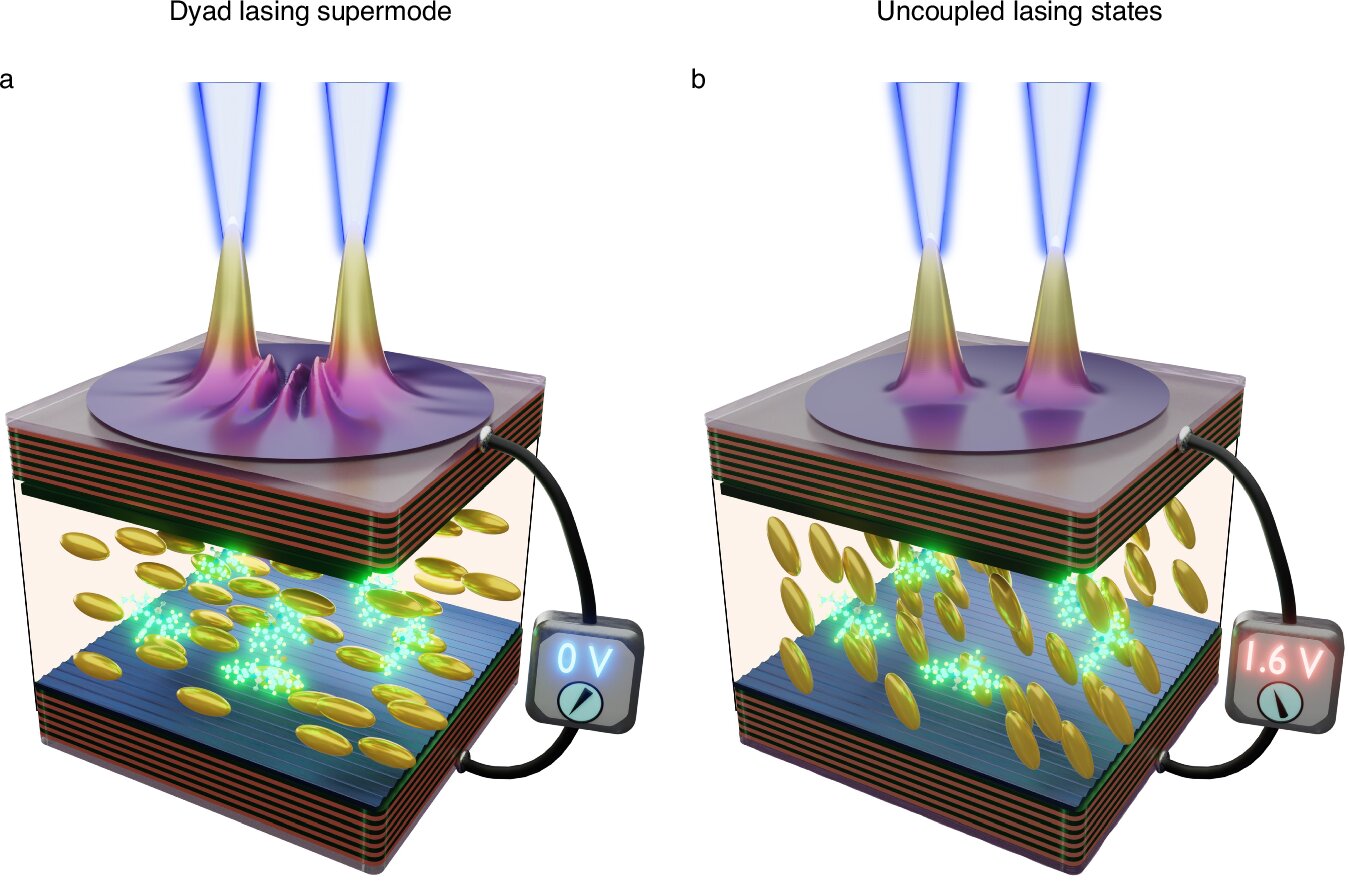
The newly developed device relies on a microscopic optical cavity filled with liquid crystals mixed with an organic laser dye. When researchers illuminated the cavity with carefully structured light, several small regions began emitting laser light independently.
Instead of remaining isolated, however, the laser spots interacted through light traveling within the plane of the optical cavity. As this interaction strengthened, the separate lasers naturally synchronized their oscillations in a process known as phase-locking.
Once synchronized, the individual laser beams formed a larger collective state called a supermode, behaving as though they were a single, spatially extended laser source rather than multiple independent emitters.
According to first author Dmitriy Dovzhenko of the University of Southampton, the work demonstrates that this type of collective behavior does not require either low temperatures or complex quantum materials. Instead, the simpler platform offers optical reconfigurability, electrical tunability, and reliable operation under everyday conditions.
Breaking Away From Conventional Thinking
Until now, similar synchronized laser behavior had primarily been observed in specialized semiconductor systems operating under cryogenic temperatures and within the strong light-matter coupling regime.
In those systems, light and matter interact so strongly that they merge into hybrid quantum states, which many researchers believed were essential for producing collective laser behavior.
The new study challenges that assumption.
The researchers found that synchronization occurred even in the weak light-matter coupling regime, where light and matter interact only modestly and do not form hybridized states.
Theoretical physicist Dmitry Solnyshkov from CNRS France noted that this result runs counter to previous studies, which had treated strong hybridization between light and matter as a necessary ingredient for these effects.
Light Itself Creates the Connection
The synchronization mechanism depends on a subtle physical process that unfolds after the laser is excited.
According to Dovzhenko, excitation causes a slight blueshift in the material’s optical properties. This creates a localized effective potential inside the illuminated region, pushing coherent photons away from each lasing spot and allowing them to travel through the cavity.
Those propagating photons act as messengers between distant laser spots, enabling them to synchronize even when separated by tens of micrometers.
Rather than relying on direct interactions between matter, the system uses the movement of light itself to establish communication across the device.
Electrical Control Adds Real-Time Flexibility
One of the platform’s most significant advantages is that researchers can actively control its behavior.
Applying a small electrical voltage reorients the liquid crystal molecules inside the optical cavity. That adjustment changes how light propagates through the device, allowing scientists to switch interactions between laser spots on and off while also tuning the strength of their coupling.
The voltage also alters both the direction and polarization of the emitted light through effects analogous to spin-orbit coupling of photons.
As a result, the synchronized supermode can be dynamically reconfigured in real time, providing a level of flexibility that could prove valuable for future photonic technologies.
Theory Matches the Experimental Results
The research team also developed a theoretical framework to explain the unexpected behavior.
Luciano Ricco, currently a postdoctoral researcher at the University of Warsaw, explained that the synchronized laser dynamics can be accurately described using the Maxwell-Bloch equations, a well-established semiclassical approach commonly used to model laser systems involving two-state quantum systems interacting with optical resonators.
The successful numerical verification suggests that these collective light states do not require exclusively quantum descriptions and can instead emerge within simpler semiclassical systems under the right conditions.
Toward Scalable Photonic Technologies
According to Jacek Szczytko from the Faculty of Physics at the University of Warsaw, the work introduces a fundamentally different strategy for coupling lasers.
Instead of depending on strong interactions between light and matter, the new approach harnesses the propagation of light itself to synchronize distant laser sources.
Because the device operates at room temperature and uses well-established materials such as liquid crystals and organic dyes, it offers a promising foundation for practical photonic devices.
The researchers believe the platform could support future advances in optical computing, photonic neural networks, beam shaping, advanced laser technologies, photonic simulators of complex systems, and integrated optical circuits.
Why This Matters
This study challenges one of photonics’ long-standing assumptions by showing that sophisticated collective light behavior does not necessarily require extreme operating conditions or exotic quantum materials. Instead, carefully engineered light propagation within a simple, electrically tunable system can produce synchronized laser states previously thought to depend on much more complex physics.
By demonstrating this effect using accessible materials under ambient conditions, the research points toward a more practical path for building scalable, reconfigurable photonic technologies that could support the next generation of optical computing, integrated photonic circuits, and advanced laser systems.