Virtual metasurfaces that can be reprogrammed in just 20 milliseconds could overcome one of the biggest limitations of today’s ultrathin optical technologies. Instead of relying on fixed physical structures, the new approach uses programmable light patterns to perform multiple optical functions within a single device, potentially opening new possibilities for imaging, telecommunications, microscopy, and next-generation cameras.
What if a single optical device could change its job almost instantly instead of being locked into one function forever? That is the promise behind a new type of virtual metasurface, a technology researchers say could redefine how light is manipulated while removing a major obstacle that has limited traditional metasurfaces for years.
Scientists at Nottingham Trent University have introduced a programmable alternative to conventional metasurfaces that replaces fixed nanostructures with dynamically generated optical patterns. Their findings, published in Advanced Photonics Nexus, suggest the technology could help move metasurfaces beyond laboratory demonstrations and toward practical, real-world applications.
Moving Beyond Fixed Metasurfaces
Metasurfaces are ultrathin optical structures capable of bending and focusing light, changing its color, and steering it in different directions. Because they are many times thinner than a human hair, they have emerged as compact alternatives to bulky components such as lenses, mirrors, and optical filters.
Despite these advantages, conventional metasurfaces have a fundamental drawback. Once manufactured, their material properties and physical structure cannot be changed. That fixed design limits their flexibility and reduces their usefulness in applications that require multiple optical functions.
The newly proposed virtual metasurface takes a different approach. Instead of depending on tiny physical particles arranged on a surface, it uses programmable two-dimensional optical patterns that can be altered whenever needed.
Light Controlled Pixel by Pixel
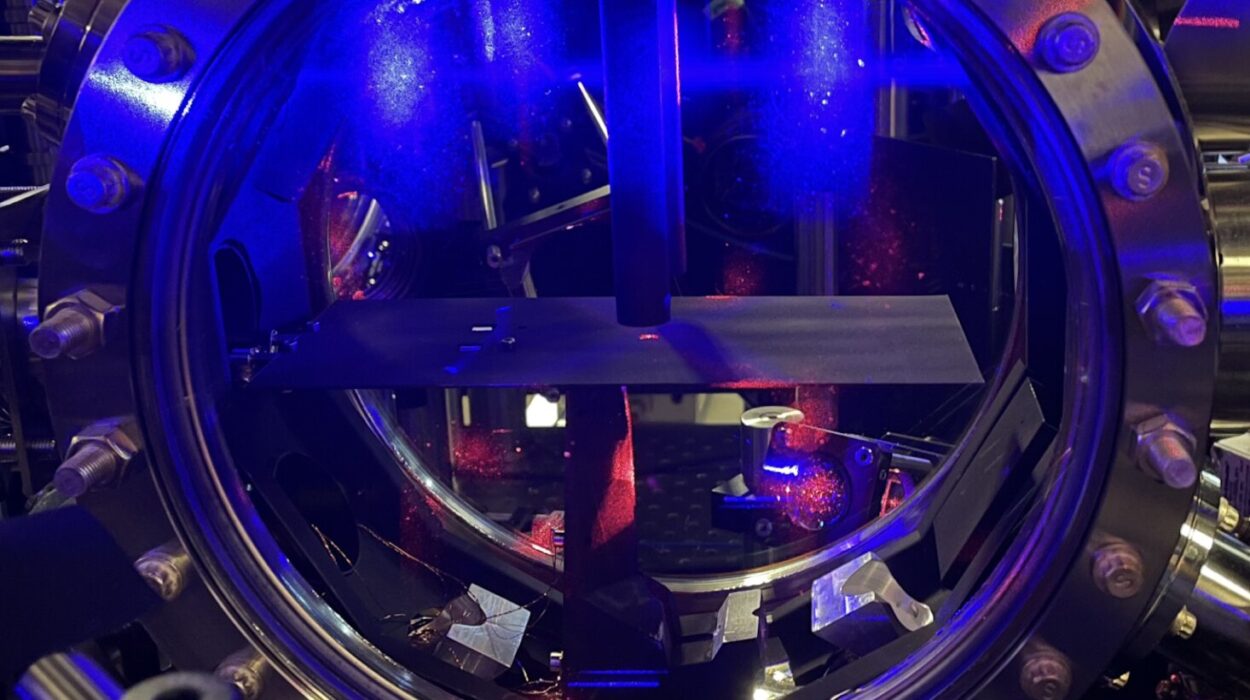
The system relies on a spatial light modulator, a device capable of manipulating light on a pixel-by-pixel basis. By updating the optical pattern faster than the blink of an eye, the technology can rapidly switch between completely different functions.
According to the researchers, the programmable patterns can be reshaped every 20 milliseconds, allowing the same device to perform a variety of optical tasks without changing its physical structure.
That means a single platform could mix colors, convert invisible infrared information into visible images, or function like a lens with adjustable focus—all by changing its digital pattern rather than replacing hardware.
Demonstrating Two Tasks at Once
To showcase the technology’s capabilities, the researchers demonstrated that the virtual metasurface could simultaneously convert invisible infrared signals into visible images while also adjusting the images’ focal lengths on demand.
Conventional lenses and mirrors cannot perform both of these functions at the same time.
Working with collaborators from the University of Brescia in Italy and Nankai University in China, the team also showed that images could be generated at arbitrary focal lengths, highlighting the flexibility of the programmable approach.
The researchers say the ability to perform multiple optical operations within a single system represents a significant departure from traditional optical components.
Simpler Infrared Imaging
The study also points to a possible advantage for infrared imaging systems.
Traditional infrared cameras typically require expensive semiconductor sensors along with separate optical components. In the new approach, the programmable light pattern converted infrared light into visible wavelengths that could then be captured using a standard camera.
While the researchers emphasize that additional research and development are still required, they believe this method demonstrates how programmable optical systems could simplify future imaging technologies.
From Physical Components to Digital Platforms
Professor Mohsen Rahmani of Nottingham Trent University’s School of Science and Technology described the work as a potential turning point for the field.
He explained that metasurfaces have become a cornerstone of modern photonics over the past decade, but their limited tunability has created a bottleneck that restricts their broader use. He suggested that this new category of emulated virtual metasurfaces could dramatically expand what these systems are capable of by allowing them to change function almost instantly.
Associate Professor Lei Xu said the virtual metasurfaces function like an “imaginary toolbox” containing numerous optical components within a single platform. He added that using AI to program the virtual metasurfaces could enable multimodal capabilities and broaden their potential for practical applications.
Dr. Ze Zheng, the study’s first author, said replacing physical metasurfaces with virtual ones represents a shift from analog optical components to more flexible digital platforms. According to Zheng, this transition offers improved programmability, multifunctionality, and fewer fabrication constraints while supporting more compact optical systems.
Broad Potential Across Optical Technologies
Although the technology remains at an early stage, the researchers believe programmable virtual metasurfaces could eventually benefit numerous fields.
They point to possible applications in imaging, microscopy, quantum photonics, sensing, beam steering, semiconductor manufacturing, telecommunications, and holography.
By allowing one device to perform multiple optical functions through software-controlled patterns, the approach could help maximize the potential of metasurfaces without requiring entirely new hardware for every task.
Why This Matters
One of the biggest barriers facing conventional metasurfaces has been their inability to adapt after fabrication. This research proposes a way around that limitation by replacing fixed nanostructures with programmable optical patterns that can change in 20 milliseconds.
If further developed, virtual metasurfaces could make optical systems more versatile, compact, and easier to reconfigure. Rather than designing separate hardware for each application, future devices could potentially switch functions on demand, offering a more flexible path toward next-generation cameras, microscopes, and other advanced imaging technologies.