Researchers at the Niels Bohr Institute have successfully generated high-quality single photons that are compatible with existing telecommunications infrastructure, overcoming a decades-long barrier in quantum physics. This development allows for the direct integration of secure quantum light sources into standard fiber-optic networks and silicon photonic chips, effectively clearing the path for a functional quantum internet.
For years, the dream of a perfectly secure quantum internet has been stalled by a fundamental mismatch in hardware. While scientists could create the specialized particles of light needed for quantum communication, those particles simply refused to travel through the optical fibers that already wrap around the globe. Now, a breakthrough in nano-engineering has bridged this gap, proving that the future of secure communication does not require us to rebuild the world’s digital infrastructure from scratch.
The Challenge of the Quantum Mismatch
At the heart of quantum communication lies the single photon. These individual particles of light are unique because they cannot be split or copied. This physical law ensures that any attempt to intercept or eavesdrop on a quantum signal would be immediately detectable, making them the gold standard for secure information transfer.
To create these particles, scientists use quantum dots, which are unsurpassed in their ability to generate coherent light. However, a significant technical hurdle has persisted: the highest-quality quantum dots previously only functioned at wavelengths around 930 nanometers. This posed a major problem for real-world application because standard telecommunications fiber-optic networks require wavelengths starting at 1260 nanometers to prevent signal loss.
Until now, researchers were forced to choose between using high-quality light that couldn’t travel far or using sub-optimal platforms that worked in the telecom band but produced unreliable results.
Overcoming the Noise Barrier
The primary enemy of quantum technology is “noise.” In the world of quantum light sources, noise refers to a lack of consistency. For quantum applications to work, every photon generated must be perfectly identical to the one before it, a property known as quantum coherence.
Historically, any attempt to produce photons directly within the telecom band resulted in light that was too noisy and incoherent for practical use. This led to a widely accepted belief within the scientific community that telecom-band photons were essentially useless for high-end quantum applications.
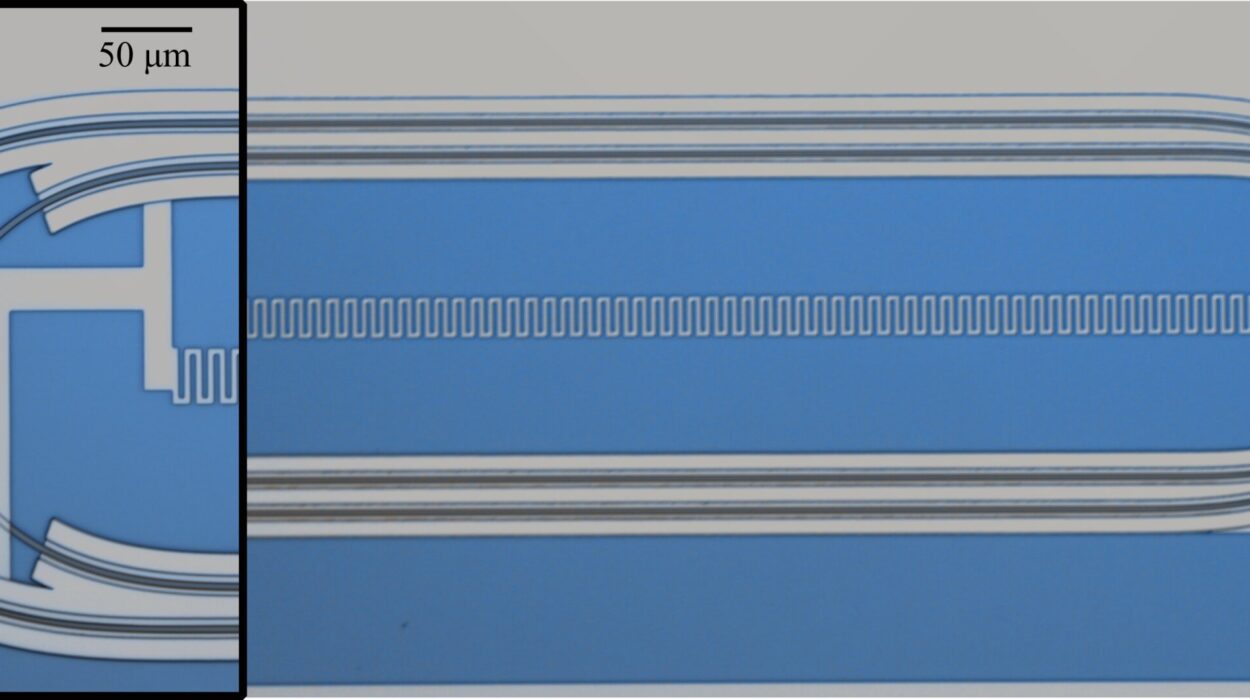
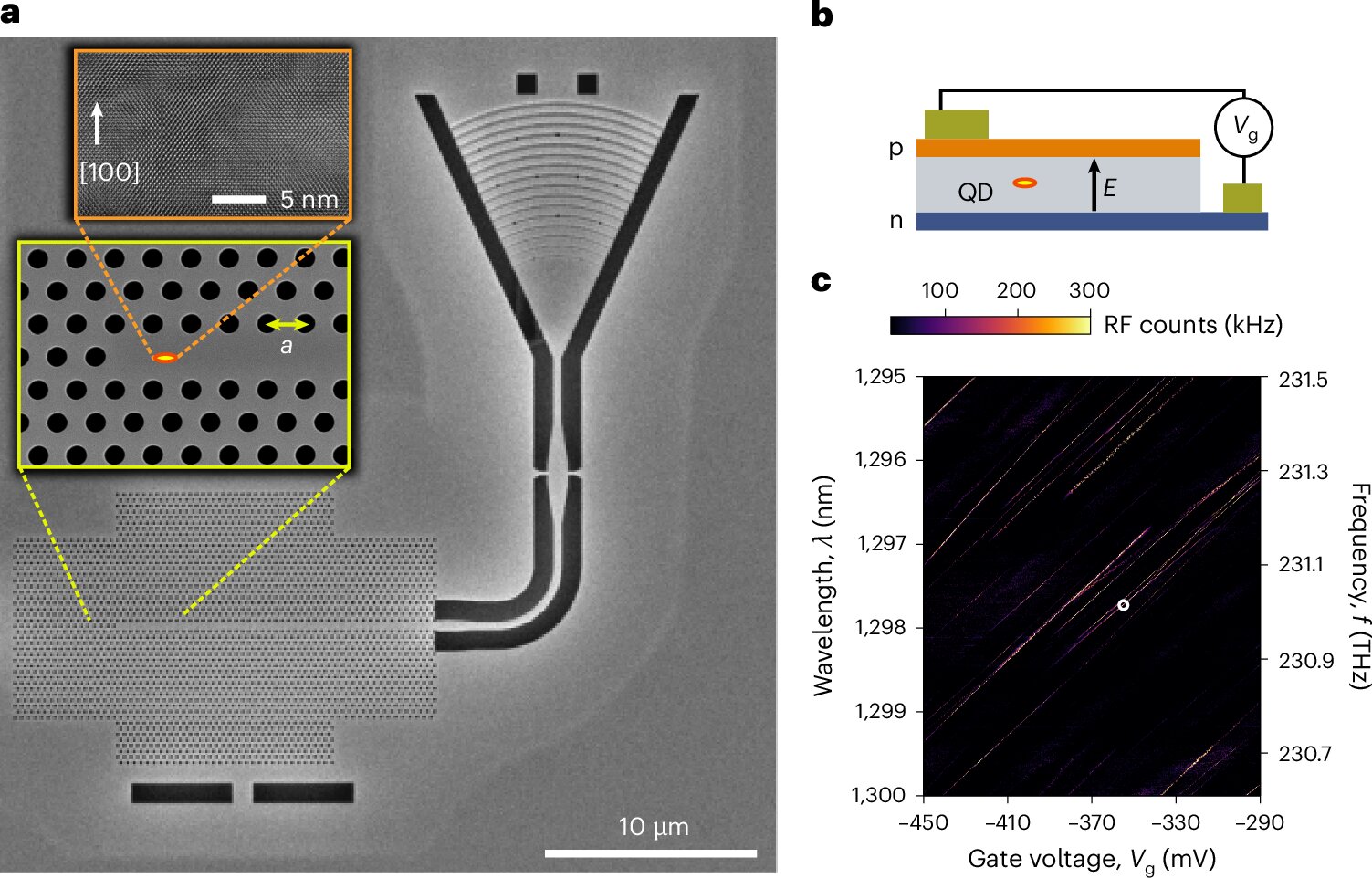
By collaborating with researchers in Bochum, Germany, the team at the Niels Bohr Institute challenged this assumption. The German team optimized the growth of ultra-low-noise quantum dot emitters, providing a foundation for a new type of light source. Using advanced nanofabrication techniques in a cleanroom environment, the researchers in Denmark then patterned these materials into complex quantum photonic circuits.
A Dual Victory in Nanofabrication
The result of this collaboration is a device that overcomes two massive hurdles simultaneously. The new quantum dots emit photons that are both highly coherent and identical, and they do so at a wavelength of approximately 1300 nanometers.
This specific wavelength is critical because it sits directly within the original telecom band used by today’s internet service providers. By reaching this benchmark, the researchers have demonstrated that it is possible to produce “quantum-grade” light that is native to our current communication systems. This eliminates the need for “nonlinear frequency conversion,” a complicated and often inefficient workaround previously used to shift light from one wavelength to another.
Seamless Integration with Silicon Technology
The implications of this breakthrough extend beyond the fiber-optic cables under our streets; they also reach the microscopic level of computer hardware. Most modern photonic integrated circuits—the chips that route and control light—are manufactured using silicon.
Silicon is a cost-effective and highly efficient material for light management, but it has a major limitation: it absorbs light at wavelengths below 1100 nanometers. Because previous quantum dots operated at 930 nanometers, they were physically incompatible with standard silicon chips.
By pushing the emission to 1300 nanometers, the Niels Bohr Institute team has made it possible to embed quantum light sources directly onto commercial silicon photonic chips. This “icing on the cake” means that the hardware required to run a quantum network can be built using the same materials and manufacturing processes already used in the semiconductor industry.
Why This Matters
This achievement marks the removal of one of the most significant roadblocks to a large-scale quantum network. By creating a “plug-and-play” technology that fits into existing infrastructure, the researchers have transformed the quantum internet from a theoretical concept into a looming reality.
The ability to send secure, un-hackable information through the fibers already in place means that quantum repeaters, quantum chips, and long-distance communication systems can now be integrated into the world’s current digital framework. This discovery effectively opens the door to a new era of digital privacy and computational power, sparking a global race to build the first scalable, functional quantum network using the tools we already own.
Study Details
Marcus Albrechtsen et al, A quantum-coherent photon–emitter interface in the original telecom band, Nature Nanotechnology (2026). DOI: 10.1038/s41565-026-02156-7. On arXiv: DOI: 10.48550/arxiv.2510.09251