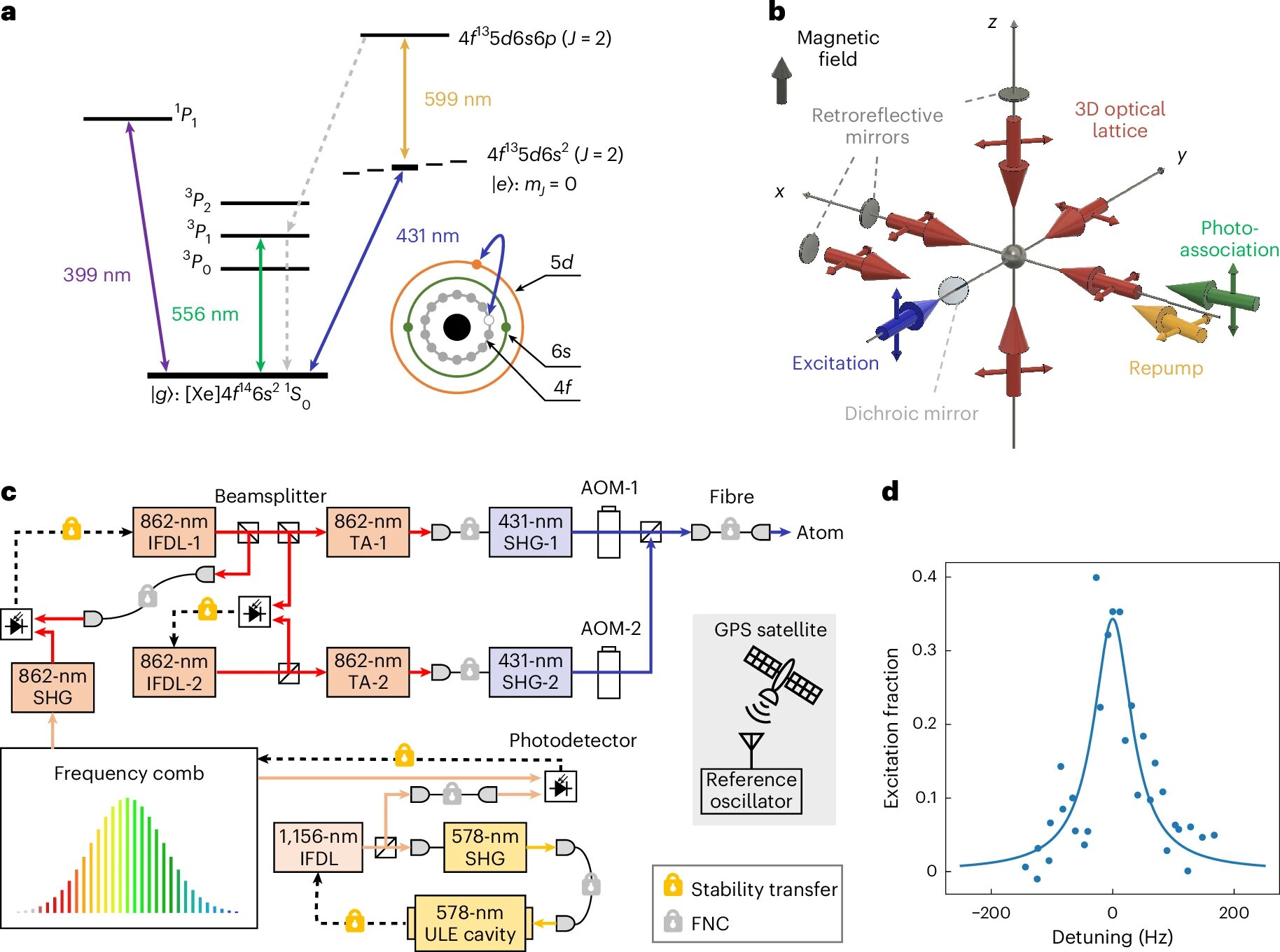
For decades, the guardians of time have lived on the surface of the atom. To build an atomic clock, physicists traditionally look to the outer electrons—those nimble particles that dance on the periphery of an atom’s structure. By hitting these electrons with a laser, scientists can make them jump between energy levels. The frequency of this jump, essentially the “tick” of the clock, is so incredibly stable that it has allowed us to measure time with more precision than any mechanical gear or quartz crystal ever could. But even the best modern clocks have a ceiling. While they are masters of keeping time, they aren’t always sensitive enough to feel the ghost-like tug of the universe’s deepest mysteries, such as dark matter or the hidden particles that might lie just beyond our current understanding.
For years, a team of international physicists led by Taiki Ishiyama at Kyoto University suspected that the key to a better clock wasn’t on the surface of the atom, but buried deep within it. They turned their attention to ytterbium, a rare-earth element with a complex internal architecture. Hidden beneath the outer layers of ytterbium is a rare orbital transition involving an inner-shell electron. This electron is tucked away, shielded by the rest of the atom, making it notoriously difficult to reach. However, theorists predicted that if someone could actually harness this hidden transition, it would be a hundred times more sensitive to the subtle ripples of new physics than the transitions we use today. The challenge was no longer just about keeping time; it was about building a microscope made of seconds.
The Light That Binds Without Breaking
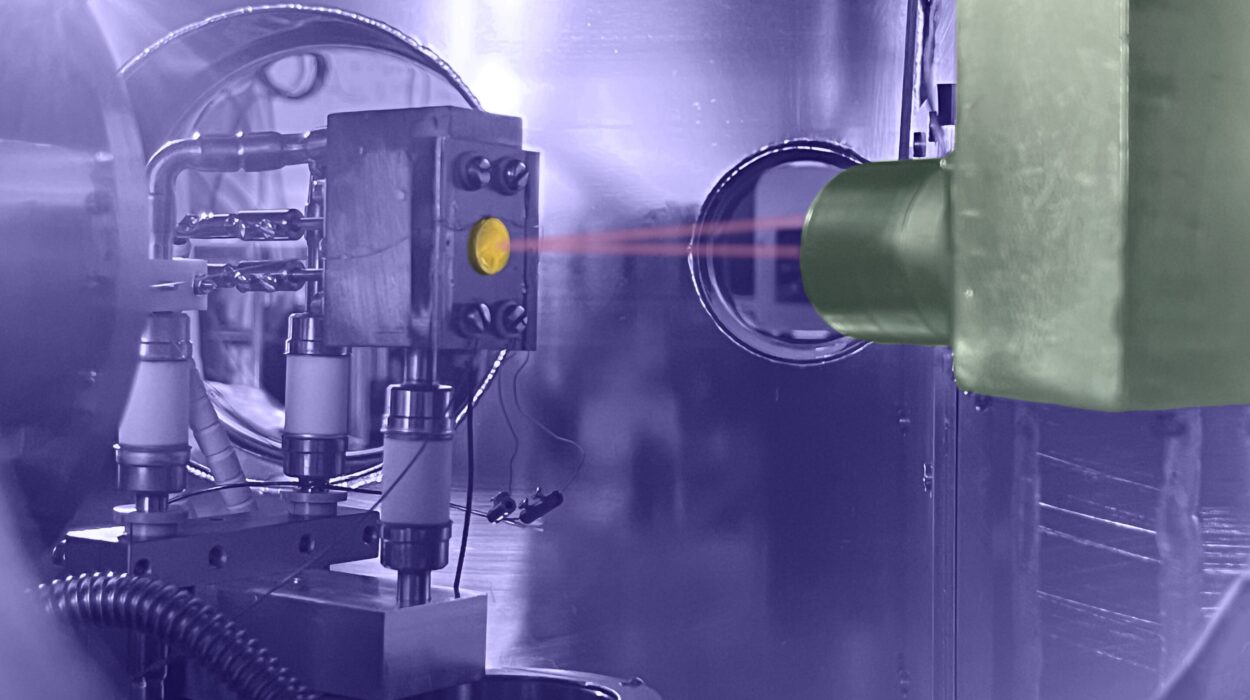
In the quest for precision, physicists use a tool called an optical lattice. Imagine a landscape made entirely of light—a microscopic egg carton created by interfering laser beams where atoms are trapped in the “wells” of the lattice. This prevents the atoms from moving around, which would otherwise blur the measurement. However, there is a fundamental catch: the very light used to trap the atoms usually interferes with them. The laser’s energy slightly nudges the atom’s internal energy levels, creating a “shift” that muddies the clock’s frequency. For the inner-shell transition of ytterbium, this interference was a wall that seemed impossible to climb. In previous attempts, the spectral linewidth—the spread or “fuzziness” of the frequency—was far too wide for high-precision work.
To solve this, Ishiyama and his team turned to a concept known as the magic wavelength. By tuning their trapping lasers to a very specific color, they found a sweet spot where the light’s influence on the ground state and the excited state of the ytterbium atom cancelled each other out perfectly. It was a feat of high-wire balancing. By trapping the atoms in a three-dimensional optical lattice at this precise wavelength and pairing it with a highly stabilized excitation laser, they managed to eliminate the frequency shifts that had plagued earlier experiments. The result was a revelation. They achieved a spectral linewidth of just 80 Hz, a staggering two-orders-of-magnitude improvement over anything seen before. Suddenly, the “whisper” from the inner shell was no longer a muffled hum; it was a clear, sharp note.
Echoes of Colliding Worlds
With the frequency finally stabilized, the researchers could begin to explore the strange behaviors of these trapped atoms. They observed coherent oscillations, where the inner-shell electron swung back and forth between states in perfect harmony with the laser. But the discovery went deeper. They encountered a phenomenon known as an interorbital Feshbach resonance. This occurs when two colliding atoms, influenced by the laser’s field, briefly bind together to form a short-lived compound state. Observing this interaction within the clock’s framework provided a new window into how atoms “talk” to one another when they are pushed into these rare energy configurations.
The team then put their new tool to the ultimate test of resolution: isotope shift measurements. Atoms of the same element can have different numbers of neutrons, creating different isotopes. By swapping one ytterbium isotope for another and measuring how the clock’s frequency changed, the team achieved an accuracy of one part in a billion. This wasn’t just a technical exercise; it was a hunt. These shifts are influenced by the way electrons and neutrons interact. If there is a “new boson”—a hypothetical particle that carries a force we haven’t yet categorized—it would leave a tiny, tell-tale signature in these measurements. By reaching this level of precision, the researchers have begun to place the most stringent constraints yet on the existence of these mystery particles, testing the very boundaries of the Standard Model.
Why the Hidden Heart of the Atom Matters
This breakthrough represents more than just a more accurate way to count the passing seconds. By successfully harnessing an inner-shell electron, the team has created a bridge between the world of timekeeping and the world of particle physics. Most atomic clocks are designed to be “deaf” to the environment to ensure they stay accurate, but this new type of ytterbium clock is intentionally “tuned” to the environment’s most subtle signals. It is an instrument designed to fail in a very specific way if the laws of physics are not what they seem.
This research matters because the Standard Model of physics, while incredibly successful, is known to be incomplete. It doesn’t explain dark matter, and it doesn’t account for several other cosmic oddities. By providing a benchmark for the atomic nuclei and searching for interactions beyond the known forces, Ishiyama’s team has turned the atomic clock into a laboratory for the universe. This new generation of clocks will serve as a sentinel, standing watch at the edge of known science, waiting for the smallest deviation in a “tick” to reveal a brand-new law of nature.
Study Details
Taiki Ishiyama et al, Orders-of-magnitude improvement in precision spectroscopy of an inner-shell orbital clock transition in neutral ytterbium, Nature Photonics (2026). DOI: 10.1038/s41566-026-01857-8