The air around us feels like nothing, yet modern physics tells us that even a physical vacuum is far from empty. It is a complex, structured medium, and it is the very fabric that allows the objects we touch to possess mass. To understand how anything becomes heavy, scientists have spent decades peering into the heart of the atom, looking for a rare and fleeting “embrace” between particles that shouldn’t normally stay together. Recently, an international team of researchers moved us closer to solving this mystery by catching a glimpse of a never-before-seen exotic state: the η′-mesic nucleus.
The Ghostly Weight of the Vacuum
For most of us, mass is simply how much something weighs on a scale. But for a physicist, mass is a profound question of origin. Current theories suggest that matter acquires its mass through interactions with the structure of the vacuum itself. To test this, scientists look at mesons—strange, composite particles made of one quark and its antimatter twin, an anti-quark. These particles are usually incredibly short-lived, surviving for less than a ten-millionth of a second before they vanish. However, theorists predicted that under the right conditions, a meson could become temporarily trapped, or “bound,” inside an atomic nucleus.
This hypothetical system, known as a mesic nucleus, serves as a microscopic laboratory. By forcing a meson into the extremely high-density environment of a nucleus, scientists can observe how the particle’s properties change. Specifically, they are interested in the η′ meson. This particular particle is a bit of an oddball in the subatomic world because it is unusually heavy compared to its relatives. Physicists suspected that if they could shove an η′ meson into a dense nucleus, its mass would actually shift, providing a direct window into the mass generation mechanism that governs our universe.
A High-Speed Hunt for the Impossible
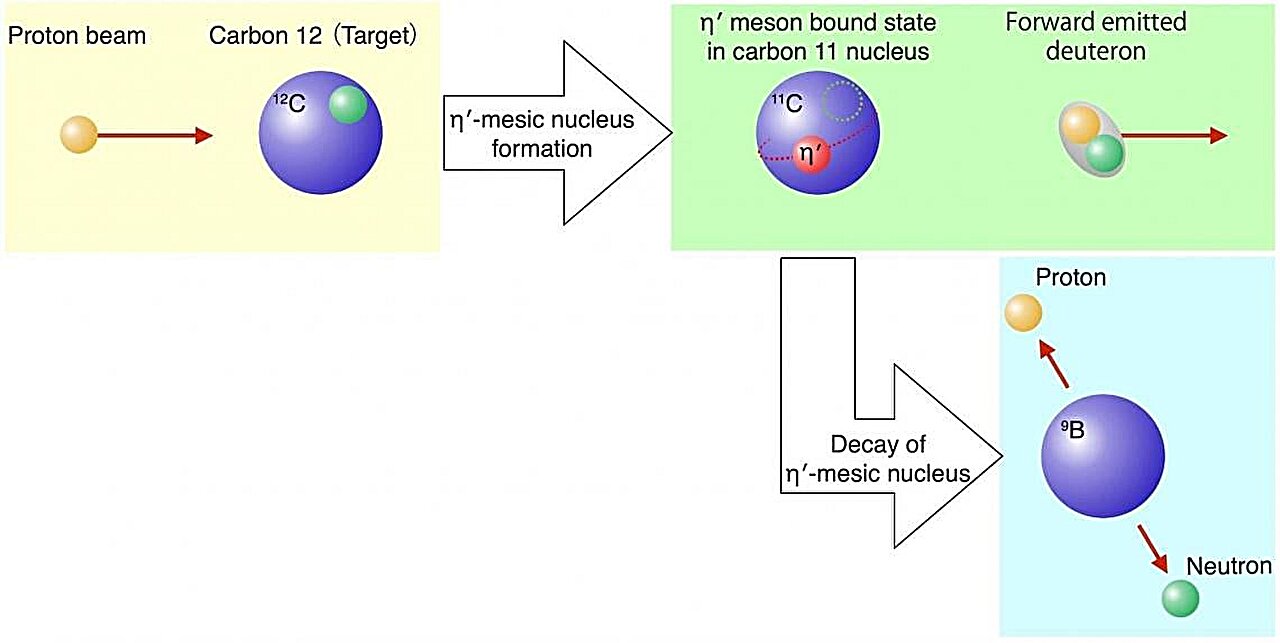
Proving this theory required more than just a standard microscope; it required a monumental feat of engineering at the GSI Helmholtzzentrum für Schwerionenforschung in Germany. Here, the team used a massive particle accelerator to fire a beam of high-energy protons at a carbon target. The goal was to create a violent enough collision to excite the carbon nuclei and, with a bit of luck, produce an η′ meson that would immediately settle into a bound state with that nucleus.

The experiment was a delicate balancing act of energy and detection. When the proton beam hit the carbon, it kicked off a reaction that produced deuterons—the simplest possible atomic nuclei, consisting of just one proton and one neutron. By using a high-resolution spectrometer called a fragment separator (FRS), the researchers could measure the energy of these deuterons as they flew forward. This energy measurement acted like a fingerprint, allowing the team to calculate the excitation energies of the carbon nuclei left behind. If the energy levels matched certain predictions, it would suggest that an η′-mesic nucleus had indeed been formed.
Listening for the Echoes of Decay
But measuring the energy of the “kick” wasn’t enough to be certain. To truly see the invisible, the researchers needed to catch the moment the system fell apart. They deployed a specialized detector named WASA, originally built in Sweden, to act as a selective guard. Its job was to identify high-energy protons escaping the target. These protons were the “decay signals”—the specific debris left behind when an η′ meson is captured and then eventually destroyed inside the nucleus.

By combining the data from the FRS and the WASA detector, lead author Ryohei Sekiya and the team were able to scan the data for structures that matched the theoretical signatures of these exotic bound states. They weren’t looking for a steady signal, but rather a specific shape in the excitation spectrum of the carbon nucleus. Their analysis revealed a pattern that suggests these bound states were truly formed, marking the first time such evidence has been captured for this specific type of exotic matter.
Why This Subatomic Shadow Matters
This discovery is more than just a footnote in a physics textbook; it is a vital clue in the search for why anything exists at all. The data indicates that the mass of the η′ meson may actually decrease when it is surrounded by the dense environment of other nuclear matter. This supports the long-held theory that particle masses are not fixed, but are a result of how they interact with the strong nuclear force and the surrounding vacuum.
By confirming that the η′-mesic nucleus can exist, researchers have found a way to study how the vacuum structure changes in environments of extreme density. It brings us one step closer to answering the most fundamental questions about the laws of nature. As Kenta Itahashi and his colleagues plan future experiments to hunt for even more precise decay signals, they are effectively mapping the hidden foundations of our reality, revealing that the “empty” space between us is actually the engine that gives the world its weight.
Study Details
R. Sekiya et al, Excitation spectra of the 12C(p,d) reaction near the η′-meson emission threshold measured in coincidence with high-momentum protons, Physical Review Letters (2026). DOI: 10.1103/6vsl-ng7x